
Process for treating nitrogenous wastewater with simultaneous autotrophic denitrification, hetertrophic denitrification and COD removal
a technology of nitrogenous wastewater and cod removal, which is applied in the field of nitrogenous wastewater treatment with simultaneous nitrification, autotrophic denitrification, heterotrophic denitrification and cod removal, can solve the problems of increasing operation cost, increasing fabrication cost, and high energy and cost, and achieves the effect of reducing fabrication and operation cos
- Summary
- Abstract
- Description
- Claims
- Application Information
AI Technical Summary
Benefits of technology
Problems solved by technology
Method used
Image

Examples
example 1
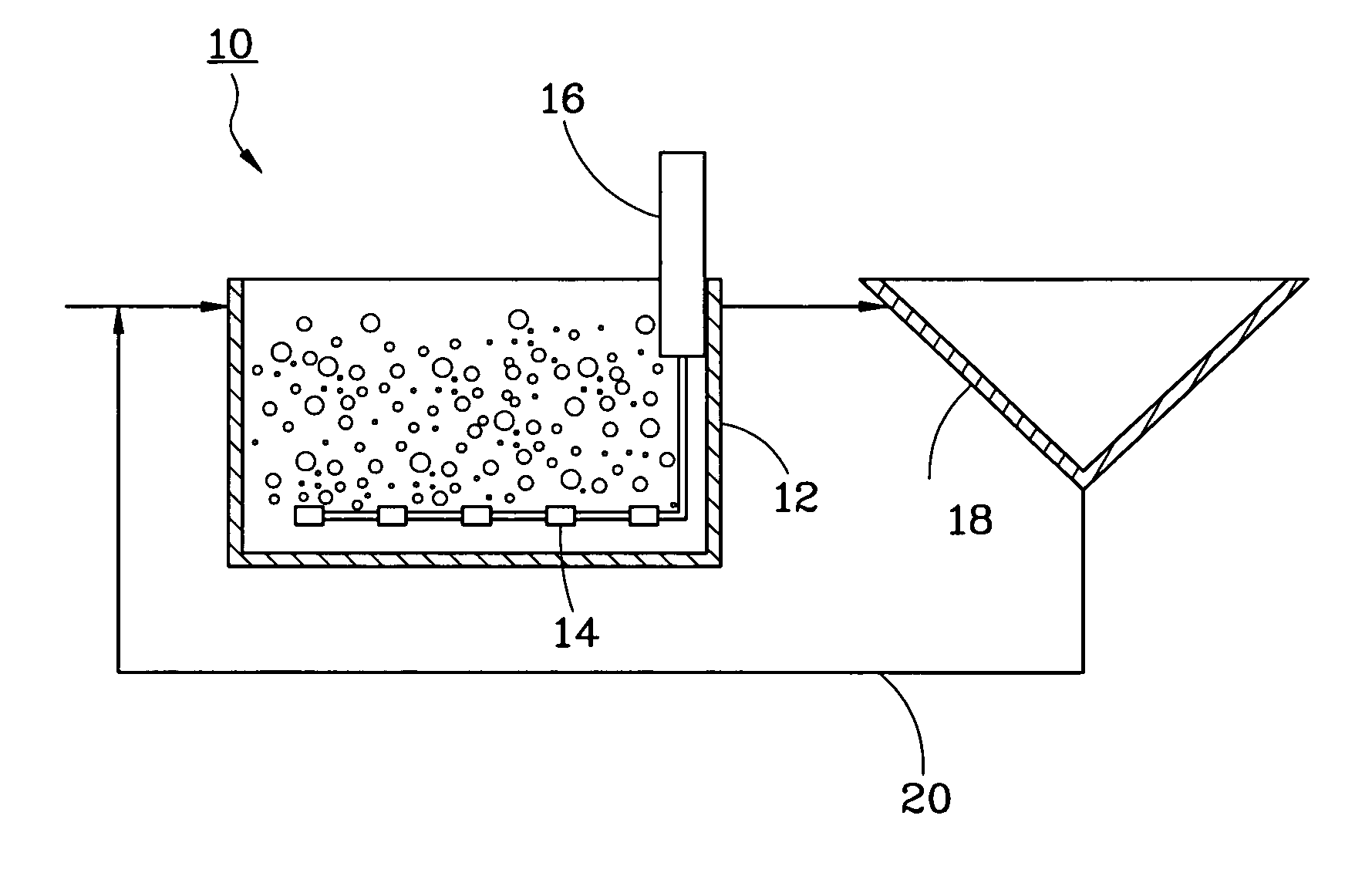
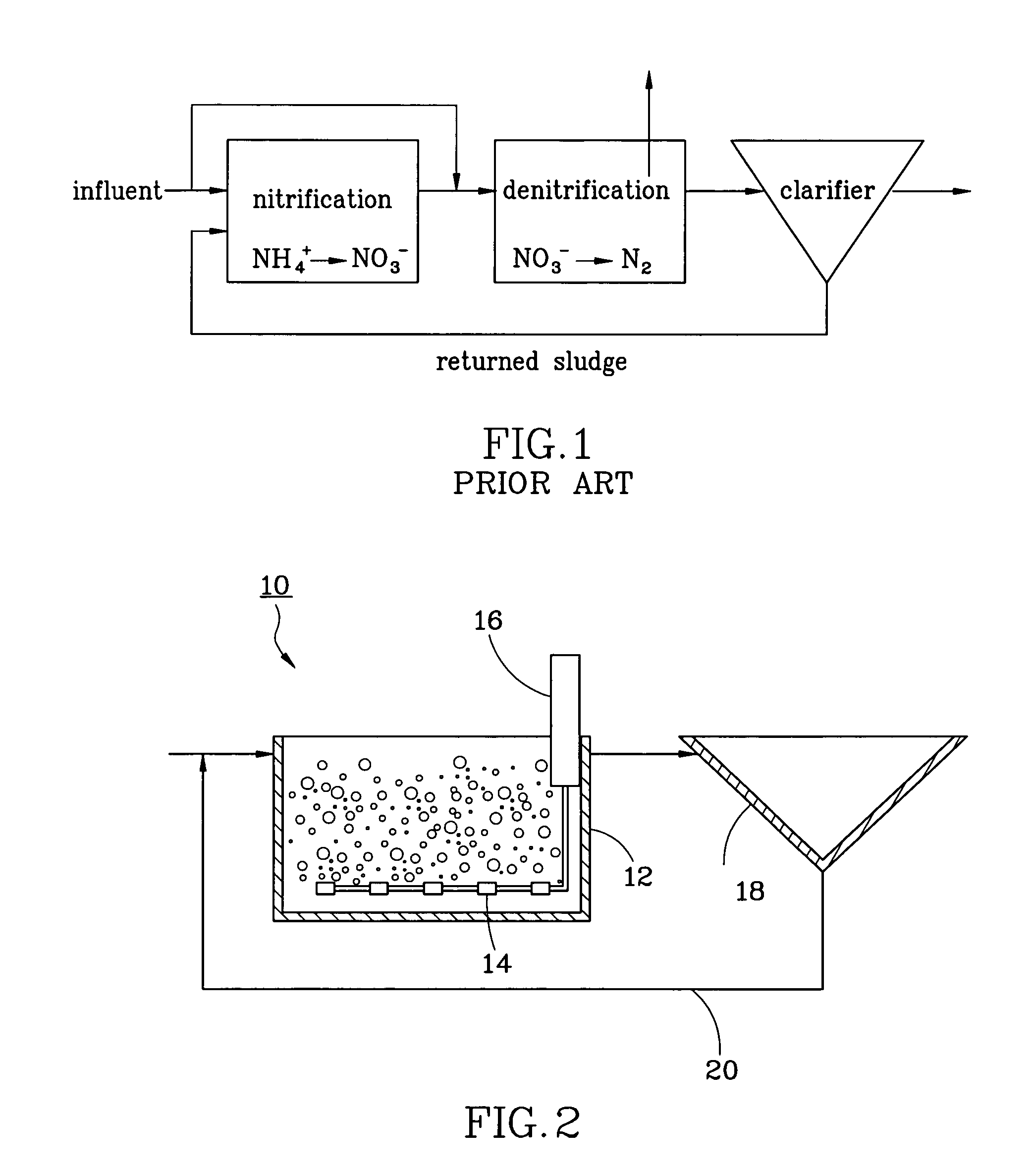
[0021]As showed in FIG. 2, the reactor 10 provided for the process of treating nitrogenous wastewater in accordance with a preferred embodiment of the present invention is a continuous stirred tank reactor (CSTR), which has a tank 12 with liquid, a variety of microorganisms, a plurality of aeration plates 14, an air compressor 16 and a clarifier 18. The microorganisms containing nitrifying bacteria and autotrophic denitrifying bacteria and heterotrophic denitrifying bacteria are mixedly suspended in the tank 12. The aeration plates 14 are installed in the bottom of the tank 12. Air compressor 16 is connected with the aeration plates 14 for supplying air to increase the dissolved oxygen in the tank 12. The air compressor and aeration plates provide enough oxygen for nitrification and for mixing. The clarifier 18 is connected with the tank 12.
[0022]The nitrogenous wastewater is introduced into the tank 12 and then decanted to the clarifier 18 to settle down suspended solid. The efflue...
example 2
[0023]A continuous stirred tank reactor (CSTR) is also used. The hydraulic retention time (HRT) and sludge retention time (SRT) of the CSTR are 1 day and 18 days, respectively. The concentration of dissolved oxygen is 0.2-0.3 mg / L in the reactor. The influent and effluent characteristics are showed as below:
[0024]
InfluentEffluentNH4+ (mg-N / L)850293NO2− (mg-N / L)075NO3− (mg-N / L)366COD (mg / L)656437Total N (mg-N / L)853434
[0025]The total nitrogen removal by this process is 49.2%, and the heterotrophic denitrification and the autotrophic denitrification contribute 5.0% and 44.2%, respectively. The total COD removal by this process is 33.4%. The heterotrophic denitrifying bacteria consume 30.0% of total influent COD, and other heterotrophic denitrifying bacteria in the reactor consume 3.4% of total influent COD. In the process for treating nitrogenous wastewater, autotrophic denitrifying bacteria are responsible for removal of total nitrogen and reduction of sludge production. Additionally,...
example 3
[0026]The hydraulic retention time (HRT) and sludge retention time (SRT) of the CSTR are 1 day and 18 days, respectively. The concentration of dissolved oxygen is 0.2-0.3 mg / L in the reactor. The influent and effluent characteristics are showed as below.
[0027]
InfluentEffluentNH4+ (mg-N / L)600168NO2− (mg-N / L)021NO3− (mg-N / L)347COD (mg / L)761435Total N (mg-N / L)603236
[0028]The total nitrogen (TN) removal of this process is 60.9% and the autotrophic denitrification contributes 54.7% TN removal. The ratio of COD removal by heterotrophic denitrifying bacteria and other heterotrophic bacteria are 19.7% and 23.2%, respectively.
[0029]The process for treating nitrogenous wastewater in accordance with the present invention contains simultaneous nitrification, autotrophic denitrification and heterotrophic denitrification. Those reactions are able to simultaneously and mixedly take place take place in the single reactor. It is not necessary to build two separate reactors for aerobic nitrification ...
PUM
| Property | Measurement | Unit |
|---|---|---|
| temperature | aaaaa | aaaaa |
| concentration | aaaaa | aaaaa |
| sludge retention time | aaaaa | aaaaa |
Abstract
Description
Claims
Application Information
 Login to View More