Systems and methods for distributing GPS clock to communications devices

a technology of communication devices and gps clocks, applied in the field of communication networks, can solve the problems of unsatisfactory service quality, manufacturers and providers are skeptical of using, and the current version of ntp does not meet the higher precision requirements of internet evolution, so as to improve the quality of service, and reduce the effect of dropped frames

a technology of communication devices and gps clocks, applied in the field of communication networks, can solve the problems of unsatisfactory service quality, manufacturers and providers are skeptical of using, and the current version of ntp does not meet the higher precision requirements of internet evolution, so as to improve the quality of service, and reduce the effect of dropped frames

US8018950B2Active Publication Date: 2011-09-13TAIWAN SEMICON MFG CO LTD

Image

Smart Image Click on the blue labels to locate them in the text.
Viewing Examples
Smart Image
  • Systems and methods for distributing GPS clock to communications devices
  • Systems and methods for distributing GPS clock to communications devices
  • Systems and methods for distributing GPS clock to communications devices

Examples

Experimental program
Comparison scheme
Effect test

Embodiment Construction

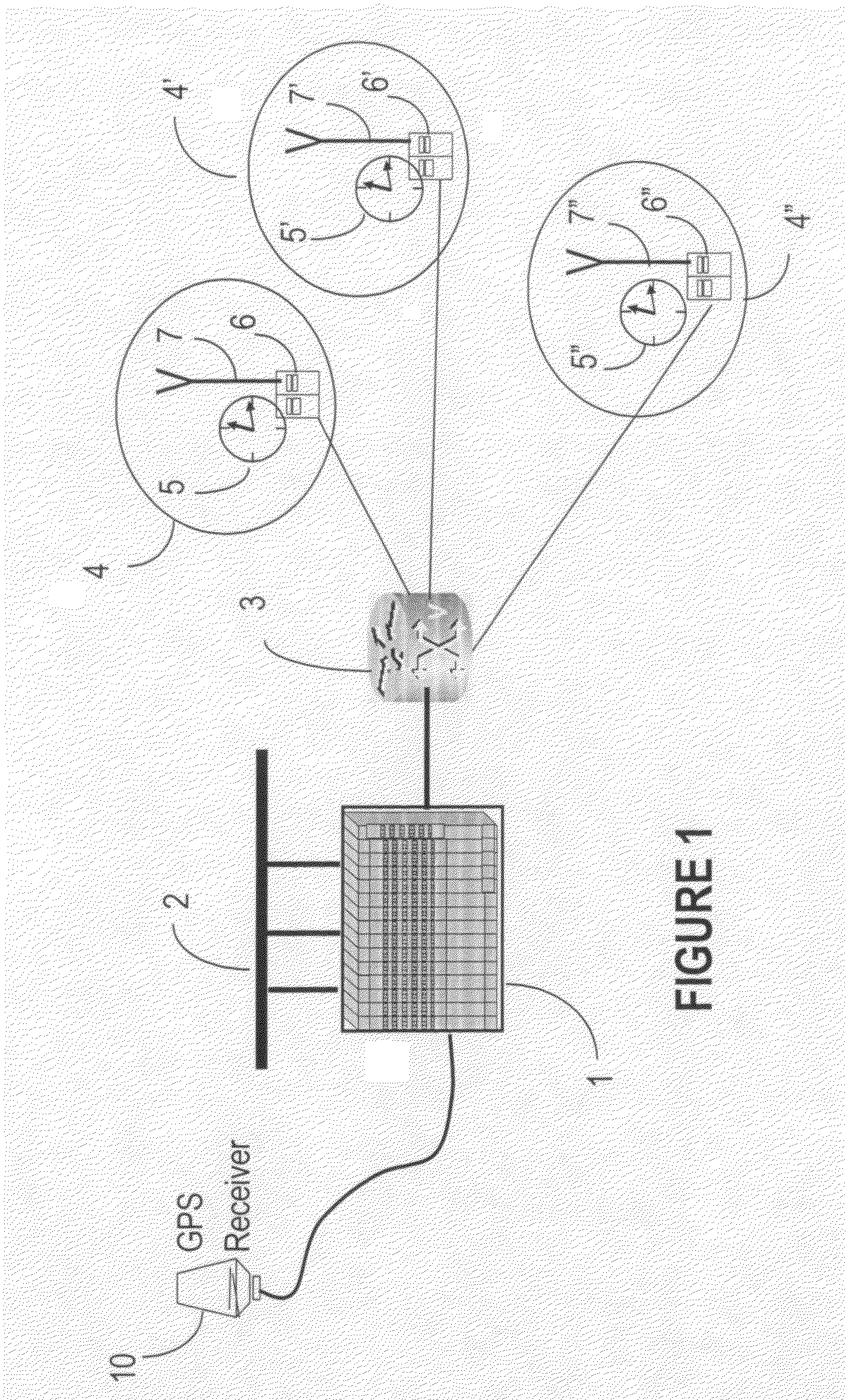
[0032]FIG. 1 shows a block diagram of a clock distribution system that uses IEEE 1588. The master clock in this architecture is a GPS clock 10, provided at a node 1. Node 1 distributes the GPS master clock 10 to slave IEEE 1588 PTP clocks 5, 5′, and 5″, each PTP clock being provided at a node 4, 4′ and 4″ in this example. Nodes 4, 4′ and 4″ could be mobile of fixed wireless nodes, as shown by the respective antennae 7, 7′ and 7″. A router or a switch 3 is used in this embodiment for establishing communication between node 1 and mobile nodes 4, 4′ and 4″. As well, FIG. 1 shows at 2 that node 1 may distribute the GPS clock to other nodes, not shown.

[0033]However, the architecture of FIG. 1 has a number of disadvantages. For example, when the GPS clock 10 becomes unavailable, the entire network loses synchronization. This drawback can be addressed by providing back-up clocks. However, such a solution is not ideal in that it increases the network costs. Another disadvantage of the synch...

the structure of the environmentally friendly knitted fabric provided by the present invention; figure 2 Flow chart of the yarn wrapping machine for environmentally friendly knitted fabrics and storage devices; image 3 Is the parameter map of the yarn covering machine
Login to View More

PUM

No PUM Login to View More

Abstract

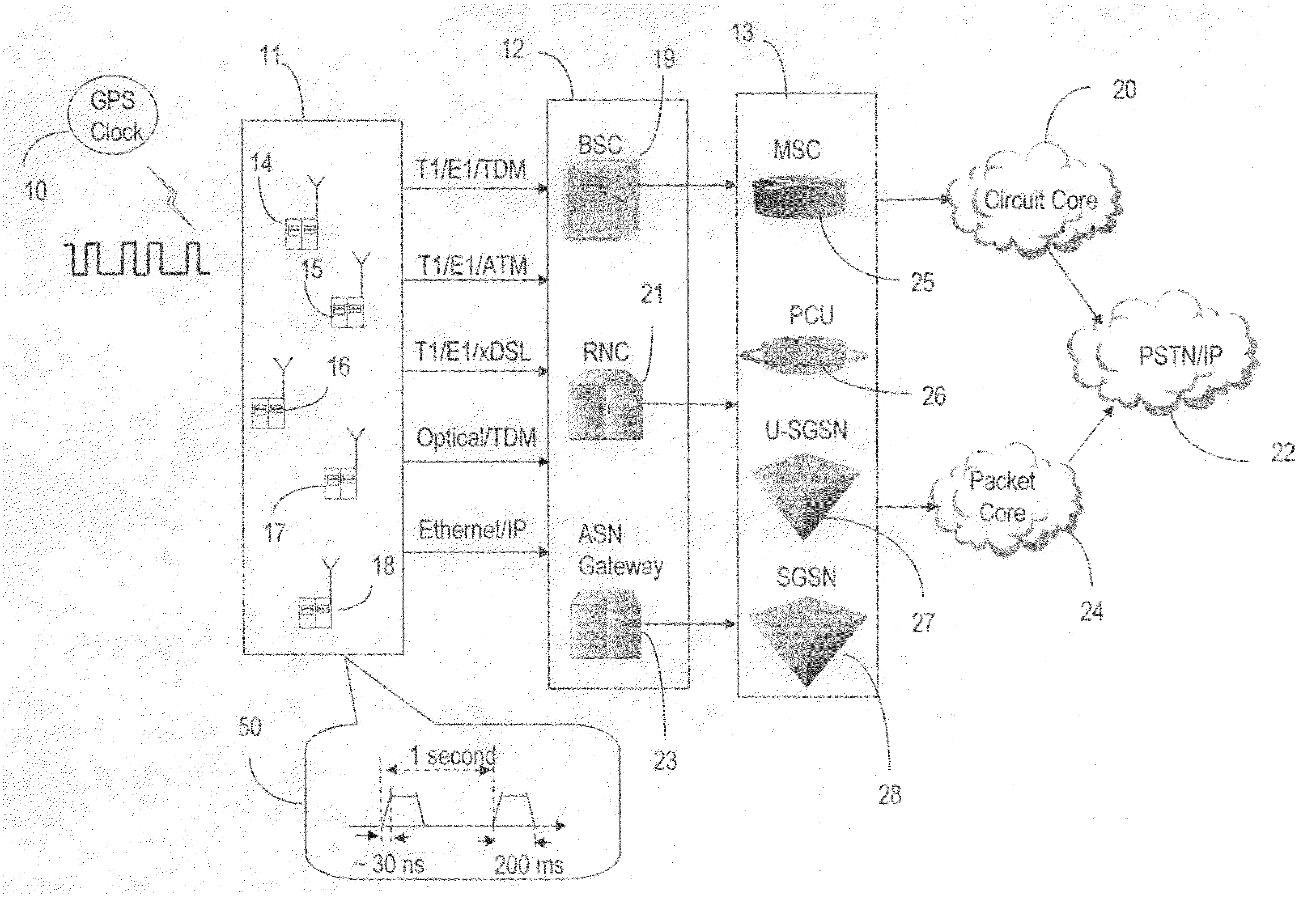
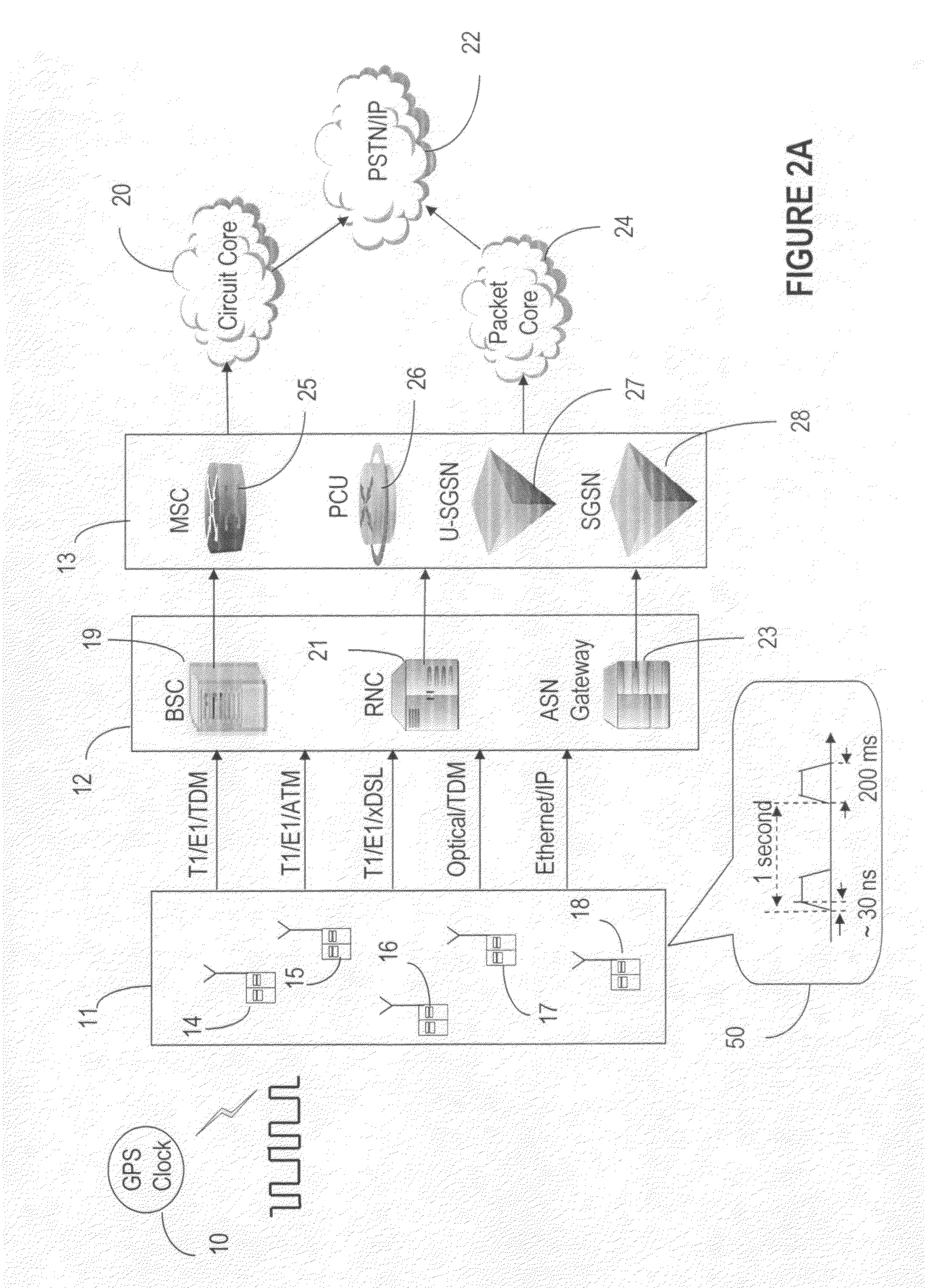
A method for synchronizing network elements to a global clock derived from the GPS clock acquired by a plurality of base stations. The global clock is distributed to controllers of various networks, and from there to network access devices. The network access devices further distribute the global clock to various wire-line and local wireless networks and from there, to the users served by these networks. The user equipment is enabled with a simple clock discipliner that adjusts the local clock to the global clock, resulting in a reliable synchronization across the converged communication networks.

Description

FIELD OF THE INVENTION[0001]The invention is directed to communication networks and in particular to systems and methods for distributing GPS clock to communication devices.BACKGROUND[0002]In a typical cellular radio system, user wireless terminals communicate via a radio access network (RAN) to one or more core networks. The user terminals can be mobile stations such as mobile / cellular telephones, laptops / notebooks with mobile capabilities, and other portable, pocket, hand-held, or car-mounted mobile devices, which communicate voice, data and / or video with a radio access network. Alternatively, the wireless units can be fixed devices, e.g. fixed cellular terminals which are part of a wireless local loop or the like.[0003]Clock synchronization is very critical for digital communication networks; the clock (also knows as the local oscillator) at the receiver end of a communication link must be well synchronized with the clock at the transmitter end both in time and frequency so that ...

Claims

the structure of the environmentally friendly knitted fabric provided by the present invention; figure 2 Flow chart of the yarn wrapping machine for environmentally friendly knitted fabrics and storage devices; image 3 Is the parameter map of the yarn covering machine
Login to View More

Application Information

Patent Timeline
13 Sep 2011
Publication
US8018950B2
IPC
H04L12/28; H04L12/56
CPC
G04G7/00; H04J3/0635; H04J3/0658; H04J3/0638
Inventors
WU, SHIQUAN; YEE, JUNG