AI technical title is built by Patsnap AI team. It summarizes the technical point description of the patent document.
a digital watermark and key technology, applied in the field of digital watermarking and steganography, can solve the problems of practical difficulty, technical challenges, and potential lack of flexibility in changing the aspects of the digital watermark system once it's deployed
Active Publication Date: 2012-03-20
DIGIMARC CORP
View PDF48 Cites 13 Cited by
Summary
Abstract
Description
Claims
Application Information
AI Technical Summary
This helps you quickly interpret patents by identifying the three key elements:
Problems solved by technology
Method used
Benefits of technology
Problems solved by technology
One practical challenge in the deployment of digital watermarking systems is the potential lack of flexibility in changing aspects of the digital watermark system once it's deployed.
While such changes may not alter the fundamental data hiding or extraction function, they present a practical difficulty because the deployed digital watermark readers may be rendered obsolete if the protocol is changed.
However, this presents technical challenges, such as whether the readers are accessible and / or re-programmable to receive and facilitate upgrades.
Method used
the structure of the environmentally friendly knitted fabric provided by the present invention; figure 2 Flow chart of the yarn wrapping machine for environmentally friendly knitted fabrics and storage devices; image 3 Is the parameter map of the yarn covering machine
View more
Image
Smart Image Click on the blue labels to locate them in the text.
Viewing Examples
Smart Image
Click on the blue label to locate the original text in one second.
Reading with bidirectional positioning of images and text.
Smart Image
Examples
Experimental program
Comparison scheme
Effect test
Embodiment Construction
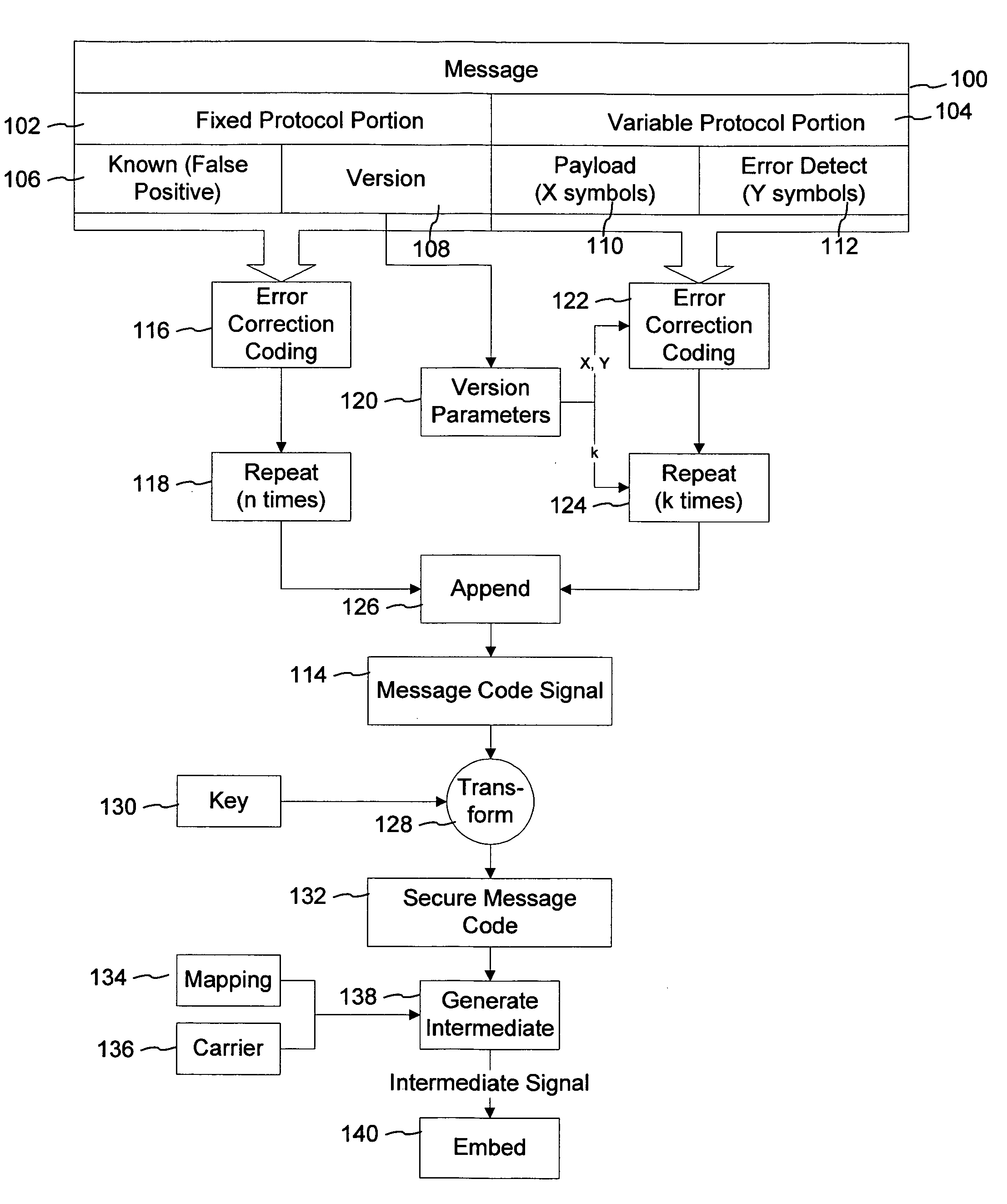
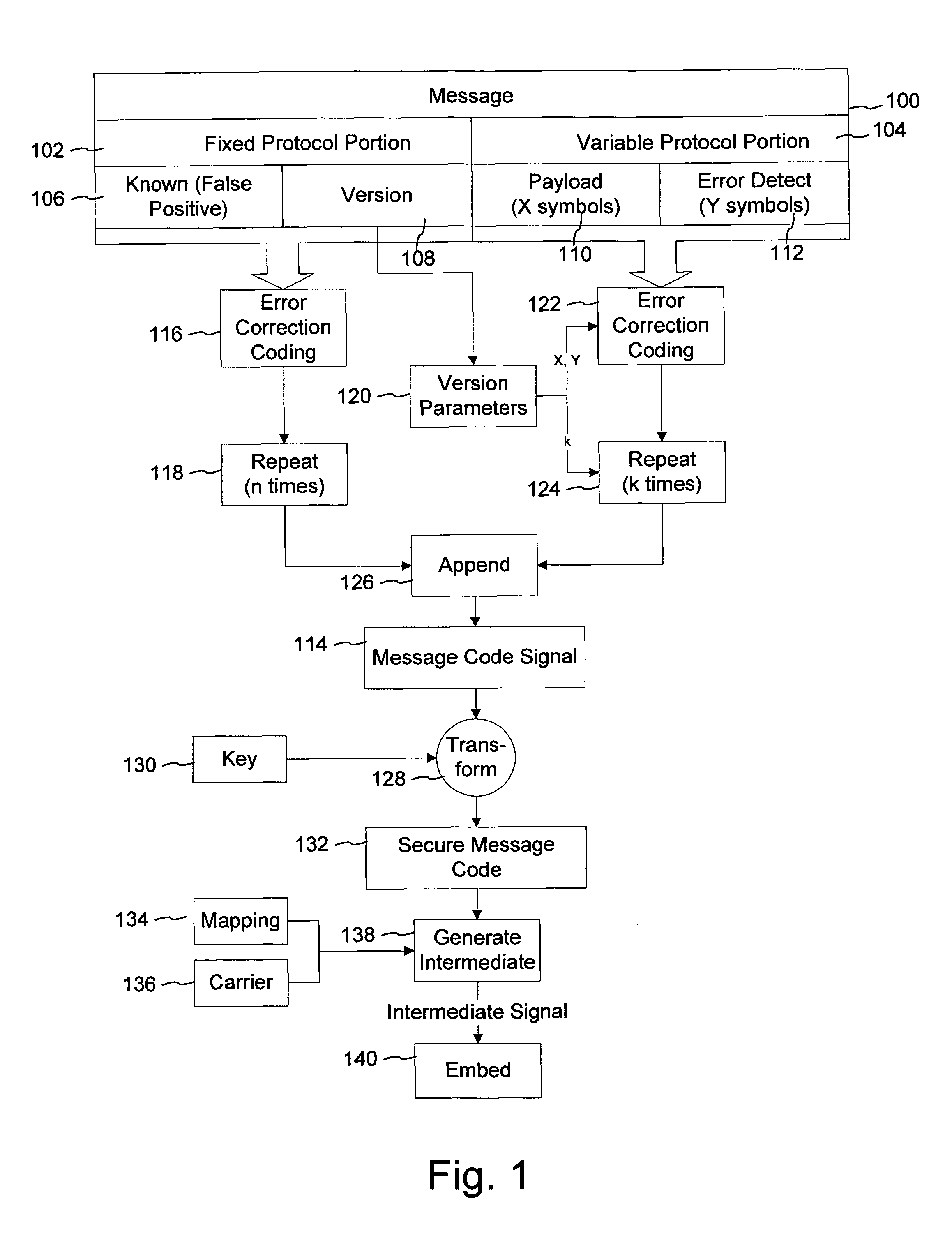
[0019]FIG. 1 is a diagram illustrating a message protocol method for digital watermark embedding. The protocol in this context refers to how the message is prepared for digital watermark embedding into a host media signal. One attribute specified by the message protocol is the error robustness coding that is applied to the message. Error robustness coding includes operations on the message that make it more robust to errors that undermine its complete and accurate recovery in potentially distorted version of the watermarked host media signal. Specific forms of error robustness coding include repetition of one or more parts of the message, and error correction coding of one or more parts of the message.
[0020]Another aspect of the message protocol is the length of the message payload. The message payload is a variable part of the message. It can be variable in both content (e.g., the values of the individual message symbols in the payload are variable), and length (e.g., the number of...
the structure of the environmentally friendly knitted fabric provided by the present invention; figure 2 Flow chart of the yarn wrapping machine for environmentally friendly knitted fabrics and storage devices; image 3 Is the parameter map of the yarn covering machine
Login to View More
PUM
Login to View More
Abstract
The present invention relates to message encoding. In a first implementation, a message is provided. The message is transformed by a secret key. The secret key is generated by providing a plural-bit seed. The seed is randomized and then error correction encoded. We prefer tail-biting convolutional encoding for our error correction encoding. The encoded seed forms a secure key, which is used to transform the message prior to embedding.
Description
RELATED APPLICATION DATA[0001]This application claims the benefit of U.S. Provisional Patent Application No. 60 / 585,177, filed Jul. 1, 2004.[0002]This patent application is related to each of the following patent documents: U.S. Published Patent Application No. US 2003-0033530 A1; U.S. patent application Ser. No. 10 / 020,519, filed Dec. 14, 2001 (published as US 2002-0159614 A1), which claims the benefit of 60 / 256,627, filed Dec. 18, 2000; U.S. patent application Ser. No. 10 / 139,147, filed May 2, 2002 (published as US 2003-0037075 A1), which claims the benefit of 60 / 288,272, filed May 2, 2001; and U.S. patent application Ser. No. 09 / 186,962, filed Nov. 5, 1998, which is a continuation of U.S. patent application Ser. No. 08 / 649,419, filed May 16, 1996 (now U.S. Pat. No. 5,862,260).[0003]Each of the above patent documents is hereby incorporated by reference.TECHNICAL FIELD[0004]The invention relates to digital watermarking, steganography, and specifically to watermark key generation us...
Claims
the structure of the environmentally friendly knitted fabric provided by the present invention; figure 2 Flow chart of the yarn wrapping machine for environmentally friendly knitted fabrics and storage devices; image 3 Is the parameter map of the yarn covering machine
Login to View More
Application Information
Patent Timeline
Application Date:The date an application was filed.
Publication Date:The date a patent or application was officially published.
First Publication Date:The earliest publication date of a patent with the same application number.
Issue Date:Publication date of the patent grant document.
PCT Entry Date:The Entry date of PCT National Phase.
Estimated Expiry Date:The statutory expiry date of a patent right according to the Patent Law, and it is the longest term of protection that the patent right can achieve without the termination of the patent right due to other reasons(Term extension factor has been taken into account ).
Invalid Date:Actual expiry date is based on effective date or publication date of legal transaction data of invalid patent.


 Login to View More
  Login to View More