
Method for selecting statistically validated candidate genes
a candidate gene and gene technology, applied in the field of molecular genetics, can solve the problems of unreasonably large number of genes to validate, wide region identified using linkage analysis, and limited to what is currently known about genes
- Summary
- Abstract
- Description
- Claims
- Application Information
AI Technical Summary
Benefits of technology
Problems solved by technology
Method used
Image

Examples
experimental examples
Example 1
QTL Detection in a Nested Population
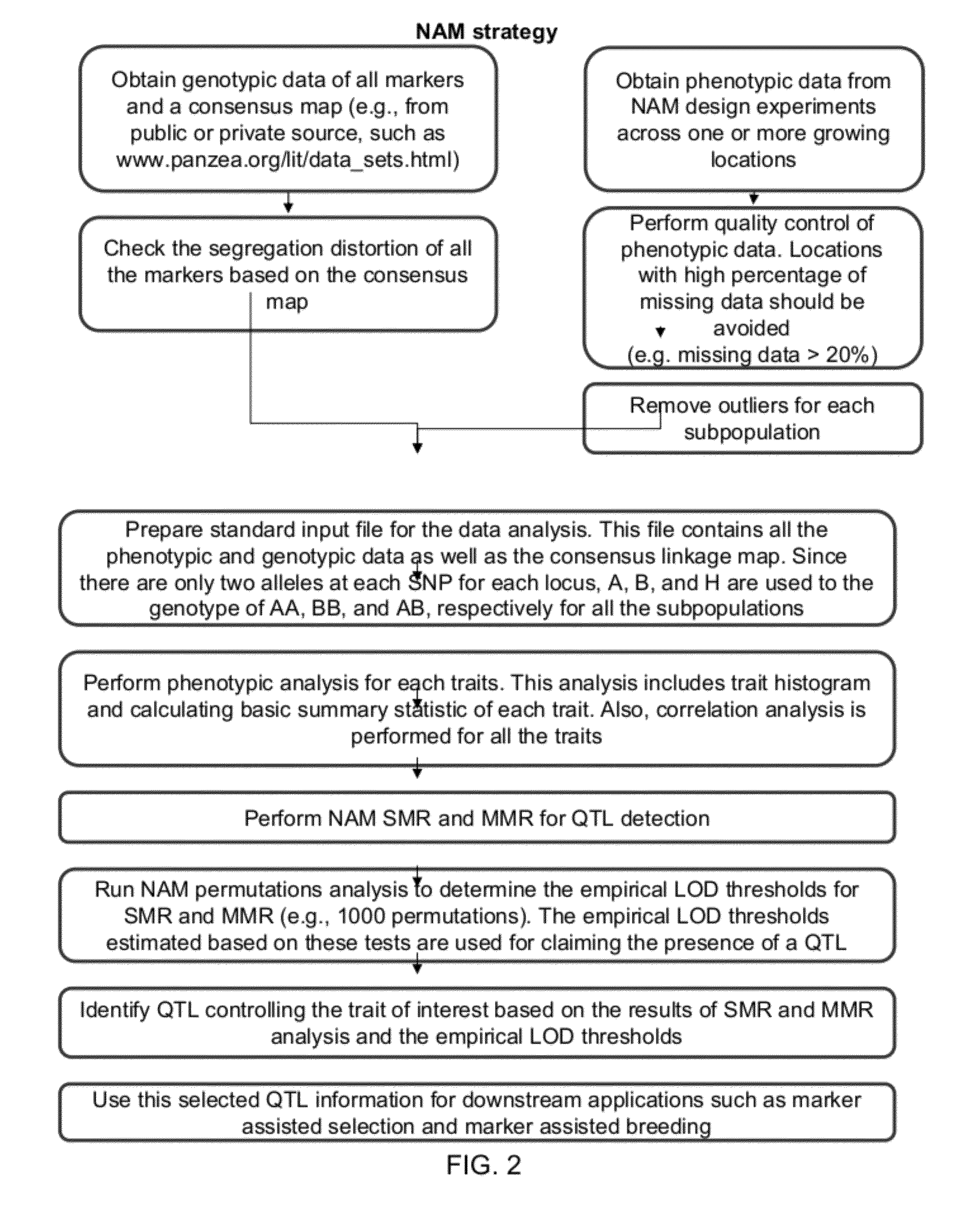
[0127]NAM is performed using SMR and MMR in combination with the permutation method described below to determine the LOD threshold for NAM.
Single Marker Regression (SMR):
[0128]The linear model to describe the relationship between trait values and marker genotypes is:
yij=μ+xija+giui+eij (model 1)
where yij is the phenotypic value of the individual j in the subpopulation i; μ is the overall mean; a is the additive effect of QTL; gi is the indicator variable of the subpopulation i; ui is the effect of the subpopulation i; eij is the residual error; and, wherein xij is defined as 1 if the individual j carries the allele from the common parent and −1 if the individual j carries the allele from the other parent.
[0129]The definition is based on the fact of there are only two distinct alleles for each marker. To exploit the simplicity of regression, the genetic background effect ui is assumed to be a fixed effect. Its inclusion into the model is...
example 2
Method of Selection of Candidate Leads for Further Validation After Genome Wide Association Mapping
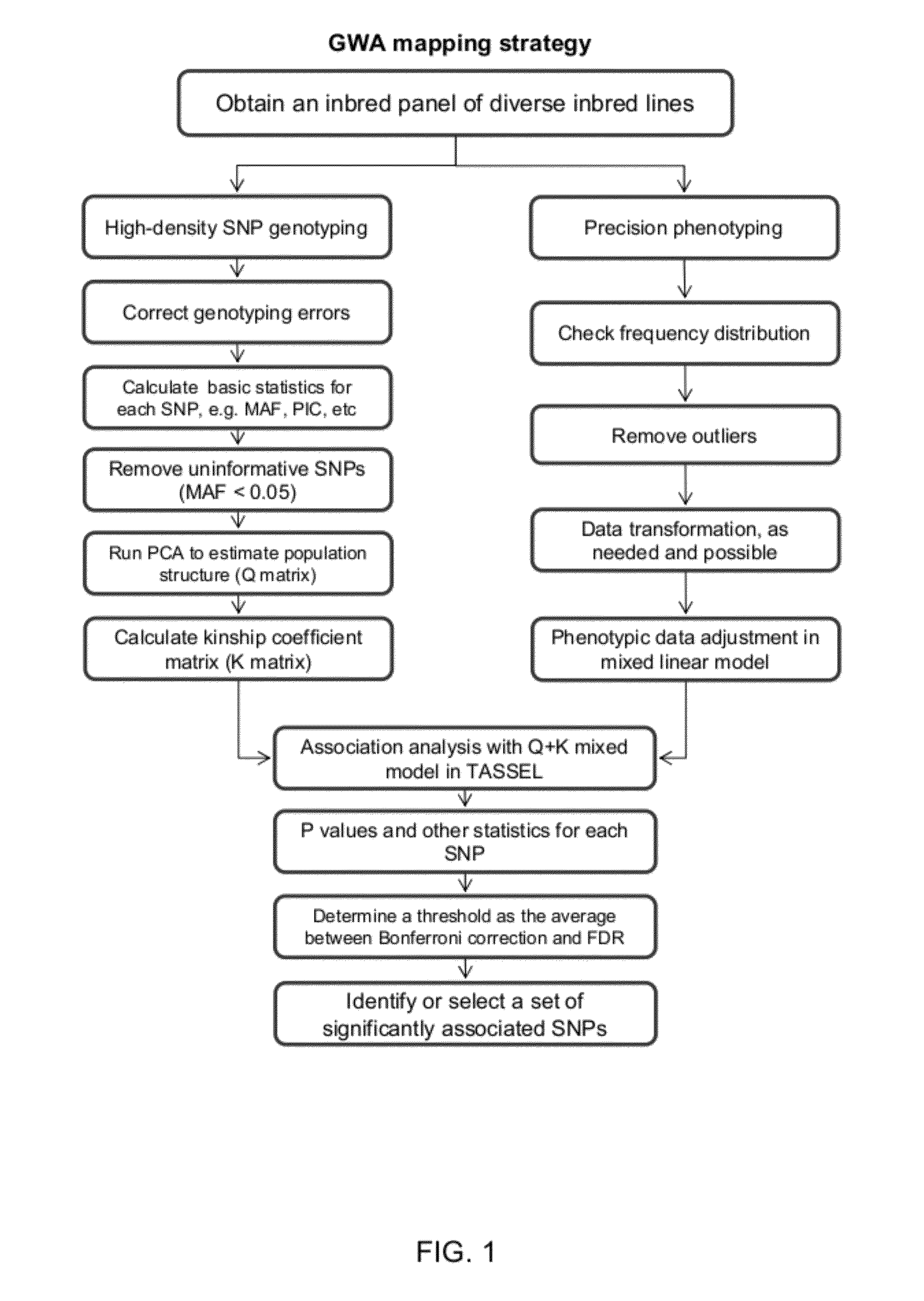
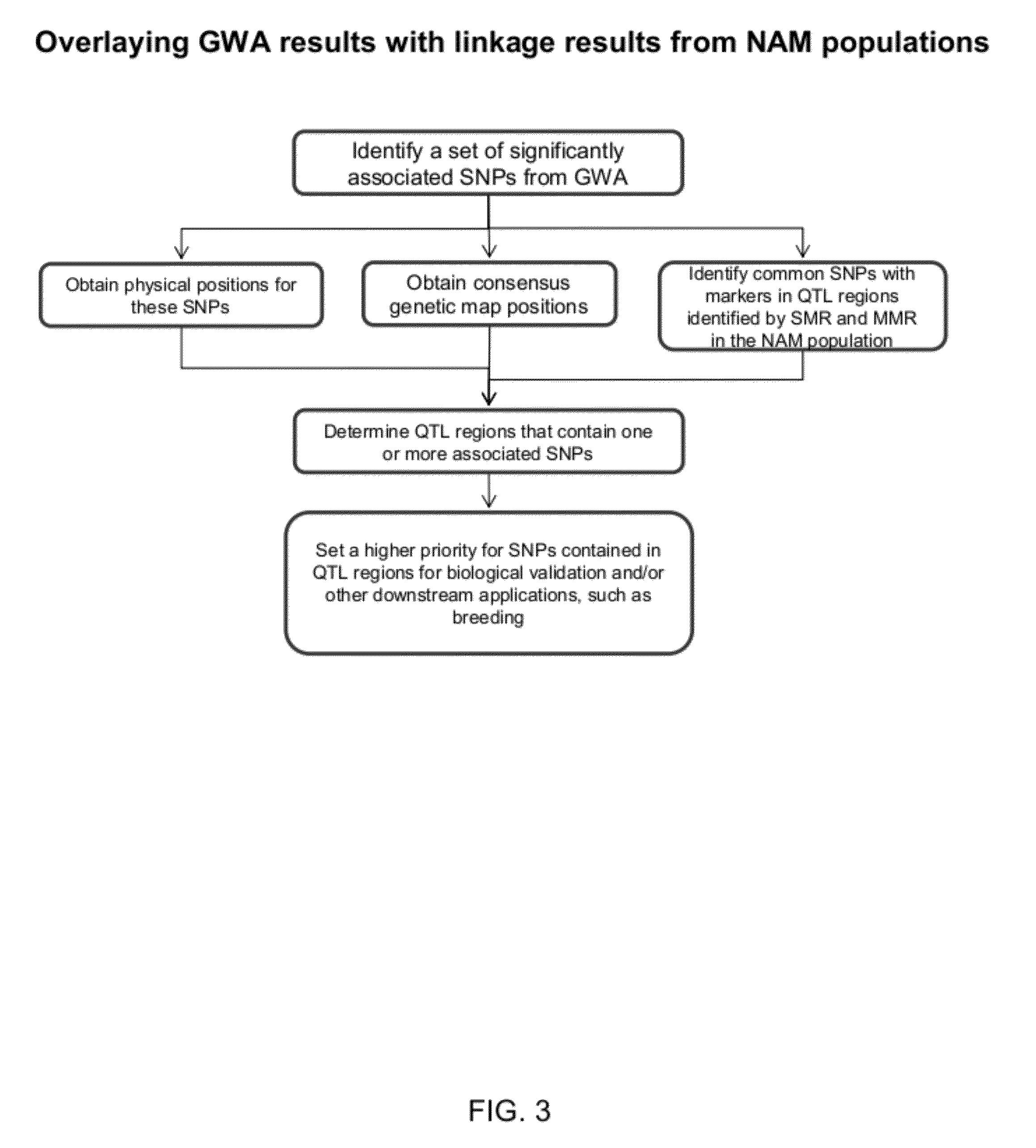
[0137]With the advent of 'omics, identifying key candidates among the thousands of genes in a genome that play a role in a phenotype or a complex biological process has paradoxically become one of the main hurdles. Indeed, contrary to some early concerns that a lack of sufficient global data would still be a limiting factor, it is precisely the opposite, a bounty of information that now poses a challenge to scientists. This has translated into a need for sophisticated tools to mine, integrate and prioritize massive amounts of information. The present invention will help prioritize the candidate leads identified by Genome wide association mapping (using, for example, sequences from Solexa technology) for further validation and implementation in marker assisted breeding.
[0138]The nested association mapping population developed by the Maize Functional diversity group (Yu et al. Genetics 2...
example 3
QTL Detection using NAM SMR and MMR
[0140]Experimental Design and Preparation of Phenotypic and Genotypic Data
[0141]The NAM RIL lines were planted across five locations within two years. The traits of interest, mainly including starch and protein in corn ethanol project, were evaluated across the locations and years. The phenotypic data from each location is unbalanced. The unbalanced data structure indicates that it is necessary to obtain the corresponding genotypic data for those lines. To do so, the genotype data was downloaded for all the markers (panzea.org / lit / data) and the genotypic information was extracted for the NAM lines evaluated. Also, to perform SMR and MMR, a consensus linkage map was found from the same website and downloaded for the further use.
[0142]Methods for Data Analysis
[0143]NAM SMR and MMR were used to detect the QTL responsible for starch and protein in corn. The details of these methods are described in Example 1. Both SMR and MMR are used for QTL mapping. ...
PUM
| Property | Measurement | Unit |
|---|---|---|
| disease resistance | aaaaa | aaaaa |
| density | aaaaa | aaaaa |
| physical genetic map | aaaaa | aaaaa |
Abstract
Description
Claims
Application Information
 Login to View More