[0012]The object of the present invention is therefore to provide improved comfort for a person wearing a progressive ophthalmic lens, particularly when he is undertaking a sporting activity.
[0018]A first
advantage of a lens according to the invention results from the variation in mean sphere of the complex surface along the meridian line. Thanks to this variation, which is small between the
prism reference point and the far-vision reference point, the far-vision area extends lower down in the lens. Thus, the wearer benefits from a correction that is adapted for his far vision, even for remote objects located at an
intermediate distance. Thus, starting the progression at a low level in the lens gives the wearer an easy view of the ground. In this way, the lens wearer may have a satisfactory view of a
golf ball on the ground, or may see the path just in front of him correctly when he is walking.
[0019]A second
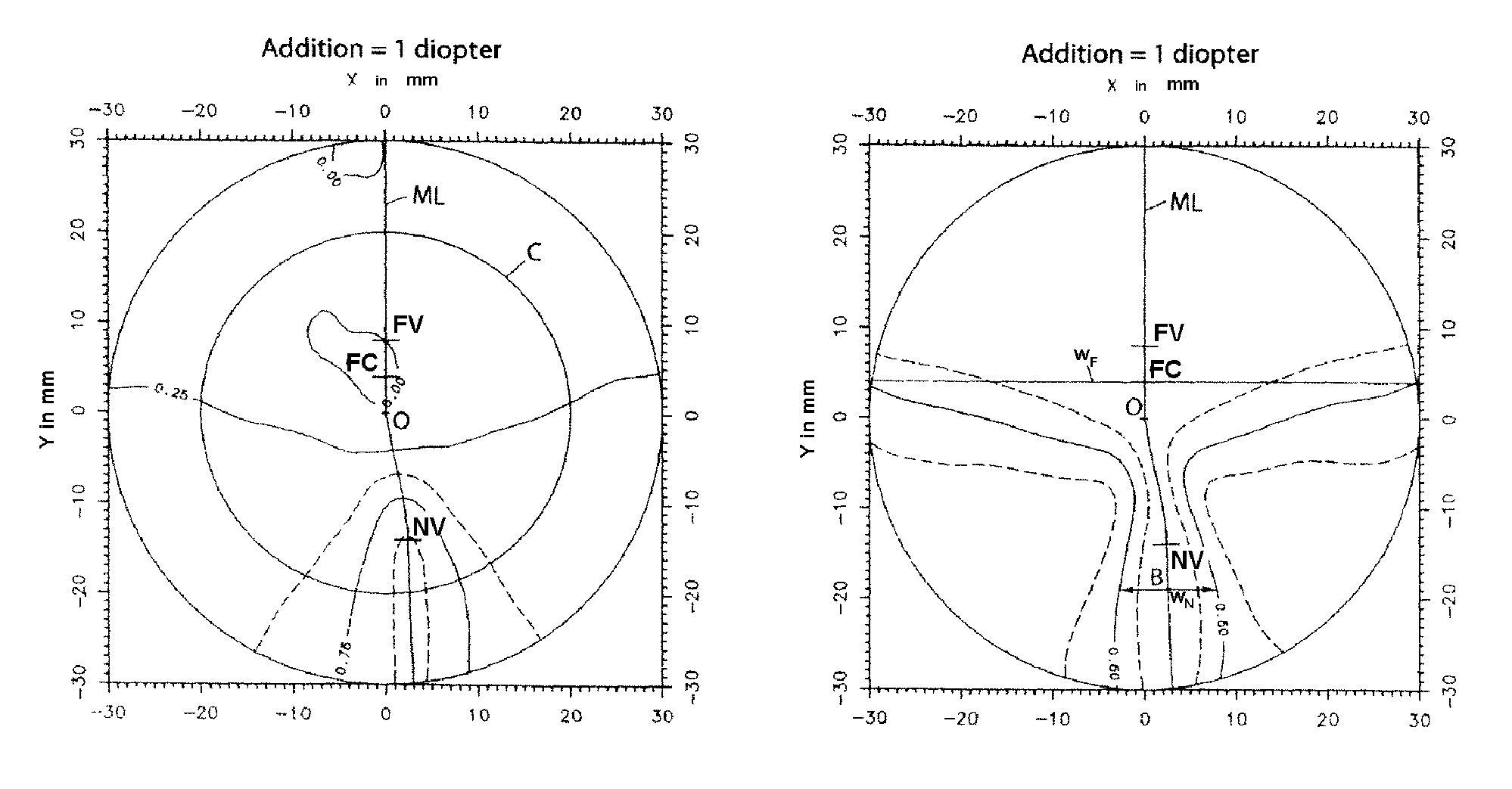
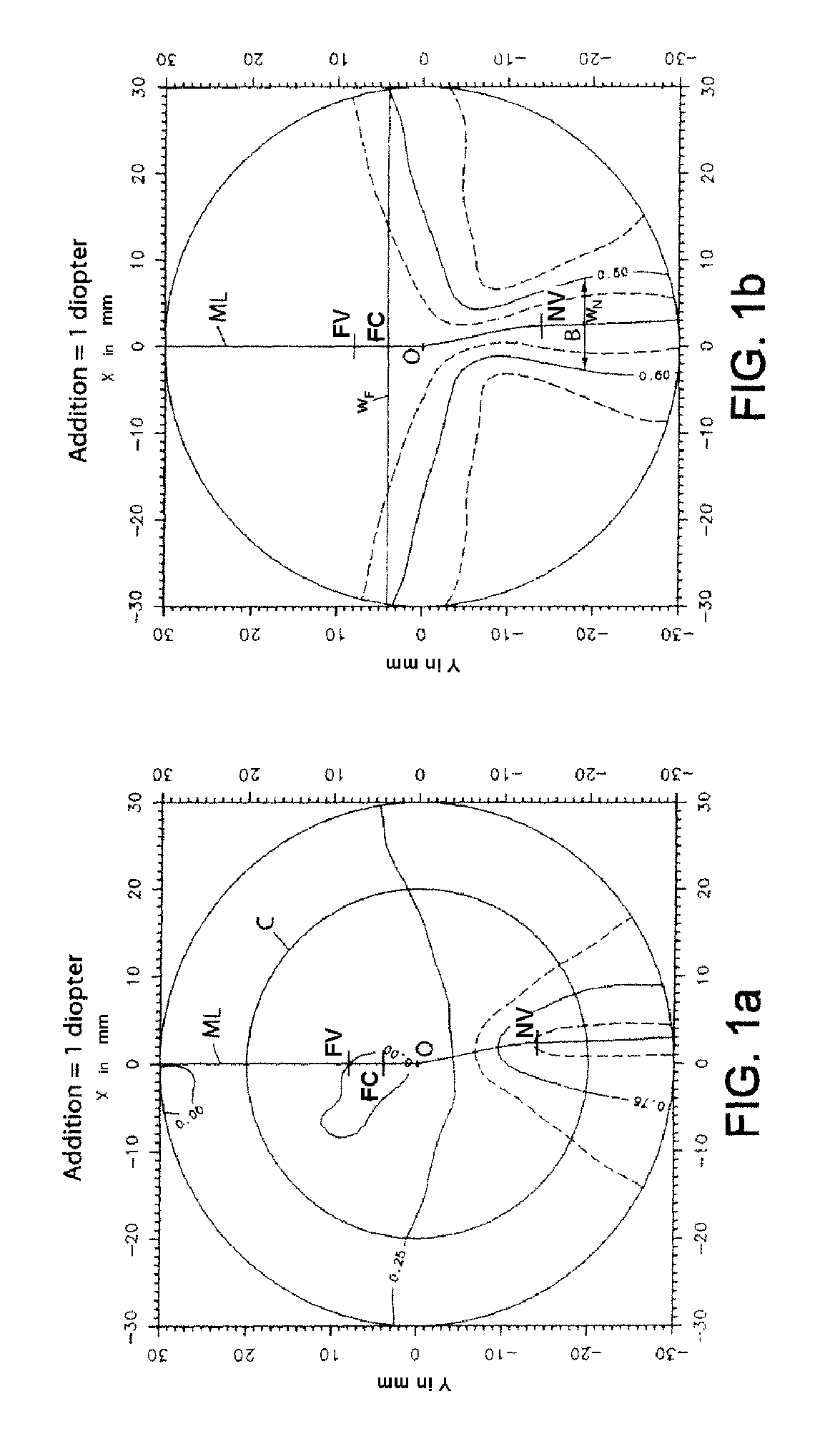
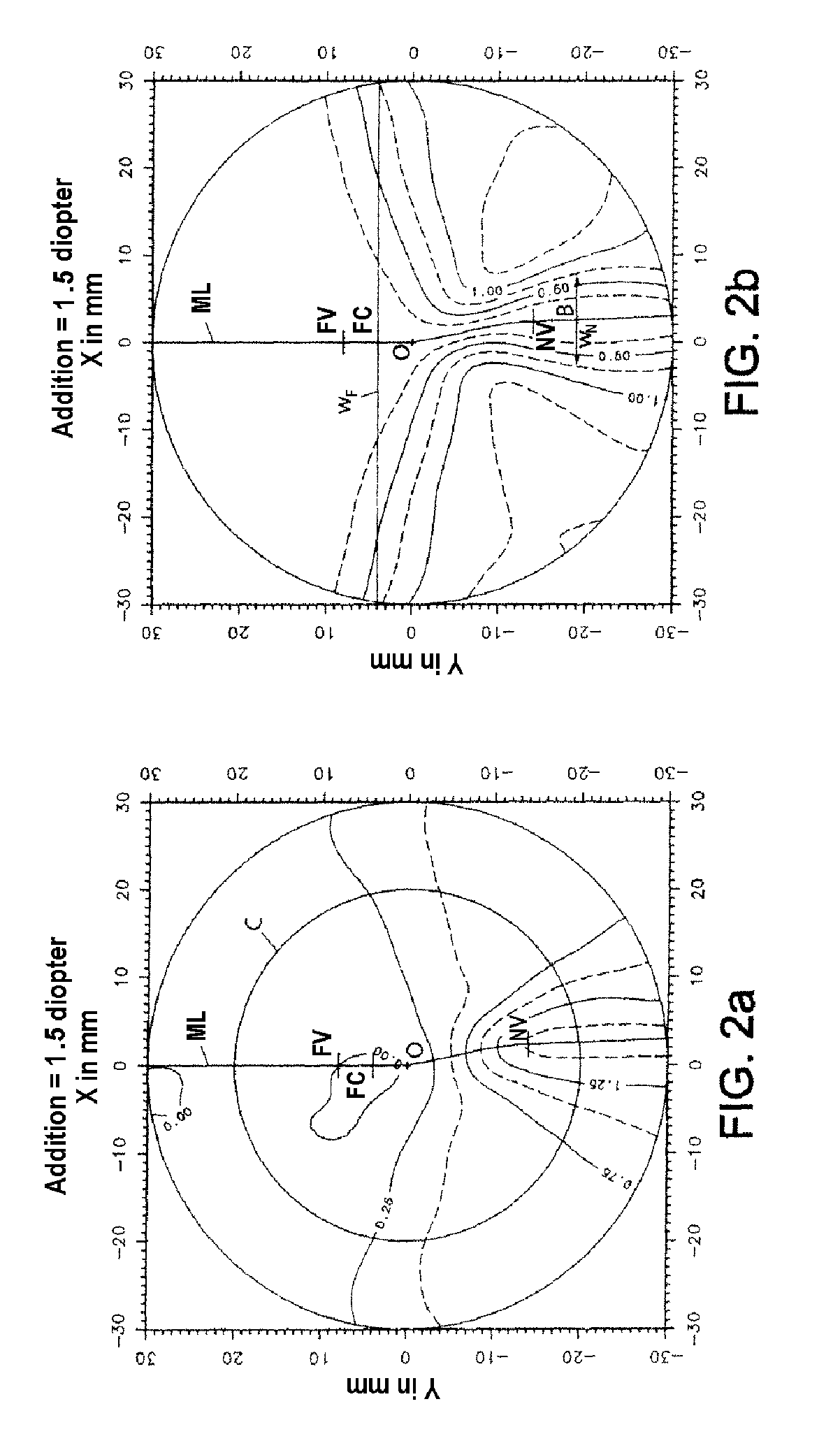
advantage of a lens according to the invention results from the cylinder of the complex surface that has limited values over the entire surface of the lens. Thanks to these low cylinder values, the unintentional
astigmatism of the lens is small, even in lateral portions of the lens that are close to its
peripheral edge. The wearer thus benefits from satisfactory vision through the
entire lens. In other words, the lens wearer has far vision through the lens that is clear-
cut, not only horizontally on the right and left sides but also vertically downwards. In addition, the absence of rebound in the mean sphere on the circle of
radius 20 mm centered on the
prism reference point guarantees that the variations in the
optical power do not disturb the
peripheral vision in the lateral portions of the lens. This clear-
cut far-vision quality and good
peripheral vision quality furthermore give the wearer good dynamic vision. In particular, any pitching
sensation that might be felt when he changes his
line of sight through the lens is very greatly reduced, or even completely absent.
[0020]A third
advantage results from the limited progression length. Thanks to this rather short progression length, the lens has an
optical power adapted for the wearer's
near vision at points on the meridian line that are not located too far below the fitting cross. In other words, the area of the lens adapted for correcting the wearer's near vision is not located too low in the lens. Thus, the near-vision area is easily and rapidly accessible for the wearer, whilst still enabling him to see the ground through the intermediate-vision area without forcing him to take up an uncomfortable posture.
[0021]According to an improvement of the invention, the mean sphere may have absolute variations that are less than 0.25 diopter in a segment of the meridian line at least 5 millimeters in length, which extends from the near-vision reference point toward the lower edge of the lens. In other words, the lens gives the wearer a vertically extended near-vision area, in which the
optical power is substantially constant. This results in good near-vision comfort, especially since the wearer has available a sufficient interval within which he can vary the line of his
sight while still retaining viewing conditions that are adapted to his near vision. This comfort enables him in particular to scan the screen of his mobile telephone vertically without impediment.
[0027]Such a method therefore includes a step of reducing the addition relative to the addition value initially prescribed for the wearer. The wearer can then benefit from even more clear-
cut far vision, while still having a near-vision area enabling him to see close objects, at least during periods of short or moderate duration. The conditions for near vision through the lens are good enough for him to be able to read the time on his watch or to consult the screen of his mobile telephone.


 Login to View More
  Login to View More