
Hydrazone derivative
a technology of hydrazone and derivatives, applied in the field of new hydrazone derivatives, can solve the problems of reducing glucose metabolism and improving obesity, and achieve the effect of excellent glucokinase activation
- Summary
- Abstract
- Description
- Claims
- Application Information
AI Technical Summary
Benefits of technology
Problems solved by technology
Method used
Image

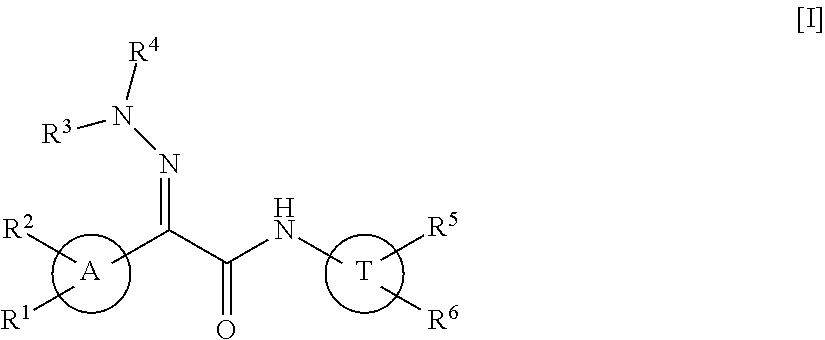

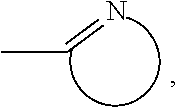
Examples
example 1
[0151]
(1) To a solution of aluminum chloride (67.0 g, 503 mmol) in methylene chloride (380 ml) was added methyl chloroglyoxylate (48.9 g, 399 mmol) under ice-cooling, and the mixture was stirred for 30 minutes at the same temperature. Then, thereto was added a solution of cyclopropyl phenyl sulfide (compound I-A) (50 g, 333 mmol) in methylene chloride (60 ml), and then the ice-cooling bath was removed and the mixture was stirred at room temperature for 1.5 hours. The reaction solution was poured into ice, and then the methylene chloride layer was separated and concentrated in vacuo. The residue was dissolved in ethyl acetate and then washed sequentially with water, a saturated aqueous sodium bicarbonate solution and brine, followed by drying over sodium sulfate and concentrated in vacuo. The residue was crystallized from hexane to give compound (1-B) (69.5 g, yield 88%) as a pale yellow crystal.
[0152]MS (m / z) APCI: 237 [M+H]+
[0153](2) To a solution of the above compound (1-B) (57.0 ...
example 2
[0159]
(1) A solution of compound (1-C2) (10.0 g, 35.4 mmol) in 16% hydrochloric acid (100 ml) was heated to reflux for 24 hours. After cooling, the reaction solution was concentrated in vacuo, and the residue was triturated in toluene to give compound (2-A) (9.0 g, quantitative) as a colorless solid.
[0160]MS (m / z) ESI: 253 [M−H]−
[0161](2) A solution of compound (2-A) (2.54 g, 9.99 mmol) and 4-aminomorpholine (1.02 g, 9.99 mmol) in methylene chloride was stirred for 3 hours at room temperature. The reaction solution was concentrated in vacuo, and then the residue was crystallized with methylene chloride-diethyl ether to give compound (2-B) (E:Z=4.2:1, 2.32 g, yield 69%) as a colorless crystal.
[0162]MS (m / z) ESI: 337 [M−H]−
[0163](3) To a solution of compound (2-B) (169 mg, 0.50 mmol), 2-amino-5-fluorothiazole hydrochloride (231 mg, 1.50 mmol) and 4-(N,N-dimethylamino)pyridine (91 mg, 0.75 mmol) in methylene chloride was added N-ethyl-N′-(3-dimethylaminopropyl)carbodiimide (0.136 ml, 0...
example 6
[0167]
[0168]MS (m / z) APCI: 413 / 415 [M+H]+
[0169]
ExamplesRMS (m / z)7—FAPCI: 397 [M + H]+8—CO2EtAPCI: 451 [M + H]+9—CF3APCI: 447 [M + H]+10—CHOAPCI: 407 [M + H]+11—CNAPCI: 404 [M + H]+12—CH2CO2EtAPCI: 465 [M + H]+
PUM
| Property | Measurement | Unit |
|---|---|---|
| reaction temperature | aaaaa | aaaaa |
| reaction temperature | aaaaa | aaaaa |
| reaction temperature | aaaaa | aaaaa |
Abstract
Description
Claims
Application Information
 Login to View More