
Screw
a screw and screw body technology, applied in the field of screws, can solve the problems of increasing friction, difficult to detect the condition of the screw, and difficulty in discerning the screw condition of users, so as to improve the drilling effect and reduce the fastening time. , the effect of increasing the efficiency of drilling and thread tapping
- Summary
- Abstract
- Description
- Claims
- Application Information
AI Technical Summary
Benefits of technology
Problems solved by technology
Method used
Image

Examples
Embodiment Construction
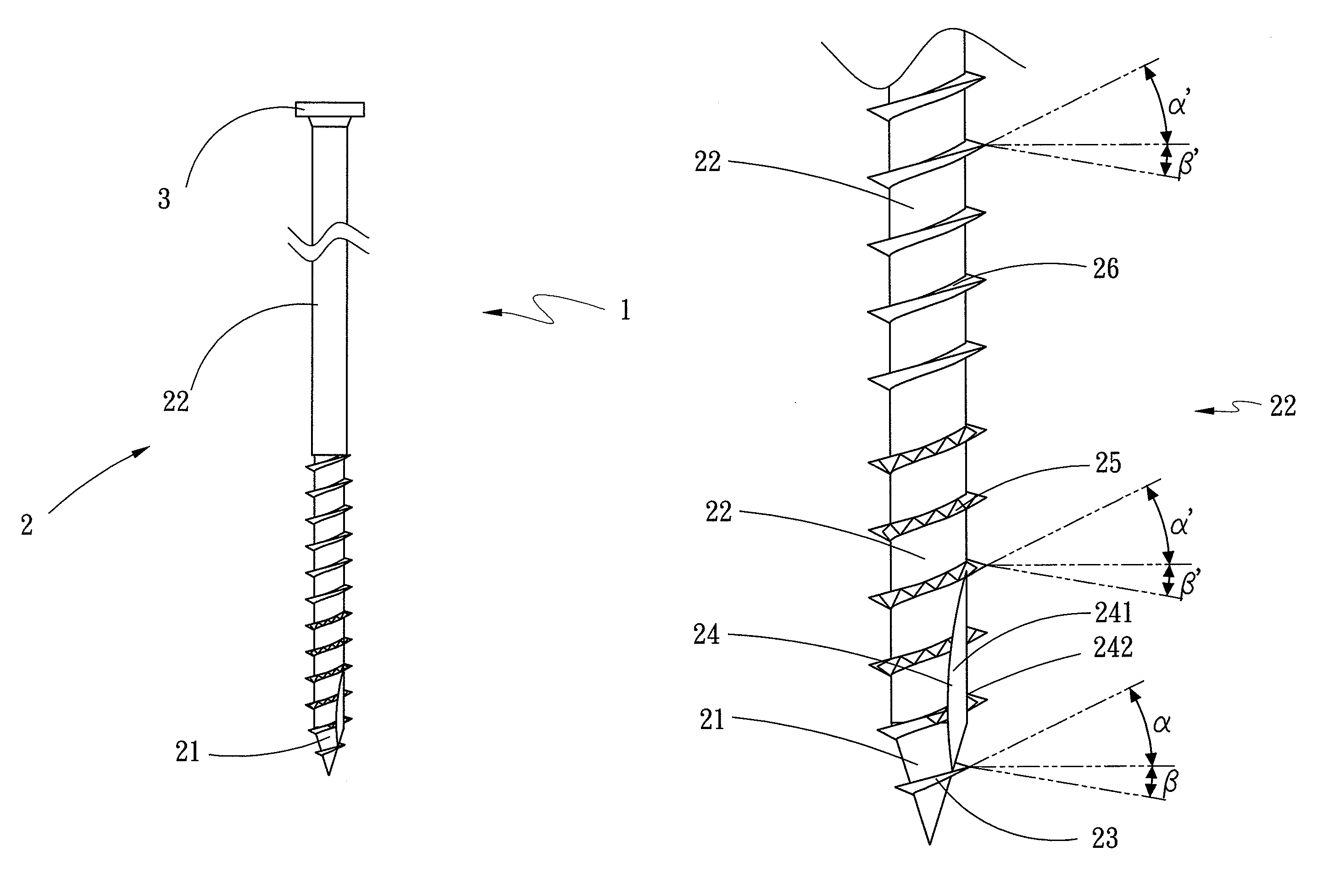
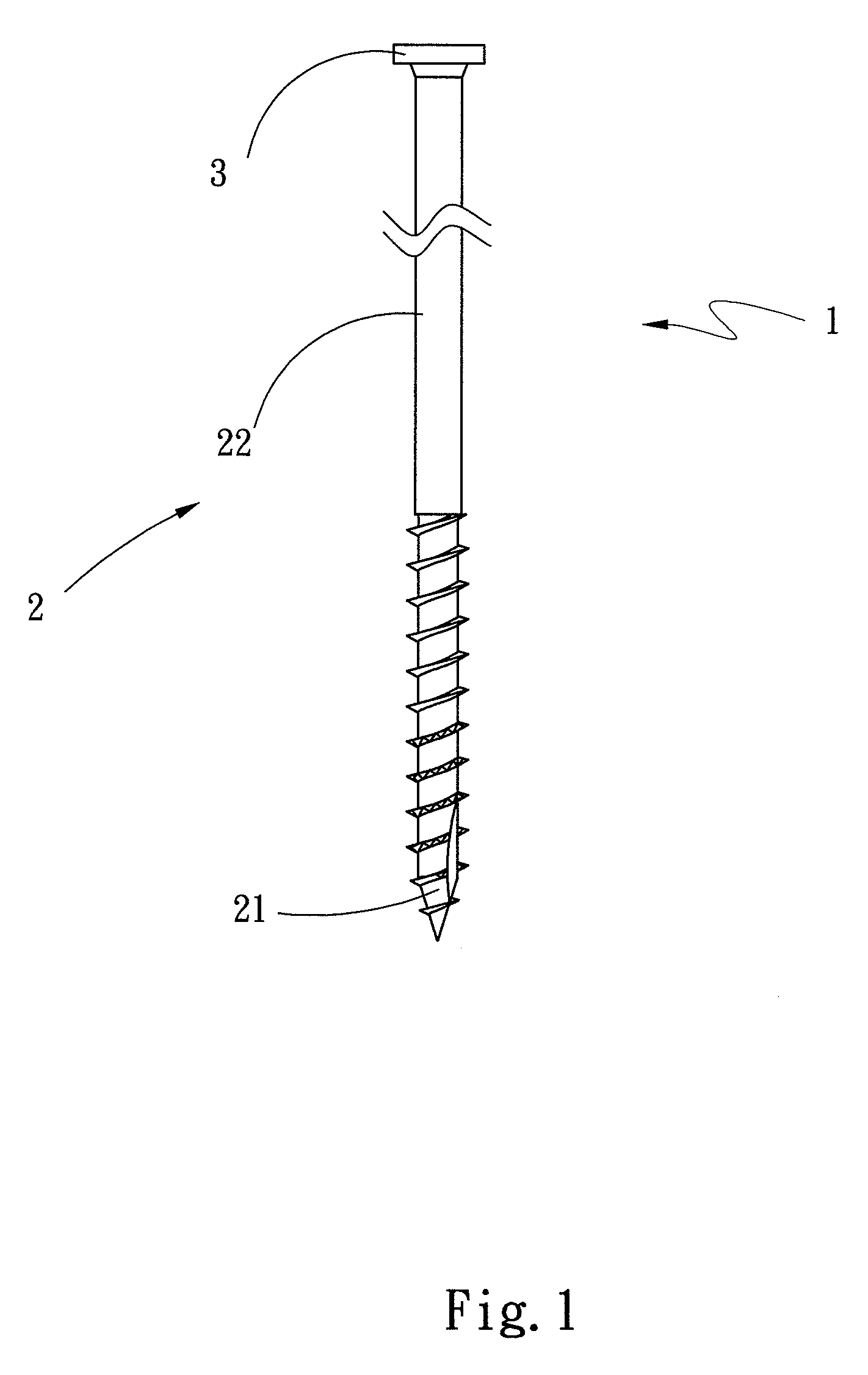
[0020]Please referring to FIGS. 1, 2 and 3, the present invention provides a screw 1 which has a shank 2 and a screw head 3 connected with the shank 2.
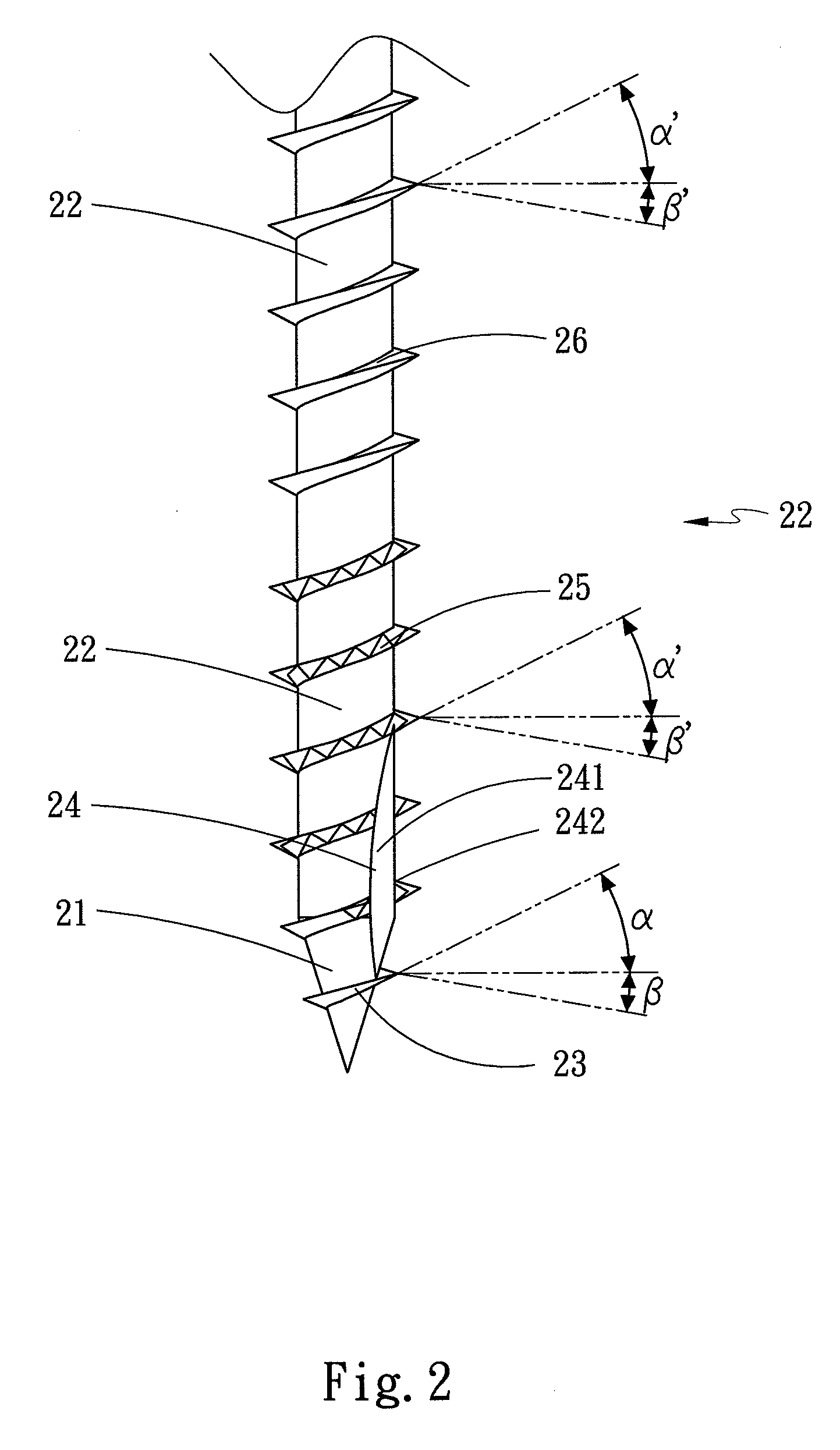
[0021]The shank 2 includes a taper 21 and a stem 22 that are connected coaxially. There is a first asymmetrical thread 23 at the taper 21 to facilitate drilling holes. The first asymmetrical thread 23 has a first front end angle α formed between 30 and 40 degrees, and a first rear end angle β formed between 10 and 20 degrees. The stem 22 has asymmetrical saw-type threads 25 and a second asymmetrical thread 26 that are extended sequentially from the first asymmetrical thread 23 towards the screw head 3. The asymmetrical saw-type thread 25 has a second front end angle α′ formed between 27 and 33 degrees, and a second rear end angle β′ formed between 7 and 13 degrees. The asymmetrical saw-type threads 25 are spaced by a second threaded pitch same as the first threaded pitch of the first asymmetrical thread 23. The shank 1 has a carved V-...
PUM
| Property | Measurement | Unit |
|---|---|---|
| rear end angle | aaaaa | aaaaa |
| rear end angle | aaaaa | aaaaa |
| rear end angle | aaaaa | aaaaa |
Abstract
Description
Claims
Application Information
 Login to View More