Check patentability & draft patents in minutes with Patsnap Eureka AI!

Cell-free system for synthesizing membrane proteins cell free method for synthesizing membrane proteins

a cell-free system and membrane protein technology, applied in the field of cell-free system and membrane protein synthesizing system, cell-free system and cell-free method for producing and maintaining heterologous membrane proteins, can solve the problems of rare quantity of pure membrane protein that is needed for extensive biochemical studies and crystallization trials, suffer limitations, and severely limit the absolute number of copies of target protein which can be properly inserted into the cell membrane. , to achieve the effect of reducing protein content, not inhibiting

Active Publication Date: 2013-06-04
UCHICAGO ARGONNE LLC
View PDF1 Cites 0 Cited by
  • Summary
  • Abstract
  • Description
  • Claims
  • Application Information

AI Technical Summary

Benefits of technology

This approach enables the production of milligram quantities of heterologous membrane proteins in functional form, facilitating subsequent steps like sequestration, solubilization, and purification, and allows for proper folding and membrane association, overcoming the limitations of traditional methods.

Problems solved by technology

While many membrane proteins have been isolated in functional form from their native host organisms, purification in such cases is highly protein-specific, is not adaptable to high-throughput methodologies, and rarely yields the amounts of pure membrane proteins that are needed for extensive biochemical studies and crystallization trials.
They suffer limitations, however, especially when applied to the expression of non-E. coli membrane proteins.
Because the host cell's own membrane proteins already occupy a defined proportion of the cell's membranes, the availability of any remaining membrane space severely limits the absolute number of copies of the target protein which can be properly inserted into the cell membranes.
In addition, a high level of expression in E. coli can saturate the secretory machinery for integration of the heterologous protein into the membrane, often resulting in cell death, degradation of the target protein, or precipitation of the heterologously-expressed membrane protein as inclusion bodies (insoluble aggregates within cells).
However, the inventors have observed that expression of some target proteins has a negative impact on cell growth rate.
However, they suffer from many of the same limitations and are cumbersome and expensive for the preparation of the quantities of membrane proteins that are necessary for structure determination experiments.
More importantly, Rhodobacter extracts have not been used to produce heterologous proteins.

Method used

the structure of the environmentally friendly knitted fabric provided by the present invention; figure 2 Flow chart of the yarn wrapping machine for environmentally friendly knitted fabrics and storage devices; image 3 Is the parameter map of the yarn covering machine
View more

Image

Smart Image Click on the blue labels to locate them in the text.
Viewing Examples
Smart Image
  • Cell-free system for synthesizing membrane proteins cell free method for synthesizing membrane proteins
  • Cell-free system for synthesizing membrane proteins cell free method for synthesizing membrane proteins
  • Cell-free system for synthesizing membrane proteins cell free method for synthesizing membrane proteins

Examples

Experimental program
Comparison scheme
Effect test

example

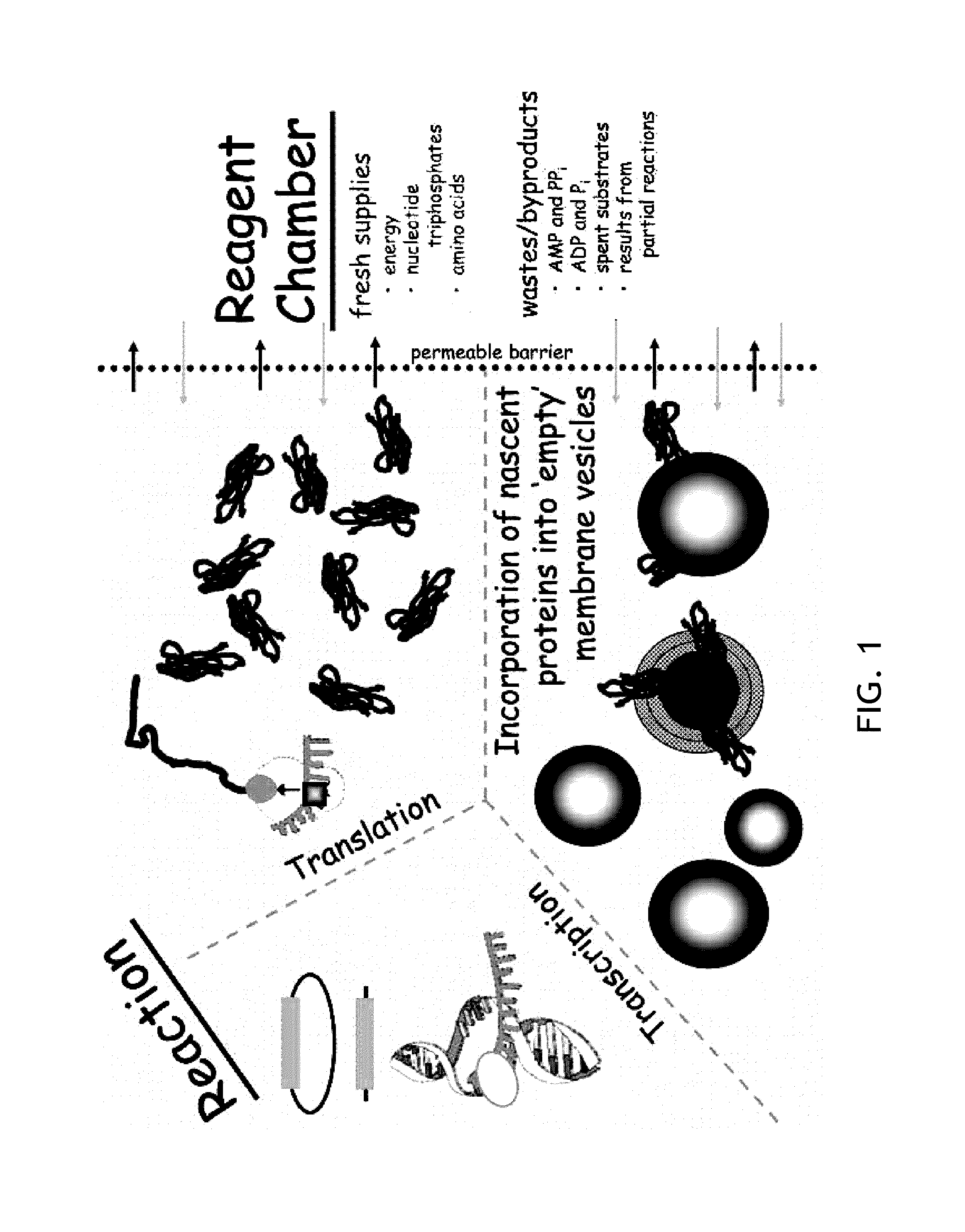
[0121]The following is an exemplary cell-free expression system based upon extracts of Rhodobacter cells used in in vitro synthesis of selected membrane proteins. Transcription / translation-competent extracts are prepared according to methods described below. Briefly, cells grown semi-aerobically were harvested, resuspended in a buffer solution [10 mM Tris-acetate, pH 8.2, 60 mM potassium acetate, 15 mM magnesium acetate, 1 mM dithiothreitol], and lysed by two passages through a French pressure cell at 12,000 psi. The lysate was then centrifuged for 30 minutes at 30,000×g. Details of such preparation are also found in Chory, J., and Kaplan, S. (1982) The in vitro transcription-translation of DNA and RNA templates by extracts of Rhodopseudomonas sphaeroides. Optimization and comparison of template specificity with Escherichia coli extracts and in vivo synthesis. J Biol Chem 257, 15110-21. Troschel, D., and Muller, M. (1990) Development of a cell-free system to study the membrane assem...

the structure of the environmentally friendly knitted fabric provided by the present invention; figure 2 Flow chart of the yarn wrapping machine for environmentally friendly knitted fabrics and storage devices; image 3 Is the parameter map of the yarn covering machine
Login to View More

PUM

PropertyMeasurementUnit
pHaaaaaaaaaa
OD 680aaaaaaaaaa
pHaaaaaaaaaa
Login to View More

Abstract

The invention provides an in vitro method for producing proteins, membrane proteins, membrane-associated proteins, and soluble proteins that interact with membrane-associated proteins for assembly into an oligomeric complex or that require association with a membrane for proper folding. The method comprises, supplying intracytoplasmic membranes from organisms; modifying protein composition of intracytoplasmic membranes from organism by modifying DNA to delete genes encoding functions of the organism not associated with the formation of the intracytoplasmic membranes; generating appropriate DNA or RNA templates that encode the target protein; and mixing the intracytoplasmic membranes with the template and a transcription / translation-competent cellular extract to cause simultaneous production of the membrane proteins and encapsulation of the membrane proteins within the intracytoplasmic membranes.

Description

PRIORITY CLAIM[0001]This utility application claims the benefit of U.S. Provisional Patent Application No. 61 / 150,436, filed on Feb. 6, 2009.CONTRACTUAL ORIGIN OF THE INVENTION[0002]The U.S. Government has rights in this invention pursuant to Contract No. AC02-06CH11357 between the U.S. Department of Energy and UChicago Argonne, LLC.BACKGROUND OF THE INVENTION[0003]1. Field of the Invention[0004]This invention relates to a system and method for producing proteins, and more particularly this invention relates to a cell-free system and cell-free method for producing and maintaining heterologous membrane proteins in their native forms.[0005]2. Background of the Invention[0006]The cell membrane serves as the interface between an organism and its environment, and internal membranes in eukaryotic organisms separate functional compartments within cells. Proteins inserted in these membranes carry out the essential functions of the cell: biological processes such as uptake of nutrients, excr...

Claims

the structure of the environmentally friendly knitted fabric provided by the present invention; figure 2 Flow chart of the yarn wrapping machine for environmentally friendly knitted fabrics and storage devices; image 3 Is the parameter map of the yarn covering machine
Login to View More

Application Information

Patent Timeline
no application Login to View More
Patent Type & Authority Patents(United States)
IPC IPC(8): C12N9/10
CPCC07K14/245C12P21/02
Inventor LAIBLE, PHILIP D.HANSON, DEBORAH K.
Owner UCHICAGO ARGONNE LLC
Features
  • R&D
  • Intellectual Property
  • Life Sciences
  • Materials
  • Tech Scout
Why Patsnap Eureka
  • Unparalleled Data Quality
  • Higher Quality Content
  • 60% Fewer Hallucinations
Social media
Patsnap Eureka Blog
Learn More