[0008]The inventors have repeatedly found that the providing of symbol sequences acoustically to biologically active zones improves various conditions associated with their bodies and the bodies of several others. They have experimented with a music player using a prototype wearable infrastructure and a symbol sequence to aid a weak organ in the other inventor, which has proven beneficial to that individual. While these experiences and experiments were not setup or recorded to provide medical proofs of the effectiveness of the invention, they do constitute an actual reduction to practice of the invention. Those reading this document are reminded that by law, these statements by the inventors are an affidavit submitted to the United State Patent and Trademark Office regarding the patentability of the invention.
[0009]The delivery of the symbol sequence to the at least one transponder may include at least one wire line physical transport and / or at least one wireless physical transport. The wire line physical transport may use commonly available headphones coupled by wires to a headphone jack, with the headphones acting as the transponders. Alternatively, the transponder(s) may couple with the music / multimedia player through a wireless physical transport, which may support a version of a wireless communications protocol. By way of example, the wireless communications protocol may implement a version of the Bluetooth communications protocol standard.
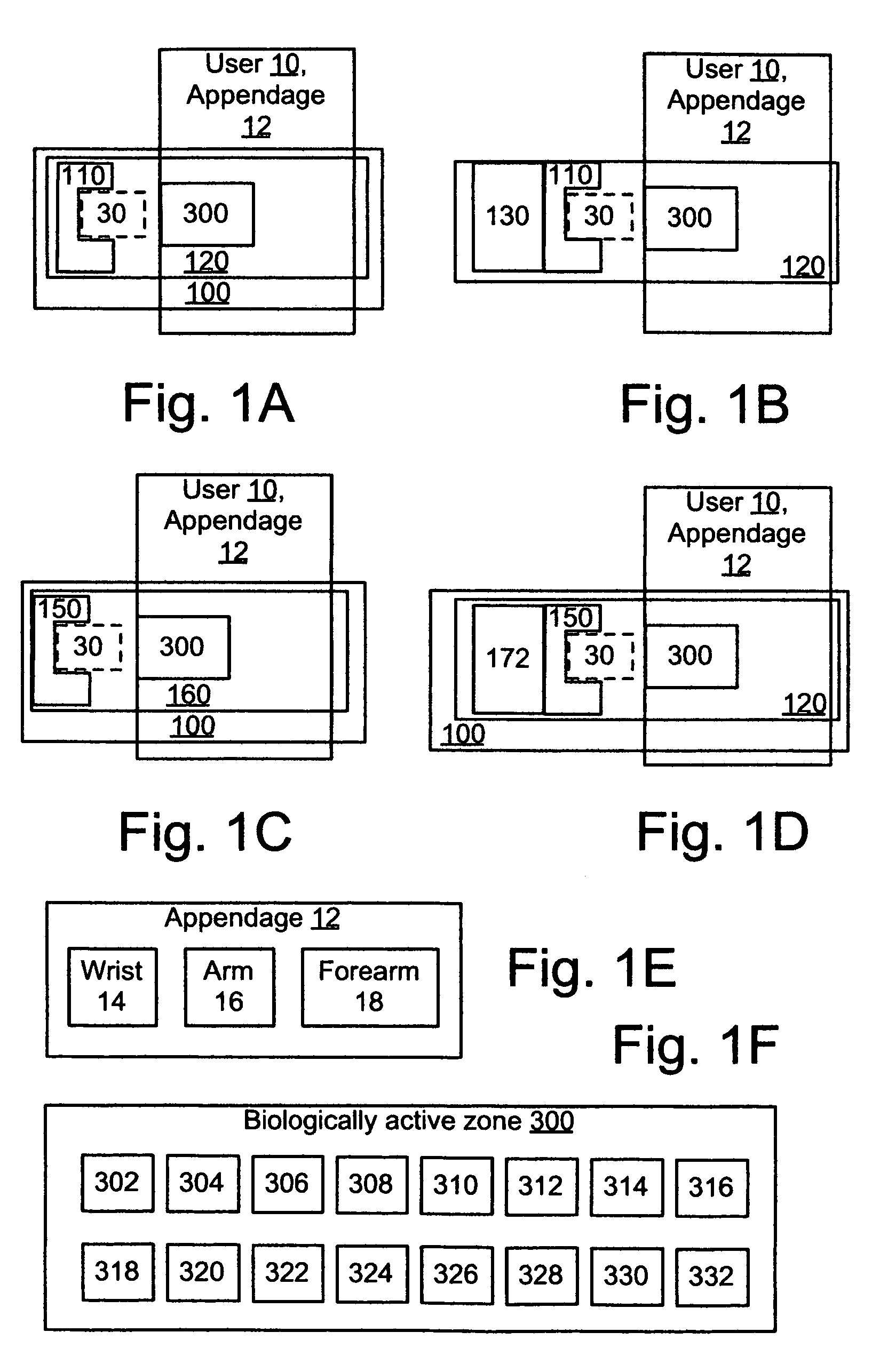
[0010]The wearable infrastructure couples with at least one transponder to provide at least one symbol sequence to the at least one biologically active zone, where the wearable infrastructure keeps the transponder near the biologically active zone on a user wearing the wearable infrastructure. The transponder provides the symbol sequence to the biologically active zone through an acoustic carrier medium as sound to the user, who is a human being.
[0011]The symbol sequence includes a succession of at least two, and preferably at least three symbols. This provides the signal, which is modulated for the carrier medium and provided at the biologically active zone. The symbols are formed of the spoken letters of Song Park's meta-alphabet as disclosed on and incorporated herein from pages 12 and 13 of the provisional application No. 60 / 605,278 filed Aug. 26, 2004 as FIG. 12C. As stated in the provisional application, the alphabet includes all combinations of consonants followed by vowels and vowels followed by consonants. The same combination of vowel+consonant has a different effect that consonant+vowel. Each alphabet syllable has two articulations, inhaling and exhaling, which have different effects. When syllable starts with consonant, it releases corresponding elemental energy and directs it depending on the vowel, creating a particular action. KA activates, directing energy upward. KU passives, directs energy downward, absorbs. When syllable starts with vowel, the energy is lead toward the organ or system. KA releases energy form organ, AK leads toward organ. The inventor's research indicates that this alphabet is a strict superset of Russian, Korean, Sanscrit, Tibetan, Japanese, the major languages of China, French, Spanish, Italian, German, Greek, English, Farsi, Hebrew, Arabic, Navaho.
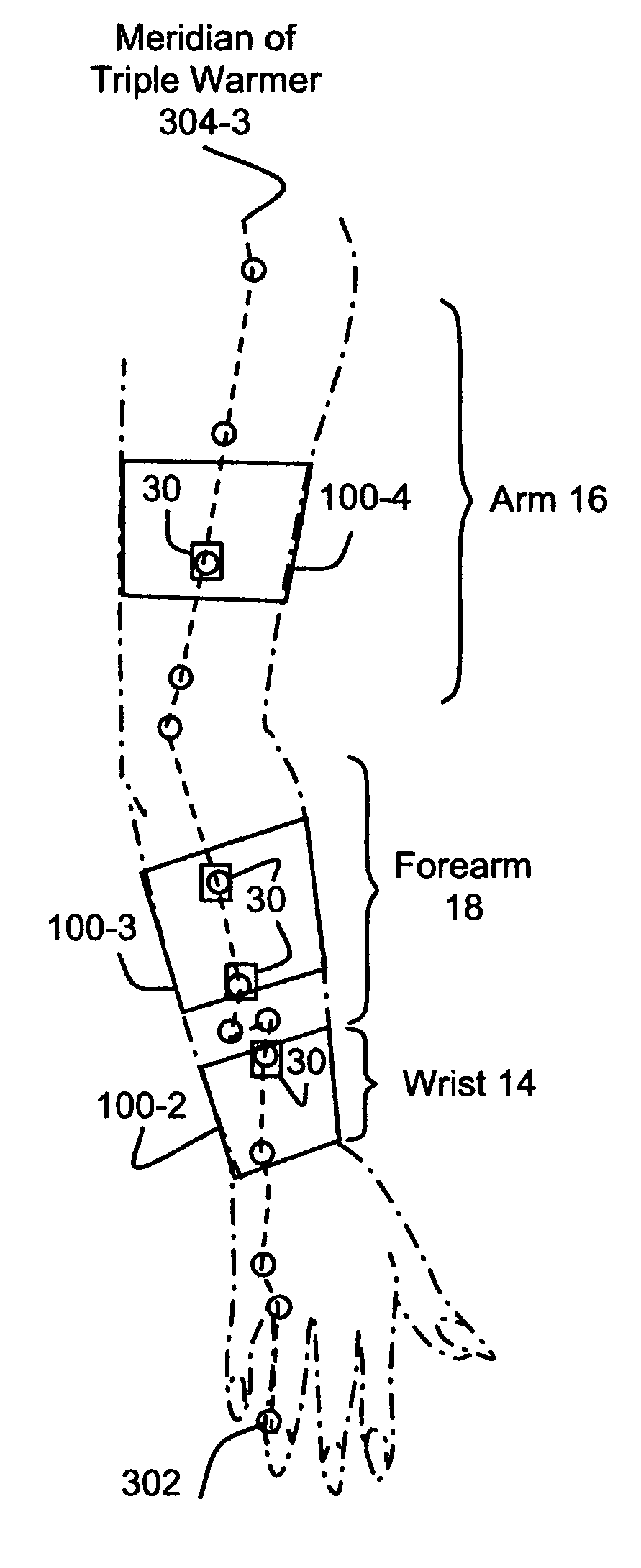
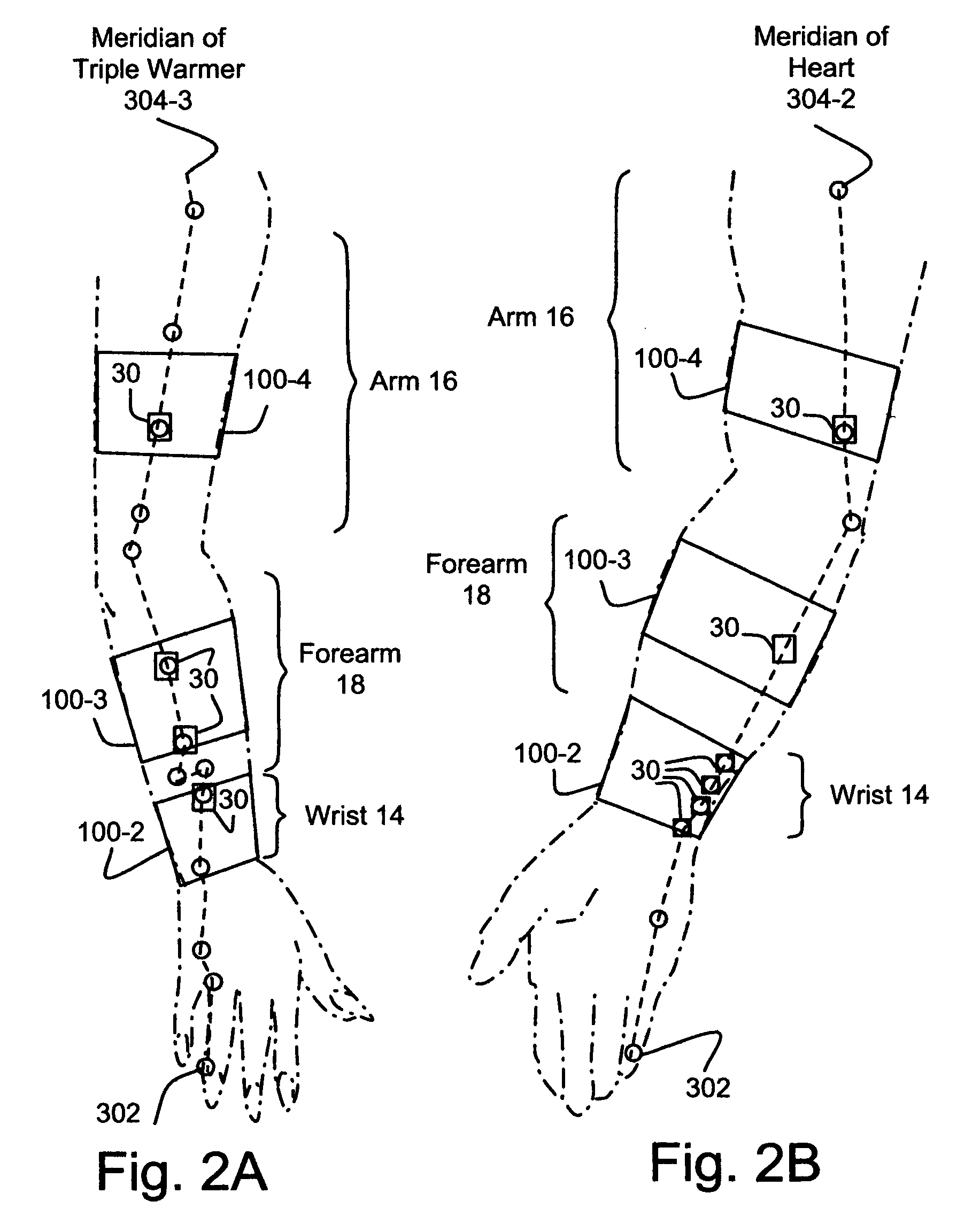
[0012]The wearable infrastructure preferably includes at least one of the following wearable infrastructure components: a wrist harness similar to a bracelet or wrist band, a forearm harness similar to a forearm wrap or binding, and an arm harness similar to an arm band.
[0013]In general, the biologically active zone includes at least one of the following. At least one point and / or meridian as defined in acupuncture, acupressure and / or shiatsu. The minimal scope of these meridians are defined in Chapter Four, “The Meridians: . . . ” pages 77 to 114, in The Web That Has No Weaver: Understanding Chinese Medicine, by Ted Kaptchuk © 1983, ISBN 0-8092-2933-1. A reflexology correspondence point. A pressure point as used in Karate, Tai Chi and Tai Kwan Do. The regions and points named and used in Tibetan medicine, as shown in Tibetan Medical Paintings: Illustrations to the Blue Beryl treatise of Sangye Gyamtso (1653-1705), © 1992 Serinda Publications, ISBN 0-8109-3861-8, two volumes. The regions and points named and used in Western Medicine, including but not limited to the named points and regions of the respiratory, muscular, arterial, fascial, and nervous system as shown in Gray's Anatomy.



 Login to View More
  Login to View More