

Display device with gray scale data correction
a technology of gray scale data and display device, which is applied in the field of display device, can solve the problems of reducing the contrast of images of certain types, difficulty in viewing images by viewers, etc., and achieves the effect of reducing crosstalk and minimizing the reduction of image contras
- Summary
- Abstract
- Description
- Claims
- Application Information
AI Technical Summary
Benefits of technology
Problems solved by technology
Method used
Image

Examples
first embodiment
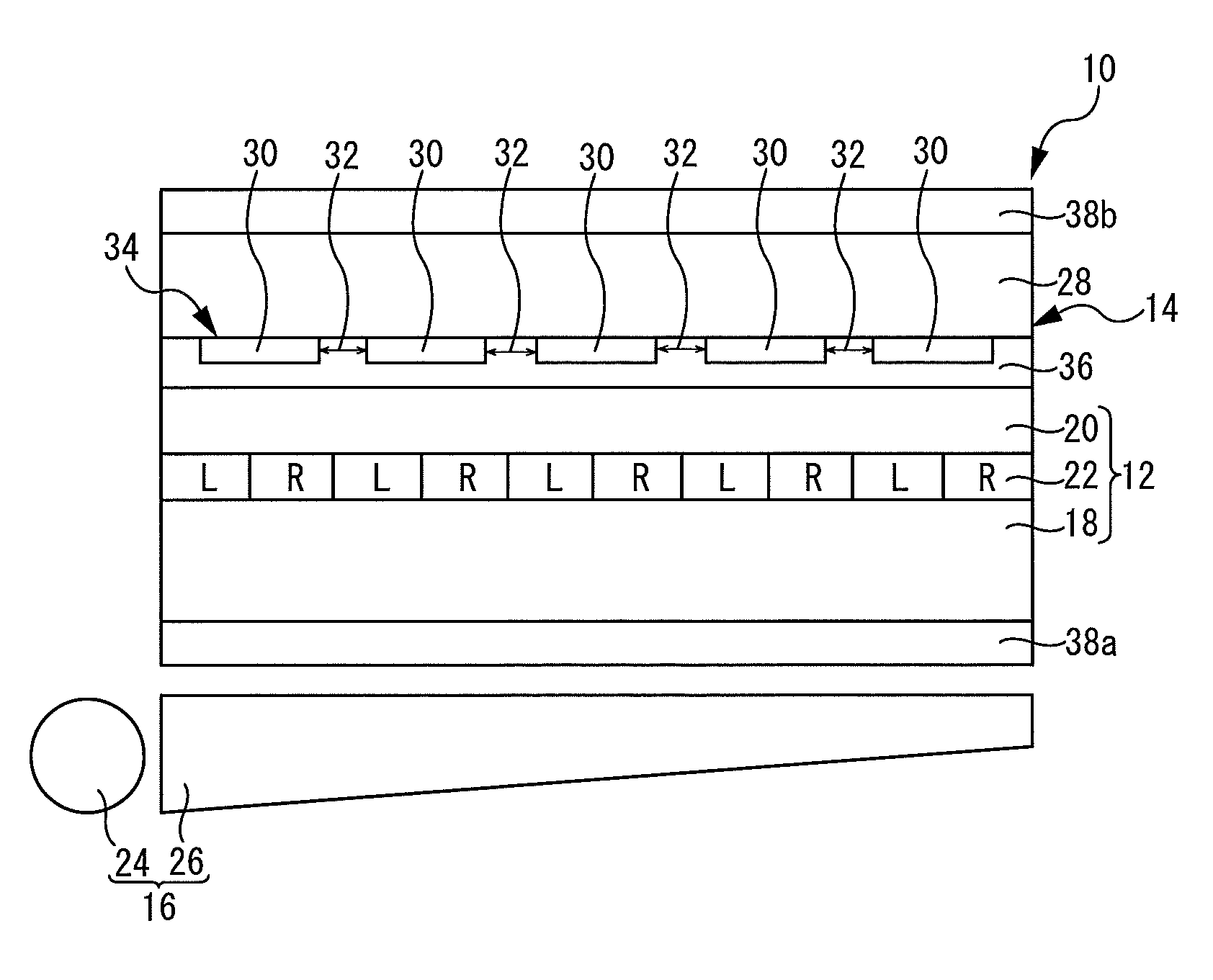
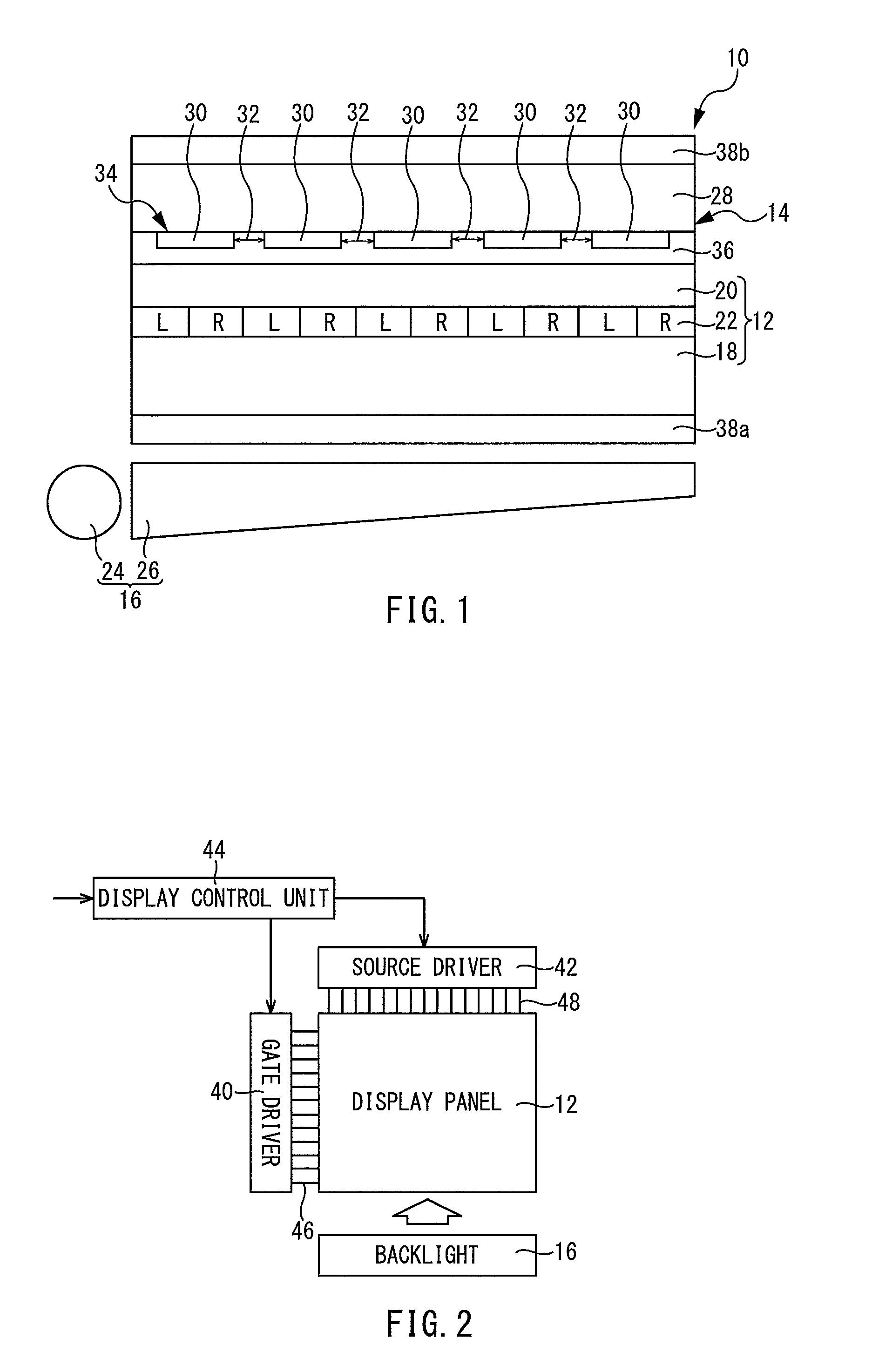
[0052]FIG. 1 shows a display device 10 of a first embodiment of the present invention. The display device 10 includes a display panel 12, a barrier unit 14 and a backlight 16.
[0053]The display panel 12 is a liquid crystal panel. Briefly, the display panel 12 includes an active-matrix substrate 18 having a plurality of pixel electrodes arranged in a matrix, a counter substrate 20 having a common electrode formed thereon, and a liquid crystal layer 22 enclosed between the active-matrix substrate 18 and counter substrate 20. Pixels that include the pixel electrodes are formed. The region where a plurality of pixels are arranged in a matrix constitutes the display region of the display panel 12. In the present embodiment, as shown in FIG. 1, rows of pixels R for displaying right eye images and rows of pixels L for displaying left eye images are arranged in an alternating manner.
[0054]In other words, in the present embodiment, right eye images and left eye images are divided into stripes...
application example 1 of first embodiment
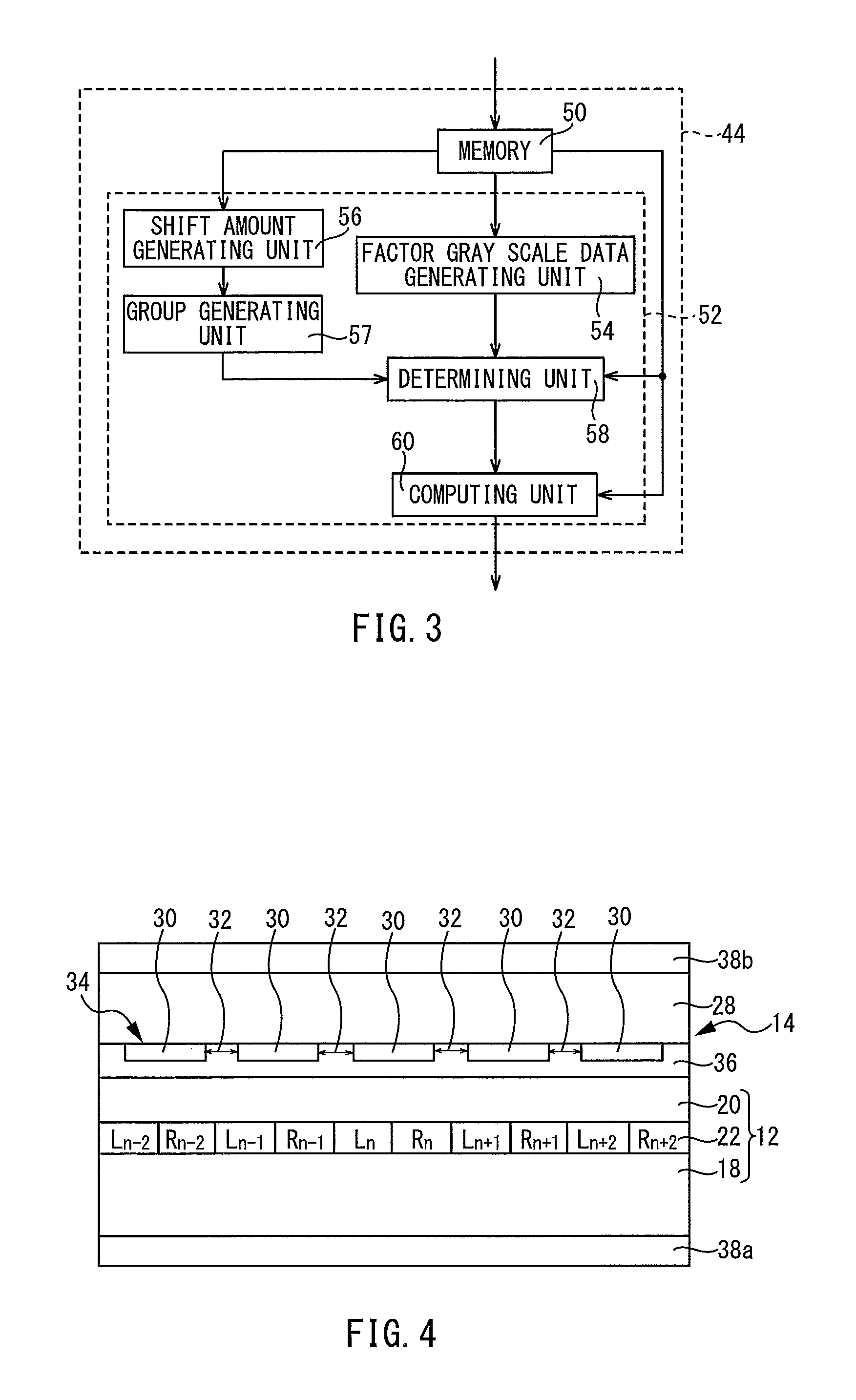
[0134]In the present application example, the factor gray scale data I′RN used to correct crosstalk for the pixel Ln shown in FIG. 4 may be calculated by the following Equation (21):
I′Rn=An-1×IRn−1+An×IRn (21),
where An-1 is the rate of contribution of the pixel Rn-1 to crosstalk. An is the rate of contribution of the pixel Rn to crosstalk. An-1 and An are in the range from 0 to 1.
[0135]An-1 and An vary for each display device depending on, for example, the distance between two adjacent light-shielding layers 30 in the parallax barrier 34, the shape of the light-shielding layers 30, the material of the light-shielding layers 30, the locations of the light-shielding layers 30, the width of the light-shielding layers 30, the thickness of the light-shielding layers 30, and the positional relationship between the light-shielding layers 30 and the pixels R and L. An-1 and An may be obtained by measurements for each display device. These values may be obtained by, for example, measuring t...
application example 2 of first embodiment
[0138]In the present application example, the barrier unit 14 is replaced by a lenticular lens 72 that serves as the separating unit, as shown in FIG. 7. The lenticular lens 72 includes a plurality of cylindrical lenses 74 aligned with rows of pixels R and rows of pixels L arranged in an alternating manner. The lenticular lens 72 is attached to the polarizer 38b adjacent the counter substrate 20 such that each cylindrical lens 74 corresponds to a row of pixels R or L. In the present application example, the polarizer 38b located adjacent the counter substrate 20 is attached to the counter substrate 20.
PUM
 Login to View More
 Abstract
Description
Claims
Application Information
 Login to View More