Check patentability & draft patents in minutes with Patsnap Eureka AI!

Image-based feature detection using edge vectors

Active Publication Date: 2018-01-02
NANT HLDG IP LLC
View PDF16 Cites 8 Cited by
  • Summary
  • Abstract
  • Description
  • Claims
  • Application Information

AI Technical Summary

Benefits of technology

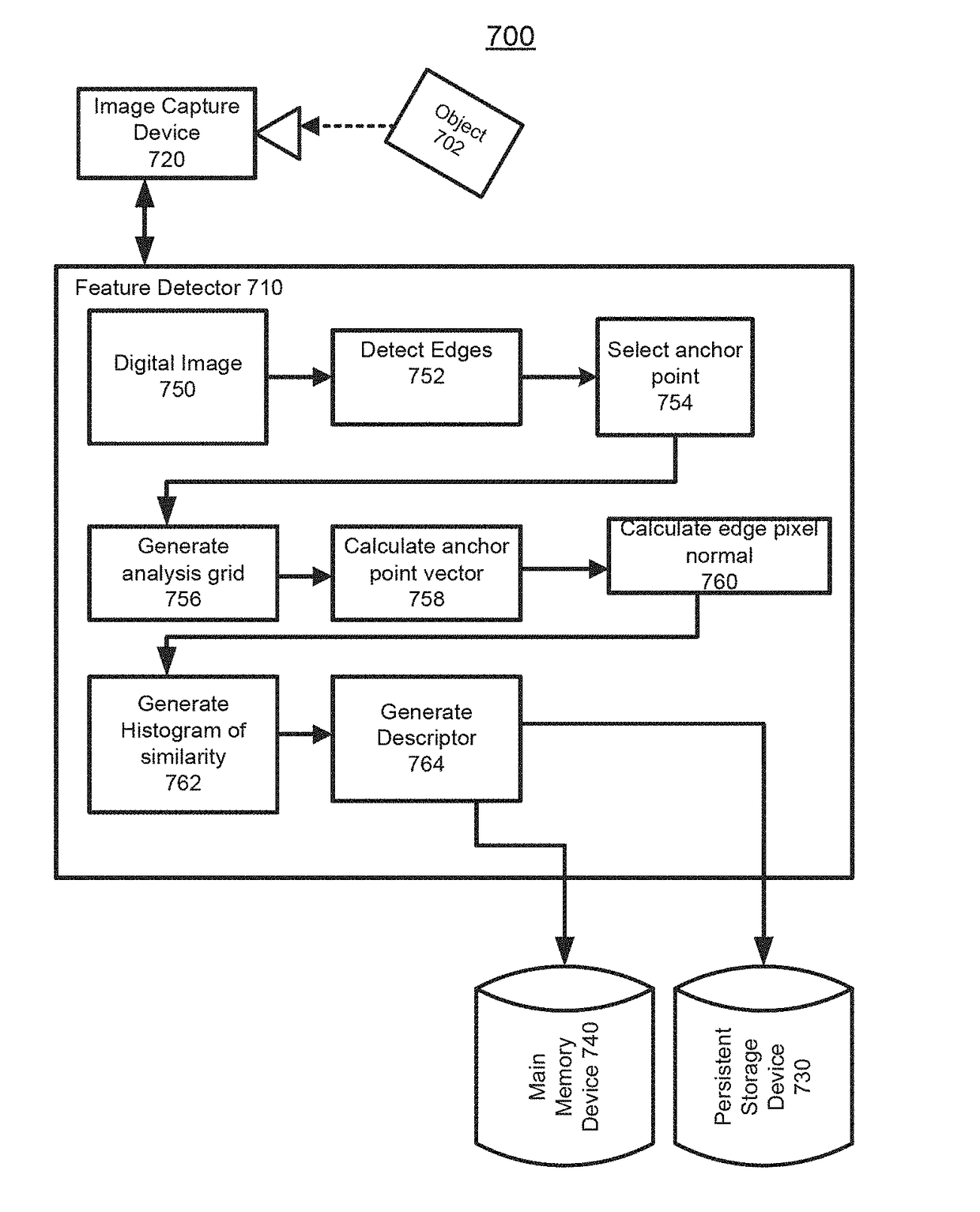
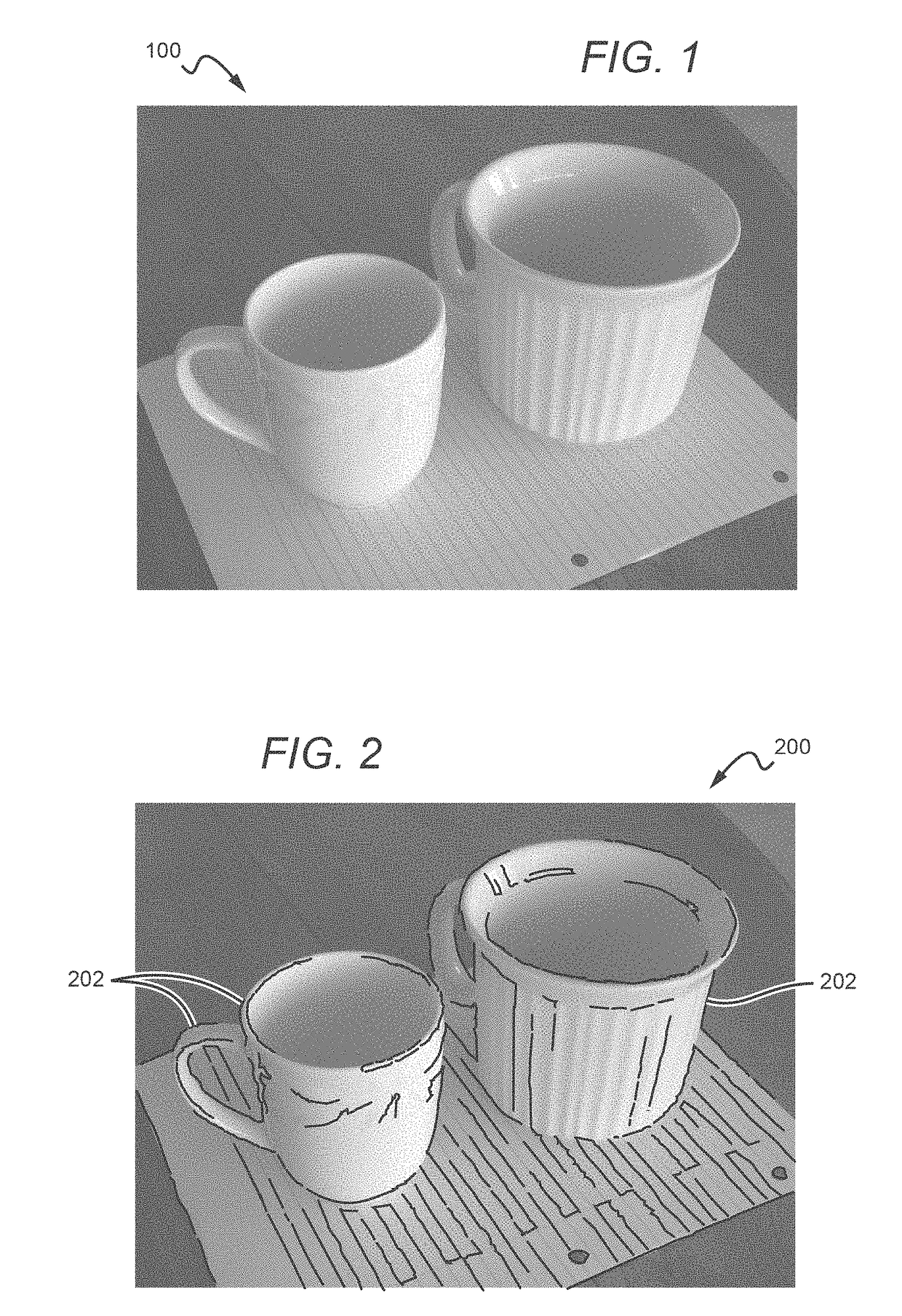
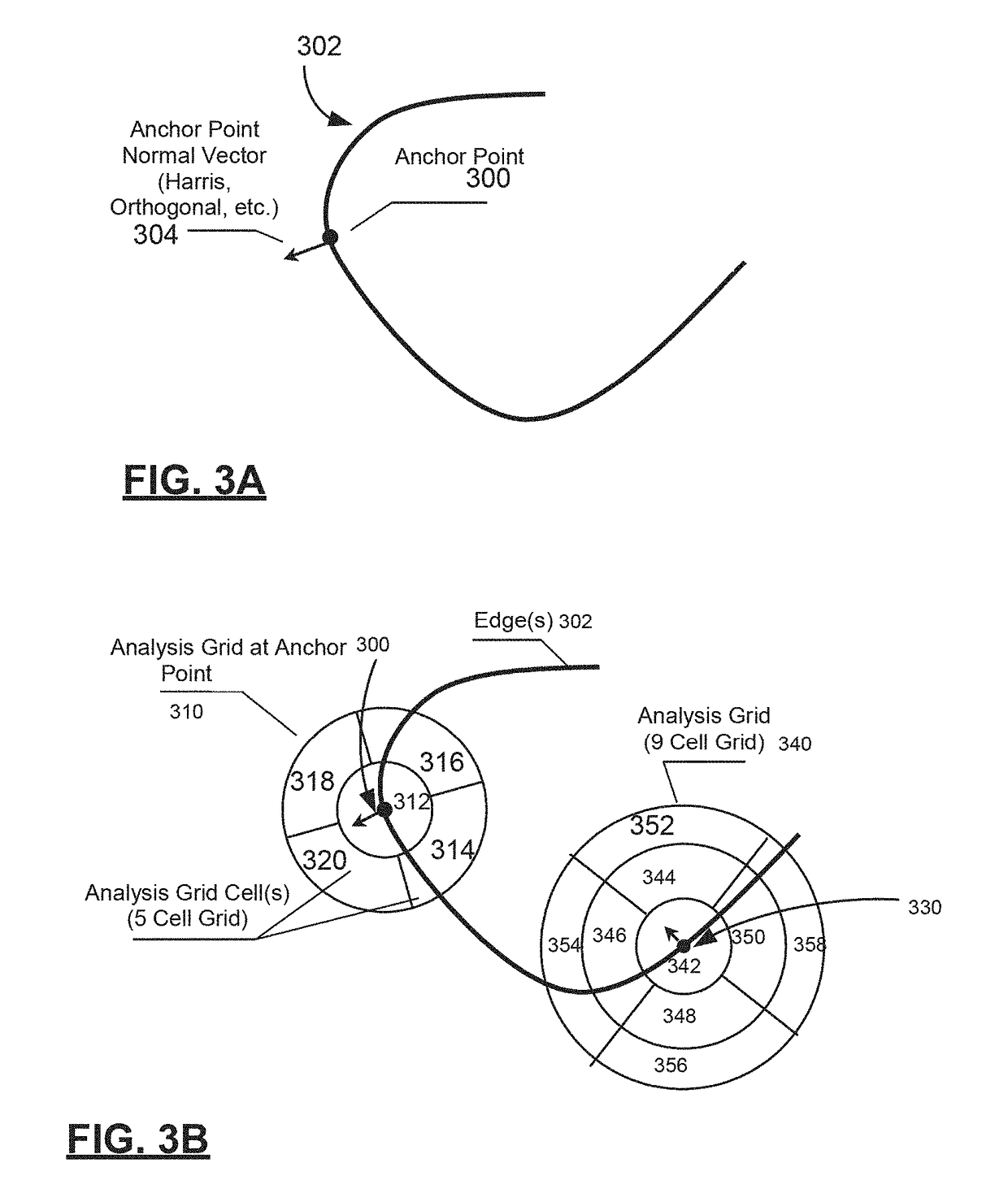
The patent describes a method for recognizing objects in images. The technology works by detecting the edges of objects and using those edges to create a descriptor that can be used for object recognition. This descriptor can be used for both texture-rich and texture-poor objects. The process involves identifying a plurality of edges in the image, selecting an anchor point on one of the edges, and creating an analysis grid around the anchor point. The analysis grid includes a set of cells that share a similarity with the anchor point. This descriptor can then be used for image-based object recognition. The invention aims to improve the efficiency and accuracy of object recognition in images.

Problems solved by technology

Many image recognition technologies have difficulty differentiating between texture-rich objects (e.g., an action figure toy or brick walls) and texture-poor objects (e.g., a solid-color field logo, metal slabs or sheets of glass) in a single image.
For example, edge feature gradients can change substantially, e.g., from one video frame to another, such that absolute information (e.g., information obtained at only one point along the edge) may fail to account for relative information, e.g., information regarding a relationship between one part of an edge and another part of the edge.

Method used

the structure of the environmentally friendly knitted fabric provided by the present invention; figure 2 Flow chart of the yarn wrapping machine for environmentally friendly knitted fabrics and storage devices; image 3 Is the parameter map of the yarn covering machine
View more

Image

Smart Image Click on the blue labels to locate them in the text.
Viewing Examples
Smart Image
  • Image-based feature detection using edge vectors
  • Image-based feature detection using edge vectors
  • Image-based feature detection using edge vectors

Examples

Experimental program
Comparison scheme
Effect test

Embodiment Construction

[0036]The various embodiments now will be described more fully hereinafter with reference to the accompanying drawings, which form a part hereof, and which show, by way of illustration, specific examples of practicing the embodiments. This specification may, however, be embodied in many different forms and should not be construed as limited to the embodiments set forth herein; rather, these embodiments are provided so that this specification will be thorough and complete, and will fully convey the scope of the invention to those skilled in the art. Among other things, this specification may be embodied as methods or devices. Accordingly, any of the various embodiments herein may take the form of an entirely hardware embodiment, an entirely software embodiment or an embodiment combining software and hardware aspects. The following specification is, therefore, not to be taken in a limiting sense.

[0037]Throughout the specification and claims, the following terms take the meanings expli...

the structure of the environmentally friendly knitted fabric provided by the present invention; figure 2 Flow chart of the yarn wrapping machine for environmentally friendly knitted fabrics and storage devices; image 3 Is the parameter map of the yarn covering machine
Login to View More

PUM

No PUM Login to View More

Abstract

Techniques are provided in which a plurality of edges are detected within a digital image. An anchor point located along an edge of the plurality of edges is selected. An analysis grid associated with the anchor point is generated, the analysis grid including a plurality of cells. An anchor point normal vector comprising a normal vector of the edge at the anchor point is calculated. Edge pixel normal vectors comprising normal vectors of the edge at locations along the edge within the cells of the analysis grid are calculated. A histogram of similarity is generated for each of one or more cells of the analysis grid, each histogram of similarity being based on a similarity measure between each of the edge pixel normal vectors within a cell and the anchor point normal vector, and a descriptor is generated for the analysis grid based on the histograms of similarity.

Description

CROSS REFERENCE TO RELATED APPLICATIONS[0001]This application is a continuation of U.S. application Ser. No. 15 / 199,267 filed on Jun. 30, 2016, which is a continuation of U.S. application Ser. No. 14 / 705,866 filed on May 6, 2015; and claims the benefit of U.S. Provisional Application No. 61 / 989,445 filed May 6, 2014. These and all other extrinsic materials discussed herein are hereby incorporated herein by reference in their entirety. Where a definition or use of a term in an incorporated reference is inconsistent or contrary to the definition of that term provided herein, the definition of that term provided herein applies and the definition of that term in the reference does not apply.TECHNICAL FIELD[0002]This disclosure relates generally to image-based object recognition, and more specifically to feature identification techniques for image-based object recognition.BACKGROUND[0003]Various feature detection algorithms are used for image-based object recognition. At the most basic l...

Claims

the structure of the environmentally friendly knitted fabric provided by the present invention; figure 2 Flow chart of the yarn wrapping machine for environmentally friendly knitted fabrics and storage devices; image 3 Is the parameter map of the yarn covering machine
Login to View More

Application Information

Patent Timeline
no application Login to View More
IPC IPC(8): G06K9/00G06K9/46G06T7/246G06T5/40G06F17/30G06T7/181G06T7/143G06T7/13G06T3/40G06K9/48G06K9/62G06V10/44G06V10/46
CPCG06K9/481G06F17/30256G06K9/00201G06K9/4604G06K9/4671G06K9/48G06K9/6212G06K9/6214G06K9/6215G06T3/40G06T3/403G06T5/40G06T7/13G06T7/143G06T7/181G06T7/248G06F17/3028G06T2207/30004G06T2207/10004G06T2207/10016G06T2207/10028G06T2207/10116G06T2207/20076G06T2207/20164G06F16/51G06F16/5838G06V10/462G06V10/44G06V10/46G06V10/758G06V20/64G06F18/22
Inventor SONG, BINGWITCHEY, NICHOLAS J.
Owner NANT HLDG IP LLC
Features
  • R&D
  • Intellectual Property
  • Life Sciences
  • Materials
  • Tech Scout
Why Patsnap Eureka
  • Unparalleled Data Quality
  • Higher Quality Content
  • 60% Fewer Hallucinations
Social media
Patsnap Eureka Blog
Learn More