
Method for producing blattella germanica allergen Bla g 7 protein in bacilliform virus-insect expression system
A German cockroach and insect expression technology, applied in the field of genetic engineering, can solve the problem of no baculovirus-insect system expression, and achieve the effect of solving the complicated purification process
- Summary
- Abstract
- Description
- Claims
- Application Information
AI Technical Summary
Problems solved by technology
Method used
Image

Examples
Embodiment 1
[0020] Example 1: Extraction of total RNA of Blattella germanica.
[0021] Take artificially raised frozen German cockroaches (from Jiangsu Provincial Center for Disease Control), grind with liquid nitrogen, and add Trizol reagent at 100 mg / mL Trizol reagent. Total RNA was extracted from Blattella germanica.
Embodiment 2
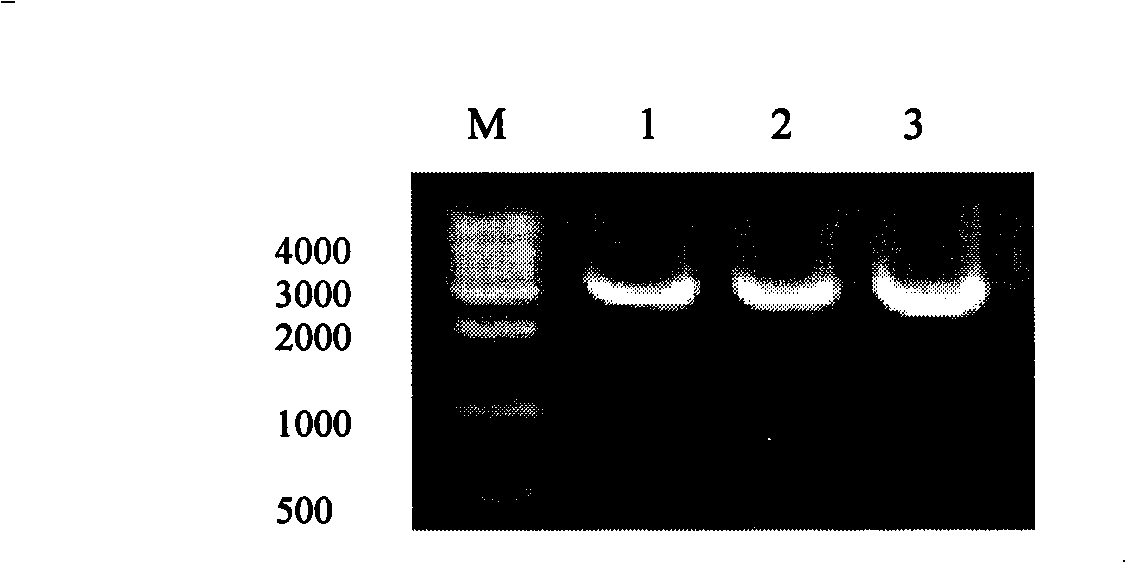
[0022] Example 2: The gene of the allergen Bla g 7 of the German cockroach was amplified by PCR and cloned.
[0023]The extracted total RNA was reverse transcribed into cDNA. Primers were designed according to the published Bla g 7 gene sequence of the German cockroach allergen: 5'-ATGGATGCCATCAAGAAGATG-3' and 5'-TTAGTTGCCAATAAGTTCGGT-3', using the PCR method (after 10 minutes of pre-denaturation at 94°C, 94°C for 30 seconds, 55°C for 45 seconds, 72°C for 1 minute, a total of 35 cycles), the Bla g 7 gene was amplified, cloned into the pMD18-T vector, and transformed into Escherichia coli JM109 competent cells. Plate overnight. Positive bacteria were screened, plasmids were extracted and identified by PCR and sequencing. The German cockroach allergen Bla g 7 gene was obtained, the nucleotide sequence of which is shown in SEQ ID No:1.
Embodiment 3
[0024] Example 3: Construction of the allergen Bla g 7 baculovirus vector pFastBacHTA of Blattella germanica.
[0025] The obtained Bla g 7 gene was cloned into the plasmid pFastBacHTA through EcoR I and Sal I restriction sites, and transformed into competent JM109. Positive clones were screened out.
PUM
 Login to View More
 Abstract
Description
Claims
Application Information
 Login to View More