

Control system and process for wastewater treatment
A waste water treatment and fluid technology, applied in water treatment parameter control, water/sewage treatment, chemical instruments and methods, etc., can solve the problems of large system, time delay, not receiving mixing time and mixing energy, etc.
- Summary
- Abstract
- Description
- Claims
- Application Information
AI Technical Summary
Problems solved by technology
Method used
Image

Examples
Embodiment Construction
[0029] DETAILED DESCRIPTION OF THE PREFERRED EMBODIMENT
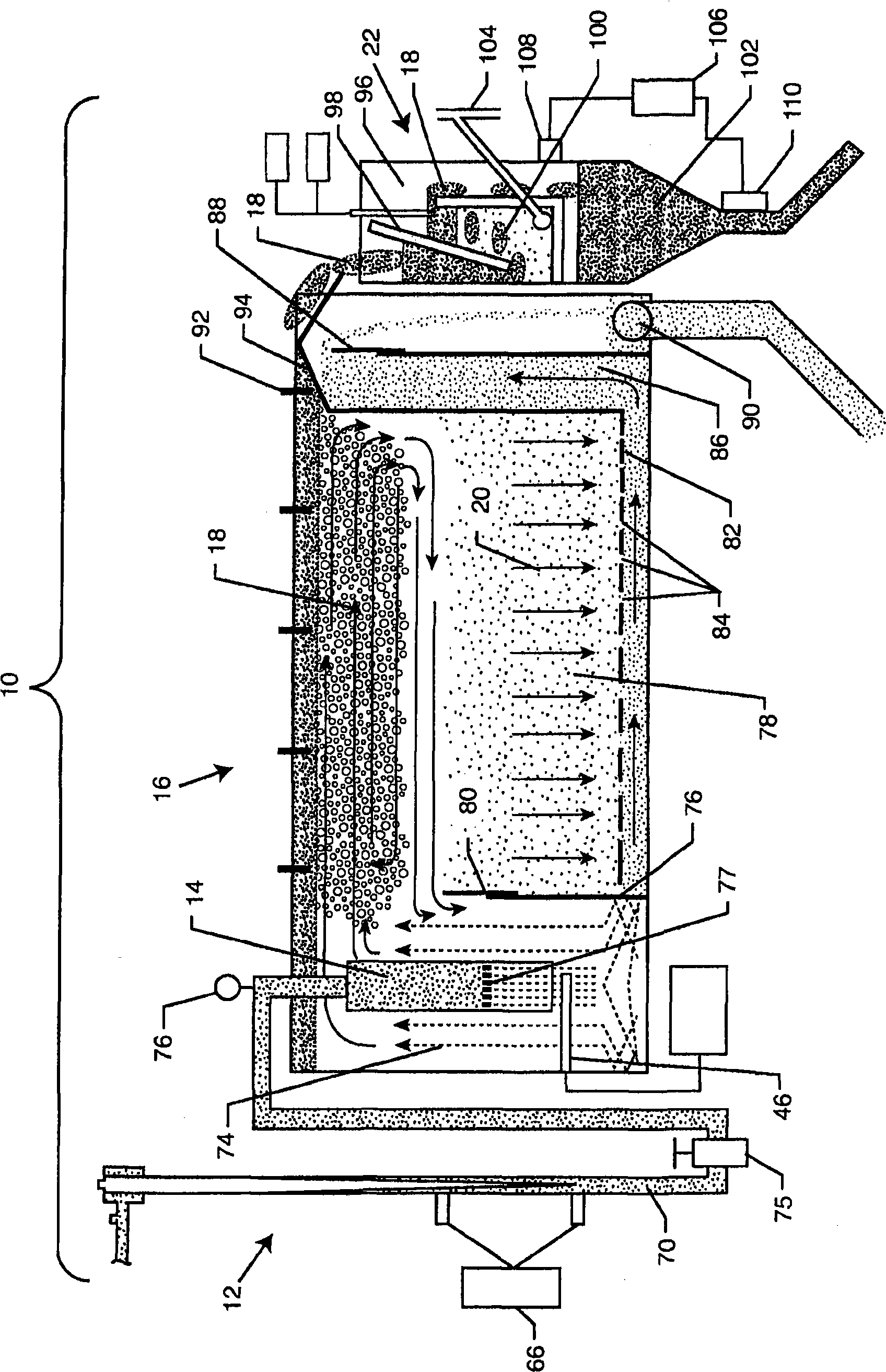
[0030] [Paragraph 29] This disclosure of wastewater treatment control systems and methods is generally referred to by reference numeral 10, as shown in the exemplary drawings for purposes of illustration. Turning now to the representative drawings in the specification, figure 1 A wastewater treatment control system 10 is shown having a mixer 12 fluidly coupled to a nucleation chamber 14 disposed within a flotation cell 16 . The mixer 12, which will be described in more detail herein, is specifically designed to mix chemical additives, gases etc. into the contaminated liquid. The gas is entrained in the liquid at a small size to adhere to the solid particles and flocculants. Thereafter, as the liquid passes through the nucleation chamber 14 , the bubble size increases and lifts the float and solid contaminants towards the surface of the flotation cell 16 . Eventually, the floating particles form a sludge or scum 18 whil...
PUM
 Login to View More
 Abstract
Description
Claims
Application Information
 Login to View More