RF (radio frequency) receiving front end with diversified gaining modes and capable of automatic tuning

A technology of radio frequency reception and automatic tuning, which is applied in the direction of multi-frequency modulation conversion, amplification control, and control of components of the amplification device, etc., which can solve the problem that the switch cannot be effectively turned off, the performance of the filter is affected, and the total capacitance value of the capacitor array is not stable. Accuracy and other issues

CN101753159AActive Publication Date: 2010-06-23TSINGHUA UNIV
2 Cites 27 Cited by

Patent Information

Authority / Receiving Office
CN · China
Current Assignee / Owner
Publication Date
2010-06-23

Smart Images

  • Figure 1
    Figure 1
  • Figure 2
    Figure 2
  • Figure 3
    Figure 3
Patent Text Reader

Abstract

The invention discloses an RF (radio frequency) receiving front end with diversified gaining modes and capable of automatic tuning. The RF receiving front end comprises a low-noise amplifier, a frequency mixer, a complex filter and a time constant correcting circuit. The input end of the low-noise amplifier is connected with an input signal, and the output end adopts NC (numerical control) resistance as load to correct gains; the differential input ends of the I-path frequency mixer and the Q-path frequency mixer are respectively connected to the output end of the low-noise amplifier, and thedifferential output ends are respectively connected to the differential input end of the complex filter; the complex filter which adopts a multi-stage cascaded structure realizes the diversified gaining modes by the NC resistance, and meanwhile a time constant can realize tuning by controlling a capacitance array; and the output end of the time constant correcting circuit is connected with the correcting control word input end of the complex filter. By combining the current-mode low-noise amplifier, the passive frequency mixer and the active RC complex filter with each other, the RF receivingfront end has the advantages of low noise, high linearity, low power consumption, low cost and the like.
Need to check novelty before this filing date? Find Prior Art

Description

technical field

[0001] The invention relates to the technical field of radio frequency receiving front end, in particular to a radio frequency receiving front end with multiple gain modes and capable of automatic tuning. Background technique

[0002] In radio frequency receivers, many applications often require the received signal to have a large dynamic range, that is, to have small receiving sensitivity, strong anti-large signal saturation capability and high linearity. The noise figure of the receiving front end of the radio frequency receiver directly determines the receiving sensitivity of the receiver, and the gain and structure of the receiving front end determine the receiver's ability to resist large signal saturation and linearity. In the CMOS (Complementary Metal Oxide Semiconductor) process, the resistance and capacitance will deviate with the process and temperature, which will seriously affect the performance of the receiver, especially the receiver using an ac...

Examples

Embodiment Construction

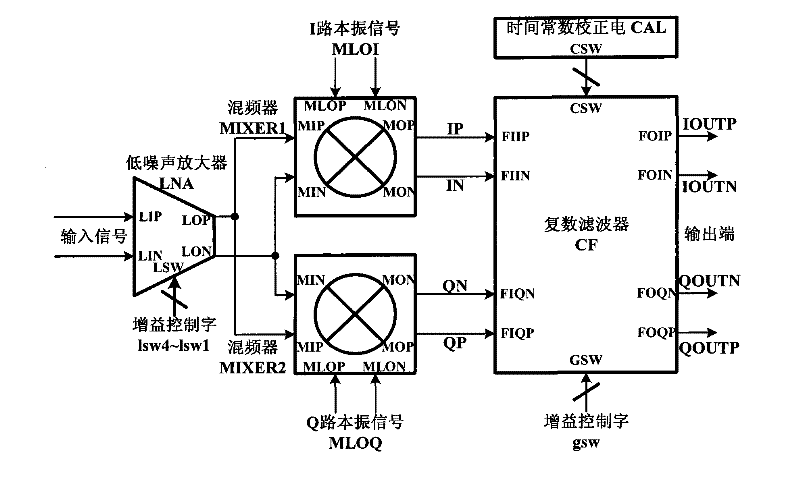
[0051] The specific implementation manners of the present invention will be further described in detail below in conjunction with the accompanying drawings and embodiments. The following examples are used to illustrate the present invention, but are not intended to limit the scope of the present invention.

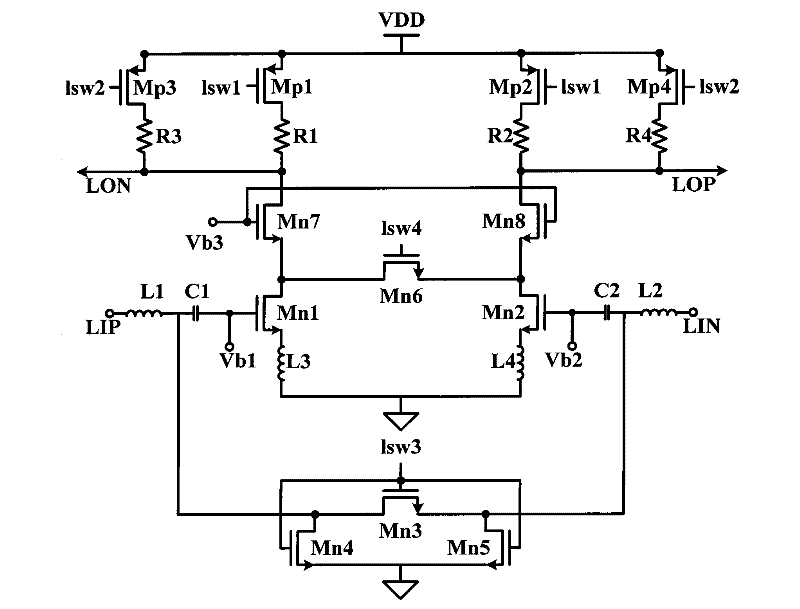
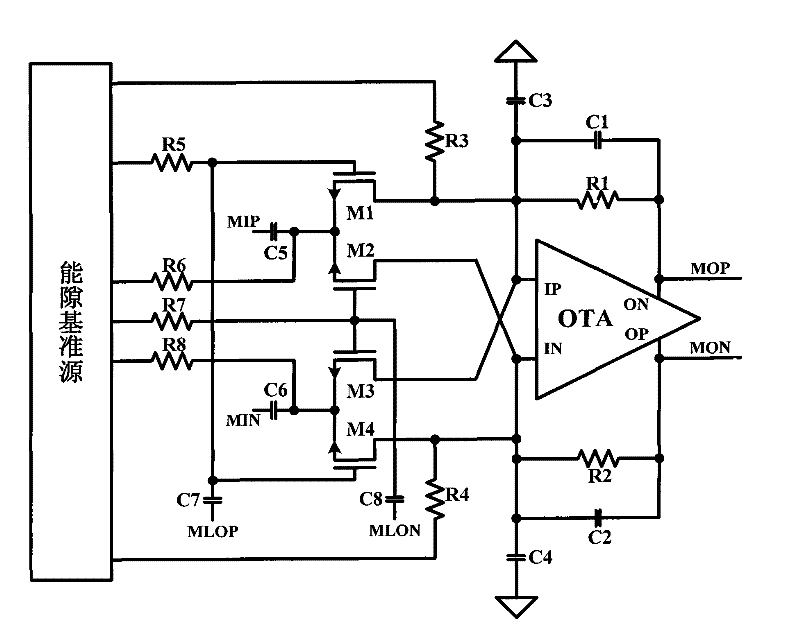
[0052] The block diagram of the radio frequency receiving front-end circuit that has multiple gain modes and can be automatically tuned according to the embodiment of the present invention is as follows figure 1 As shown, the differential input terminals LIP and LIN of the low noise amplifier LNA are connected to the input signal, and the gain control terminal LSW of the low noise amplifier is connected to the gain control words lsw4˜lsw1. The differential input terminals MIP and MIN of the I-channel mixer MIXER1 and the Q-channel mixer MIXER2 are respectively connected to the differential output terminals LOP and LON of the LNA, and the local oscillator signal differentia...