Vitreoscilla hemoglobin vgbS nucleotide sequence and plasmid and preparation method thereof

A technology of nucleotide sequence and Vitiligo hyaline, applied in the field of bioengineering

CN101805742AInactive Publication Date: 2010-08-18SHANGHAI JIAO TONG UNIV
0 Cites 7 Cited by

Patent Information

Authority / Receiving Office
CN · China
Current Assignee / Owner
Publication Date
2010-08-18
Estimated Expiration
Not applicable · inactive patent

Smart Images

  • Figure 1
    Figure 1
  • Figure 2
    Figure 2
  • Figure 3
    Figure 3
Patent Text Reader

Abstract

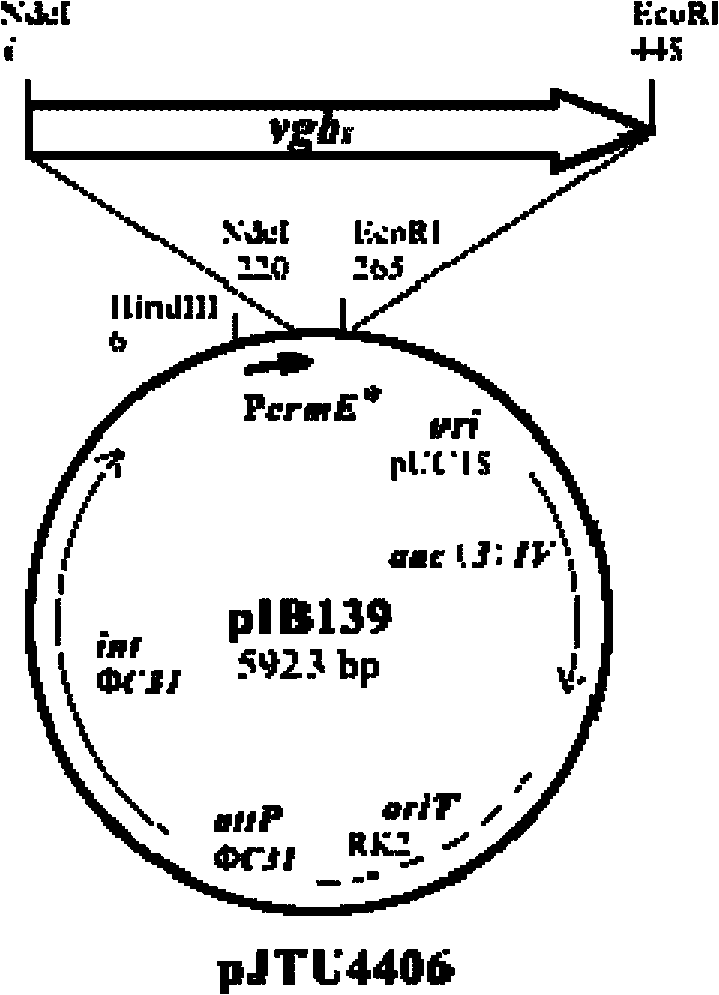
The invention relates to a vitreoscilla hemoglobin vgbS nucleotide sequence and a plasmid and a preparation method thereof, and belongs to the technical field of biological engineering. The vitreoscilla hemoglobin vgbS nucleotide sequence is prepared by introducing restriction enzyme cutting sites of NdeI and EcoRI at both ends of a vgb nucleotide sequence of streptomyces serving as a host cell respectively. In addition, the plasmid pJTU4406 is generated by cutting off the vgbS nucleotide sequence on pJTU4405 through the NdeI and the EcoRI, and inserting the vgbS nucleotide sequence into corresponding sites of a carrier pIB139. An amino acid sequence of protein expressed and generated by the vgbS nucleotide sequence is totally identical to that of the natural vitreoscilla hemoglobin, and the vitreoscilla hemoglobin vgbS nucleotide sequence can improve the utilization efficiency of the streptomyces to oxygen, promote the growth velocity of thalli and improve the yield of antibiotics.
Need to check novelty before this filing date? Find Prior Art

Description

technical field

[0001] The present invention relates to a gene sequence in the technical field of bioengineering, a plasmid thereof and a preparation method thereof, in particular to an artificially synthesized nucleotide sequence of Vitella hyaline hemoglobin vgbS, a plasmid thereof and a preparation method thereof. Background technique

[0002] In large-scale cell culture or high-density fermentation such as fed-batch culture and immobilized cell systems, how to supply oxygen is especially important. Traditional approaches to address this issue generally increase oxygen transfer in the cell growth environment, including: feeding pure oxygen, using an aeration / stirring optimization configuration, and increasing oxygen in the liquid phase by adding chemicals such as n-dodecane or perfluorocarbons solubility. Another way to solve the problem is to use genetic engineering technology to improve the oxygen utilization rate of cells themselves, and the most commonly considered i...

Examples

Embodiment

[0032] Step 1, gene vgb codon modification and total synthesis of new gene vgbS

[0033] According to the usage frequency of codons in the Streptomyces coelicolor genome, the source address of the usage frequency is:

[0034] http: / / www.cbs.dtu.dk / services / GenomeAtlas / show-codon.php?id=1 &segmentid=Scoelicolor_A3_Main Codon Usage in Streptomyces coelicolor strain A3.

[0035] Check each codon in the natural sequence of the gene vgb, change the codon that is not used frequently in Streptomyces to the codon that is used most frequently in Streptomyces, keep the amino acid sequence unchanged, and generate a new gene vgbS. For the convenience of later DNA operations, NdeI and EcoRI restriction sites were introduced at both ends of the gene vgbS, and 7 nucleotides were added to the 5' end of the vgbS nucleotide sequence to form a restriction endonuclease NdeI site Points and protection bases, add 8 nucleotides to the 3' end of the vgbS nucleotide sequence to form a restriction en...