Fast connection establishment method and system after reconstruction of radio resource control connection fails
A technology for radio resource control and connection re-establishment, applied in connection management, wireless communication, access restriction, etc., can solve problems such as affecting user service experience, reducing the speed of RRC re-establishment connection, etc., achieving fast RRC connection establishment, saving cell selection and Random access time, the effect of reducing time consumption
- Summary
- Abstract
- Description
- Claims
- Application Information
AI Technical Summary
Problems solved by technology
Method used
Image


Examples
Embodiment 1
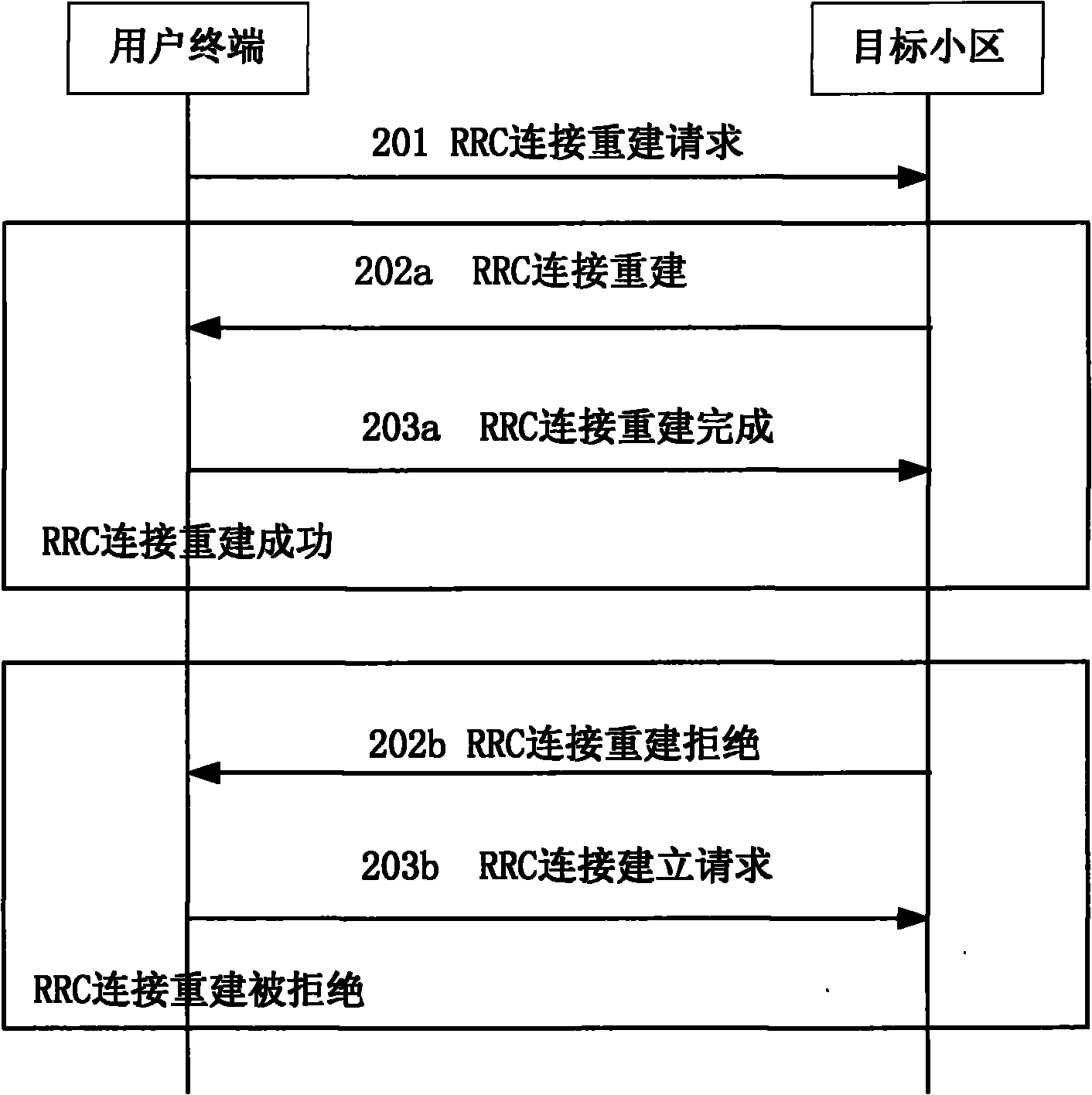
[0057] In Embodiment 1, after the target cell receives the RRC connection re-establishment request, it sends the RRC connection re-establishment rejection signaling to the user terminal, and allocates uplink authorization for the user terminal, and the user terminal maintains the RRC connection state and continues to reside in the target cell , and notify the NAS layer that the RRC connection failed. After receiving the tracking area update request or service request returned by the NAS layer within the system setting time, the RRC connection establishment request is sent to the target cell on the uplink resources corresponding to the uplink authorization, and the target cell Allocating dedicated radio resources for the user terminal, configuring the dedicated radio resources, and notifying the target cell to complete the RRC connection.
[0058] Such as image 3 As shown, in the first embodiment, the method for quickly completing the establishment of the radio resource contro...
Embodiment 2
[0067] The solution of Embodiment 2 is the same as the application scenario of Embodiment 1, but the processing method in Embodiment 1 is a serial method, that is, the UE needs to receive the NAS tracking area update request or service request before it can initiate RRC to the target cell In the second embodiment, when the UE does not receive a tracking area update request or a service request from the NAS, it can initiate an RRC connection establishment request to the target cell. Such as Figure 4 As shown, the specific method includes the following steps:
[0068] Steps 400 to 402 are the same as steps 300 to 302;
[0069] Step 403, before the UE receives the tracking area update request or service request from the NAS layer, it directly sends an RRC connection establishment request on the uplink resource corresponding to the uplink authorization allocated by cell B for the UE;
[0070] Step 404, Cell B receives the UE's RRC connection establishment request, allocates ded...
Embodiment 3
[0074] Embodiment 3 is different from Embodiment 1 and Embodiment 2 in that the target cell does not need to allocate uplink authorization for the UE, and directly allocates dedicated radio resources for the user terminal, and the terminal device does not need to send an RRC connection to the target cell. The establishment request directly configures radio resources according to the dedicated radio resources allocated to the target cell, and establishes SRB1. Such as Figure 5 As shown, the specific method in embodiment three comprises the following steps:
[0075] Step 501, cell B receives the UE's RRC connection re-establishment request, and when it judges that the cell has no UE context and the current cell has idle resources that can be allocated to the UE, it directly allocates dedicated radio resources for the user terminal, and the allocation method can be Is any of the following 501a, 501b and 501c:
[0076] In step 501a, the cell B rejects the RRC connection reestab...
PUM
 Login to View More
 Abstract
Description
Claims
Application Information
 Login to View More