AI technical title is built by PatSnap AI team. It summarizes the technical point description of the patent document.
An extraction method and technology of crude polysaccharides, applied in the field of extraction of rose crude polysaccharides, can solve problems that have not yet been discovered, and achieve the effects of good organizational structure and appearance, stable product properties, and stable properties
Inactive Publication Date: 2013-07-10
QILU UNIV OF TECH
View PDF0 Cites 0 Cited by
Summary
Abstract
Description
Claims
Application Information
AI Technical Summary
This helps you quickly interpret patents by identifying the three key elements:
Problems solved by technology
Method used
Benefits of technology
Problems solved by technology
No technical publications on extracting polysaccharides from rose pomace after extraction of rose essential oil have been found
Method used
the structure of the environmentally friendly knitted fabric provided by the present invention; figure 2 Flow chart of the yarn wrapping machine for environmentally friendly knitted fabrics and storage devices; image 3 Is the parameter map of the yarn covering machine
View more
Image
Smart Image Click on the blue labels to locate them in the text.
Viewing Examples
Smart Image
Click on the blue label to locate the original text in one second.
Reading with bidirectional positioning of images and text.
Smart Image
Examples
Experimental program
Comparison scheme
Effect test
Embodiment 1
[0030] (1) Pretreatment of raw materials
[0031] Crush the rose dregs, weigh 25g, soak in water for 12 hours and then filter, discard the filtrate to remove oligosaccharides; keep the pH of the original solution during pretreatment, which is about 6.4.
[0032] (2) Raw materials for acetone washing: add the soaked rose flower dregs to the same volume (w / v) of acetone solution, wash repeatedly for 3 times, filter, and discard the filtrate to remove part of the pigment and polyphenols in it.
[0033] (3) Extraction of crude polysaccharides from roses: add the above-mentioned washed rose residues to 750g of water at a material-to-water ratio of 1:30 (w / w), and reflux leaching in a water bath at 90°C for 4 hours.
[0034] (4) Second leaching: After the first leaching, filter to obtain the filtrate, then add 750g of water to extract the filter residue for 2 hours. After the extraction, the two filtrates were combined.
[0035] (5) Concentration: Concentrate the filtrate obtained...
Embodiment 2
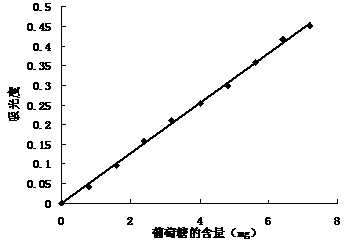
[0041] The content of the polysaccharide in the extracted rose crude polysaccharide is detected by the phenol-sulfuric acid method: the curve is as follows figure 1 .
[0042] The rose polysaccharide sample is a band in agarose gel electrophoresis, indicating that rose polysaccharide is a relatively uniform acidic polysaccharide.
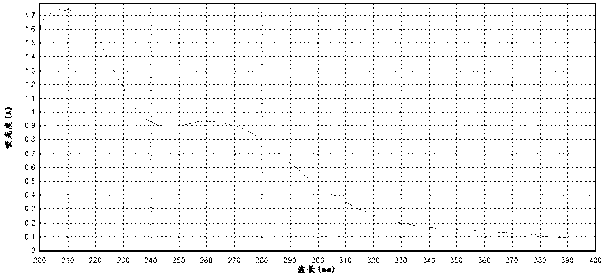
[0043] The ultraviolet absorption spectrum figure of gained rose crude polysaccharide is as figure 2 shown. Using a UV-visible spectrophotometer, the rose polysaccharide sample has a maximum absorption peak around 220 nm, and at the same time, there are protein and nucleic acid absorption peaks between 270-290 nm, indicating that there are proteins, pigments, or nucleic acids in the sample. Is a glycoprotein complex that binds pigments.
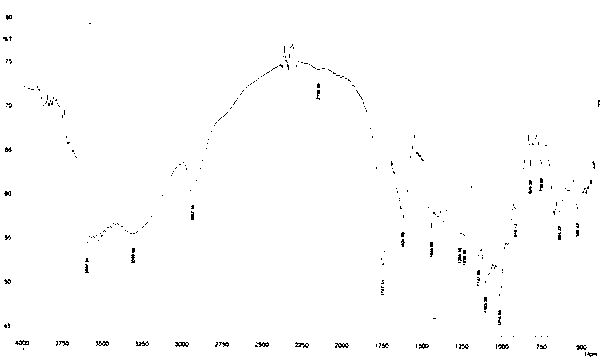
[0044] The infrared absorption spectrum figure of gained rose crude polysaccharide is as image 3 shown. The infrared spectrum of rose polysaccharide samples showed that rose polysaccharide had typical polysa...
the structure of the environmentally friendly knitted fabric provided by the present invention; figure 2 Flow chart of the yarn wrapping machine for environmentally friendly knitted fabrics and storage devices; image 3 Is the parameter map of the yarn covering machine
Login to View More
PUM
Login to View More
Abstract
The invention relates to an extraction method of natural product effective components, and especially discloses an extraction method of rose crude polysaccharide. According to the invention, rose slag is adopted as a raw material. The rose slag is extracted by using hot water, and is processed with a water extraction and alcohol precipitation method, such that the rose crude polysaccharide is obtained. After the hot water extraction process, an obtained extracting solution is condensed; 95% ethanol is added to the solution, and alcohol precipitation is carried out, such that a final concentration of ethanol is 65%-80%; the solution is processed through centrifugation, such that a precipitate is obtained; albumen-removed polysaccharide is re-dissolved, and is processed through alcohol precipitation several times by using 95% ethanol; and an obtained material is lyophilized, such that the rose crude polysaccharide is obtained. With the method provided by the invention, a comprehensive utilization value of roses is improved. The quality of the product is stable, such that the product can be stored for a long time. The product is also advantaged in good tissue structure, good appearance, and good reconstituability. With the method, active components in the raw material are preserved.
Description
(1) Technical field [0001] The invention relates to a method for extracting and separating effective components of natural products, in particular to a method for extracting crude polysaccharides from roses. (2) Background technology [0002] Polysaccharides, also known as polysaccharides, are polar macromolecules formed by the polymerization of monosaccharides, with molecular weights ranging from tens of thousands to millions. Polysaccharides are an important class of biologically active substances and are abundant biopolymers in nature, mainly including plant polysaccharides, animal polysaccharides and microbial polysaccharides. Because polysaccharides have a variety of biologically active functions and are widely used in functional foods and clinically, the research on polysaccharides has become a hot spot in recent years. So far, more than 300 polysaccharides have been isolated from natural products, among which water-soluble polysaccharides extracted from plant...
Claims
the structure of the environmentally friendly knitted fabric provided by the present invention; figure 2 Flow chart of the yarn wrapping machine for environmentally friendly knitted fabrics and storage devices; image 3 Is the parameter map of the yarn covering machine
Login to View More
Application Information
Patent Timeline
Application Date:The date an application was filed.
Publication Date:The date a patent or application was officially published.
First Publication Date:The earliest publication date of a patent with the same application number.
Issue Date:Publication date of the patent grant document.
PCT Entry Date:The Entry date of PCT National Phase.
Estimated Expiry Date:The statutory expiry date of a patent right according to the Patent Law, and it is the longest term of protection that the patent right can achieve without the termination of the patent right due to other reasons(Term extension factor has been taken into account ).
Invalid Date:Actual expiry date is based on effective date or publication date of legal transaction data of invalid patent.



 Login to View More
  Login to View More