
Natural antioxidant detecting method
A natural antioxidant and detection method technology, applied in the direction of material electrochemical variables, etc., can solve the problems of high cost, complicated operation, low sensitivity, etc., and achieve the effect of long oscillation life, simple operation and high stability
- Summary
- Abstract
- Description
- Claims
- Application Information
AI Technical Summary
Problems solved by technology
Method used
Image

Examples
Embodiment 1
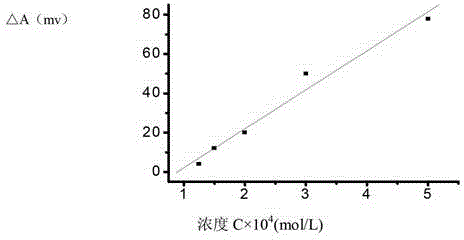
[0053] Applying KIOs 3 -MA (malonate)-H 2 o 2 -H 2 SO 4 -[NiL](ClO 4 ) 2 The Briggs-Rauscher oscillation system was used as the detection solution for quantitative analysis of ascorbic acid. Add different contents of ascorbic acid, establish a working curve (such as a linear relationship diagram) between the concentration of antioxidant (ascorbic acid) and the change value of the oscillation parameter, and realize the detection of the content of antioxidant ascorbic acid.
[0054] (1) Prepare the solution
[0055] First prepare the sulfuric acid solution of 0.025mol / L with 98% concentrated sulfuric acid as a solvent; then use the sulfuric acid solvent of 0.025mol / L to prepare respectively the potassium iodate solution of 0.14mol / L, the malonic acid solution of 2.0mol / L, and the 4.0 mol / L hydrogen peroxide solution and 0.0173 [NiL](ClO 4 ) 2 solution. Then, add 15ml, 0.025mol / L sulfuric acid solution to the open system of the 50ml beaker; 6ml, 0.14mol / L potassium ioda...
Embodiment 2
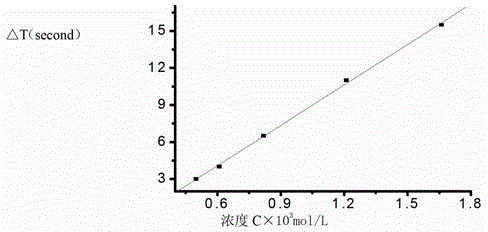
[0061] Applying KIOs 3 -MA (malonate)-H 2 o 2 -H 2 SO 4 -[NiL](ClO 4 ) 2 The Briggs-Rauscher oscillation system was used as the detection solution for quantitative measurement of phytic acid. By adding different contents of phytic acid, a working curve (such as a linear relationship diagram) is established between the concentration of antioxidant (phytic acid) and the change value of the oscillation parameter, so as to realize the function of indirectly detecting the content of antioxidant phytic acid.
[0062] (1) Prepare the solution
[0063] First prepare the sulfuric acid solution of 0.025mol / L with 98% concentrated sulfuric acid as a solvent; then use the sulfuric acid solvent of 0.025mol / L to prepare respectively the potassium iodate solution of 0.14mol / L, the malonic acid solution of 2.0mol / L, and the 4.0 mol / L hydrogen peroxide solution and 0.0173 [NiL](ClO 4 ) 2 solution. Then, add 15ml, 0.025mol / L sulfuric acid solution to the open system of the 50ml beaker...
Embodiment 3
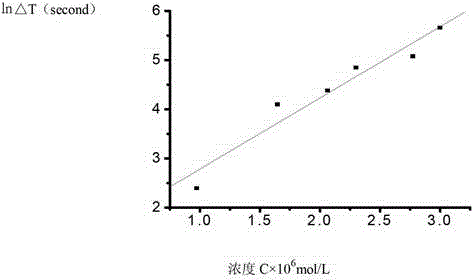
[0069] Applying KIOs 3 -MA (malonate)-H 2 o 2 -H 2 SO 4 -[NiL](ClO 4 ) 2 The Briggs-Rauscher oscillation system was used as the detection solution for quantitative measurement of rutin. Add different contents of rutin, and establish a working curve (such as a linear relationship graph) between the concentration of antioxidants and the change value of the oscillation parameter. Realize the function of indirectly detecting the content of antioxidant rutin.
[0070] (1) Prepare the solution
[0071] First prepare the sulfuric acid solution of 0.025mol / L with 98% concentrated sulfuric acid as a solvent; then use the sulfuric acid solvent of 0.025mol / L to prepare respectively the potassium iodate solution of 0.14mol / L, the malonic acid solution of 2.0mol / L, and the 4.0 mol / L hydrogen peroxide solution and 0.0173 [NiL](ClO 4 ) 2 solution. Then, add 15ml, 0.025mol / L sulfuric acid solution to the open system of the 50ml beaker; 6ml, 0.14mol / L potassium iodate solution; 3ml,...
PUM
 Login to View More
 Abstract
Description
Claims
Application Information
 Login to View More