Human papilloma virus (24 types) detection (fluorescent PCR method) kit and detection method
What is AI technical title?
AI technical title is built by Patsnap AI team. It summarizes the technical point description of the patent document.
A detection method and technique for papilloma, which are applied in the directions of fluorescence/phosphorescence, biochemical equipment and methods, and determination/inspection of microorganisms, to achieve the effect of avoiding the decline of amplification efficiency
Inactive Publication Date: 2014-04-16
JIANGSU MOLE BIOSCI
View PDF3 Cites 14 Cited by
Summary
Abstract
Description
Claims
Application Information
AI Technical Summary
This helps you quickly interpret patents by identifying the three key elements:
Problems solved by technology
Method used
Benefits of technology
Problems solved by technology
[0019] The above patents and products can only detect up to 14 HPV types in one tube, and the cost increase caused by the use of new probes makes it difficult to apply to clinical diagnosis
Method used
the structure of the environmentally friendly knitted fabric provided by the present invention; figure 2 Flow chart of the yarn wrapping machine for environmentally friendly knitted fabrics and storage devices; image 3 Is the parameter map of the yarn covering machine
View more
Image
Smart Image Click on the blue labels to locate them in the text.
Viewing Examples
Smart Image
Click on the blue label to locate the original text in one second.
Reading with bidirectional positioning of images and text.
Smart Image
Examples
Experimental program
Comparison scheme
Effect test
Embodiment 1
[0055] Example 1: Primer probe design
[0056] Studies have shown that the L1 regions of various types of HPV genomes have both certain homology and certain specificity, and degenerate primers can be designed according to the homologous sequences. The present invention detects the primer probe design principle of 24 types of HPV DNA is: the L1 region of HPV genome of each type selects the sequence with high homology to design forward and reverse primers, and designs the probe sequence at the sequence with high specificity, Perform PCR in the same tube while using Taqman probes to detect 24 types of HPV. The template denaturation temperature is 95°C; the primer annealing and extension temperature is 52°C; the number of cycles for the amplification reaction is 35-45.
[0057] Table 1 is the gene bank number of the amplified target sequence
[0058] HPV type Genebank number target sequence position HPV6 probe X00203 6227-6409 HPV11 probe M14119 6220-...
Embodiment 2
[0059] Example 2: Sample Preparation
[0060] In order to quickly and easily prepare HPV DNA templates that can be used for PCR amplification, the present invention uses a non-ionic detergent in conjunction with a high temperature environment to crack the HPV outer membrane protein to release the DNA therein, and uses chelex-100 to remove the metal therein Impurities such as ions that inhibit PCR can be used to improve detection efficiency.
Embodiment 3
[0061] Embodiment 3: system optimization
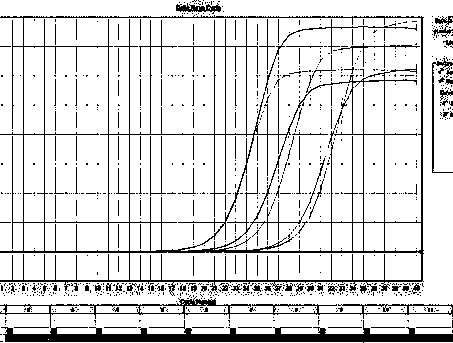
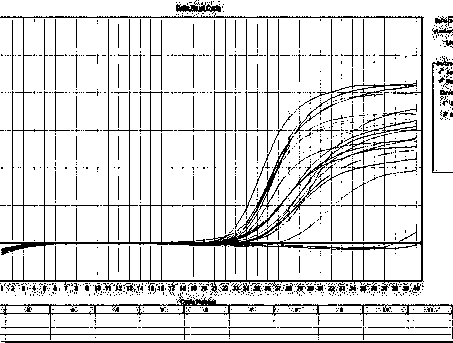
[0062] In order to simultaneously detect 24 types of HPV in the same reaction tube, the primer probe concentration and reaction system must be optimized to avoid interference between primer probes and the lower extension temperature required for Taqman probe hybridization .
the structure of the environmentally friendly knitted fabric provided by the present invention; figure 2 Flow chart of the yarn wrapping machine for environmentally friendly knitted fabrics and storage devices; image 3 Is the parameter map of the yarn covering machine
Login to View More
PUM
Login to View More
Abstract
The invention relates to a fluorescent PCR detection method for diagnosing human papilloma virus (HPV) infection, and a kit which is prepared according to the detection method and is used to detect HPV genotype of a DNA sample isolated from a patient body for diagnosing whether the HPV genotype belongs to one of the 24 types of human papilloma virus and determining as high risk, moderate high-risk and low risk, and belongs to the field of life science and technology. The method comprises: taking fluorogenic quantitative PCR as the technological basic polymerase chain reaction (PCR), employing the kit comprising multiple-type-directing forward primers, reverse primers and probes, and under specific PCR conditions and in a reaction tube, simultaneously detecting DNA of 24 types of HPV such as HPV 6, 11, 16, 18, 31, 33, 35, 39, 42, 43, 44, 45, 51, 52, 53, 56, 58, 59, 66, 68, 73, 83, MM4 and cp8304. The kit and the detection method helps to simply accurately rapidly detect DNA of multiple types of HPV and reduce the cost, and is effectively applicable to prevention and screening of cervical cancers.
Description
[0001] Technical field: [0002] The invention relates to a fluorescent PCR detection method for diagnosing human papillomavirus (HPV) infection, and a kit made by using the method to detect HPV genotypes in DNA samples isolated from patients to diagnose whether they belong to the above-mentioned One of the 24 types is judged as high-risk, moderately high-risk, and low-risk types, which belong to the field of life science and technology. The method of the present invention includes a polymerase chain reaction (PCR) based on fluorescent quantitative PCR, including forward primers, reverse primers and probes for multiple types, which can be processed in a reaction tube under specific PCR conditions. Simultaneous detection of HPV6, 11, 16, 18, 31, 33, 35, 39, 42, 43, 44, 45, 51, 52, 53, 56, 58, 59, 66, 68, 73, 83, MM4 and cp8304 And so on 24 types of DNA. [0003] Background technique: [0004] Cervical cancer is the most common malignancy in women, mainly occurring in early ...
Claims
the structure of the environmentally friendly knitted fabric provided by the present invention; figure 2 Flow chart of the yarn wrapping machine for environmentally friendly knitted fabrics and storage devices; image 3 Is the parameter map of the yarn covering machine
Login to View More
Application Information
Patent Timeline
Application Date:The date an application was filed.
Publication Date:The date a patent or application was officially published.
First Publication Date:The earliest publication date of a patent with the same application number.
Issue Date:Publication date of the patent grant document.
PCT Entry Date:The Entry date of PCT National Phase.
Estimated Expiry Date:The statutory expiry date of a patent right according to the Patent Law, and it is the longest term of protection that the patent right can achieve without the termination of the patent right due to other reasons(Term extension factor has been taken into account ).
Invalid Date:Actual expiry date is based on effective date or publication date of legal transaction data of invalid patent.



 Login to View More
  Login to View More