Unlock instant, AI-driven research and patent intelligence for your innovation.
Synthetic method of ezetimibe and its intermediate
What is Al technical title?
Al technical title is built by PatSnap Al team. It summarizes the technical point description of the patent document.
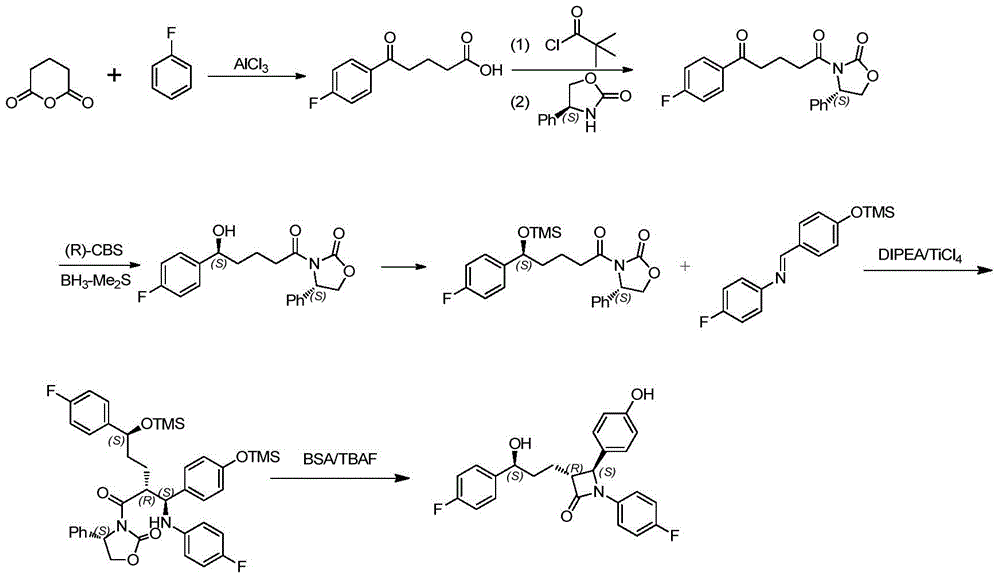
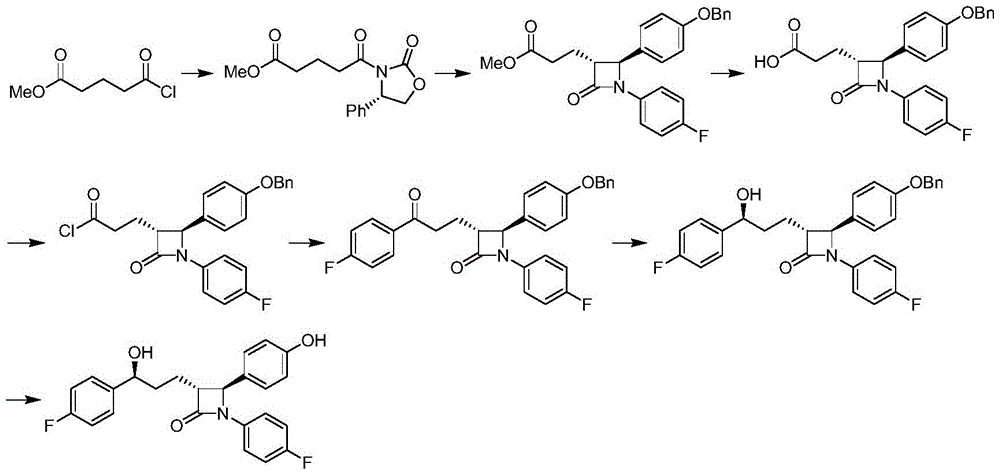
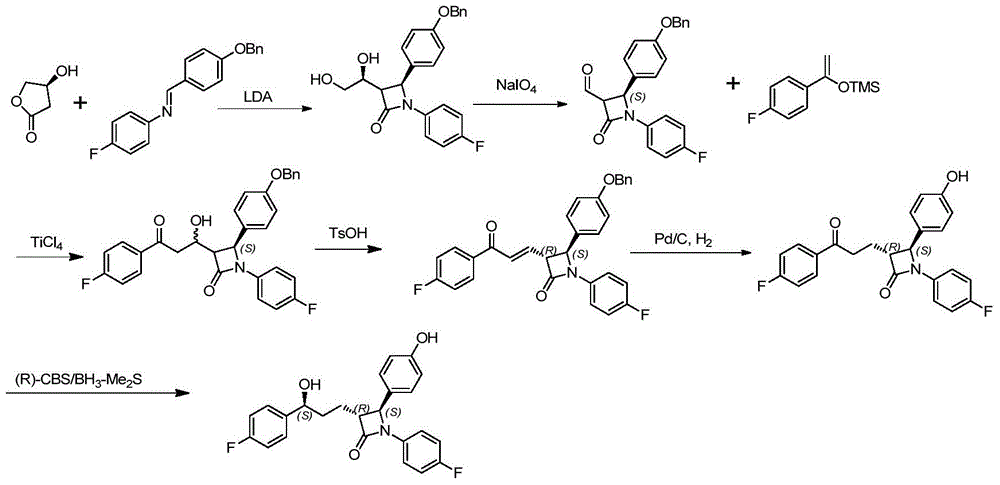
A technique of ezetimibe and a synthetic method, which is applied in the field of preparation of small-molecule chemical drugs, can solve the problems of high solvent toxicity, harsh reaction conditions, low yield and purity, and achieve easy control of process conditions, mild reaction conditions, and high product quality. The effect of high purity
Active Publication Date: 2017-05-31
ARROMAX PHARMATECH
View PDF10 Cites 1 Cited by
Summary
Abstract
Description
Claims
Application Information
AI Technical Summary
This helps you quickly interpret patents by identifying the three key elements:
Problems solved by technology
Method used
Benefits of technology
Problems solved by technology
[0010] The second synthetic route uses the starting material 4-pentenoic acid, which is more expensive and difficult to purchase in the market. The synthetic route is long, the process is complicated, and the reaction conditions are harsh, so it is difficult to realize industrial production.
[0016] Synthetic Method 4, Starting Materials and Catalyst Pd(OAc) 2 The price is more expensive, the process is complex, the reaction conditions are harsh, and it is not easy to scale up production
[0017] In summary, in the above-mentioned synthetic methods, there are problems that the synthetic route is relatively long or the yield and purity are low. Some synthetic route raw materials and precious metal palladium reagents are expensive, and ultra-low temperature reactions are required. The CBS chiral reducing agent used is The amount is large, the solvent is highly toxic
Therefore, the cost of the synthetic method of ezetimibe in the prior art is relatively high, is not suitable for industrialized production
Method used
the structure of the environmentally friendly knitted fabric provided by the present invention; figure 2 Flow chart of the yarn wrapping machine for environmentally friendly knitted fabrics and storage devices; image 3 Is the parameter map of the yarn covering machine
View more
Image
Smart Image Click on the blue labels to locate them in the text.
Viewing Examples
Smart Image
Click on the blue label to locate the original text in one second.
Reading with bidirectional positioning of images and text.
Smart Image
Examples
Experimental program
Comparison scheme
Effect test
Embodiment 1
[0047] Preparation of compound (2)
[0048]
[0049] Compound (1) (10g, 81.90mmol) and p-fluoroaniline (9g, 81.00mmol) were dissolved in isopropanol (75ml), heated to 50°C, stirred for 1h, cooled to room temperature, suction filtered, and isopropanol ( 10ml) to obtain a pale yellow solid, compound (2) (14.2g, 80% yield).
Embodiment 2
[0051] Preparation of compound (3)
[0052]
example 2-1
[0053] Example 2-1: Preparation of compound (3a) (ie, R=TBS in compound (3))
[0054] Compound (2) (6g, 27.88mmol), TBDMSCl (5.04g, 33.44mmol) and imidazole (3.8g, 55.80mmol) were dissolved in DMF (12ml), heated to 60°C, stirred for 4h, cooled to room temperature, added water (60ml), add ethyl acetate (20ml×3) for extraction, combine the organic phases, wash the organic phase with water (20ml×2), add MgSO to the organic phase 4 Drying and concentration gave a pale yellow solid, compound (3a) (9.0 g, 97.5% yield).
the structure of the environmentally friendly knitted fabric provided by the present invention; figure 2 Flow chart of the yarn wrapping machine for environmentally friendly knitted fabrics and storage devices; image 3 Is the parameter map of the yarn covering machine
Login to View More
PUM
Login to View More
Abstract
The invention provides an Ezetimibe synthesis method comprising the following steps: (a) a compound (5) is subjected to asymmetric reduction reaction to obtain a compound (6), and the compound (6) and tert-butyldimethylsilyl chloride react in an organic solution under the action of alkali to obtain a compound (7); (b) the compound (7) and diisopropylethylamine are dissolved in the organic solution, titanium tetrachloride is added in the organic solution to react at 20-50 DEG C, and a compound (3) is added in the organic solution at minus 20 to minus 60 DEG C to react to obtain a compound (8); (c) the compound (8) and N,O-bis(trimethylsilyl) acetamide react in the organic solution at 20-80 DEG C, tetrabutylammonium fluoride trihydrate is added into the organic solution to react at 20-80 DEG C to obtain a compound (9); (d) the compound (9) is subjected to off-protection reaction to obtain Ezetimibe, wherein R is equal to TBS, Ac or COOCH2CCl3. The invention further provides an Ezetimibe intermediate and a preparation method thereof.
Description
technical field [0001] The invention relates to the field of preparation of small molecule chemical drugs, and more particularly relates to a synthesis method of ezetimibe. Background technique [0002] Ezetimibe, also known as Ezetimibe and Ezetimibe, is the first selective cholesterol absorption inhibitor jointly developed by Schering-Plough and Merck. This product is The first selective cholesterol absorption inhibitor drug approved by the US FDA. It was launched in Germany for the first time in November 2002 and was launched in the United States at the same time. [0003] Ezetimibe is the first selective inhibitor of intestinal cholesterol absorption, and its mechanism of action is different from that of other lipid-lowering drugs (such as: statins, bile acid sequestrants, phenoxyacid derivatives and plant sterol esters). Compounds), which can be used alone or in combination with HMG-CoA reductase inhibitors (statins) for the treatment of primary (heterozygous familial...
Claims
the structure of the environmentally friendly knitted fabric provided by the present invention; figure 2 Flow chart of the yarn wrapping machine for environmentally friendly knitted fabrics and storage devices; image 3 Is the parameter map of the yarn covering machine
Login to View More
Application Information
Patent Timeline
Application Date:The date an application was filed.
Publication Date:The date a patent or application was officially published.
First Publication Date:The earliest publication date of a patent with the same application number.
Issue Date:Publication date of the patent grant document.
PCT Entry Date:The Entry date of PCT National Phase.
Estimated Expiry Date:The statutory expiry date of a patent right according to the Patent Law, and it is the longest term of protection that the patent right can achieve without the termination of the patent right due to other reasons(Term extension factor has been taken into account ).
Invalid Date:Actual expiry date is based on effective date or publication date of legal transaction data of invalid patent.

 Login to View More
  Login to View More