Insect prevention wood plastic interior door and preparation method thereof

A kind of door and wood plastic technology, applied in other household appliances, household components, applications, etc., can solve the problems of short lifespan, prone to insects, etc., and achieve the effect of improving performance, prolonging service life, and less manual operation

CN104558969AActive Publication Date: 2015-04-29许冰
10 Cites 8 Cited by

Patent Information

Authority / Receiving Office
CN · China
Current Assignee / Owner
Publication Date
2015-04-29

Smart Images

  • Figure 1
    Figure 1
  • Figure 2
    Figure 2
  • Figure 3
    Figure 3
Patent Text Reader

Abstract

The invention discloses an insect prevention wood plastic interior door and a preparation method of the insect prevention wood plastic interior door. The interior door is prepared from the following raw materials in percent by weight: 10-15 percent of PVC resins, 0.3-0.7 percent of stearic acid, 0.4-0.6 percent of chlorinated paraffin, 0.3-0.6 percent of ACR processing agent, 0.3-0.5 percent of CPE, 0.3-0.5 percent of Ba / Cd / Zn stabilizing agent, 4-7 percent of light calcium carbonate, 2-4 percent of DIOP plasticizers, 0.2-0.5 percent of BPO cross-linking agents, 0.04-0.06 percent of light stabilizers, 28-35 percent of wood powder, 38-50 percent of PVC waste strips, and 1-3 percent of Chinese medicine residue powder. According to the insect prevention wood plastic interior door, the Chinese medicine residue powder having an effect of desinsectization or insect protection is added into a formula, so that a door plate can keep in a good condition in a moist or bad-illumination room, the breakage and the crevice are avoided, and the service life is prolonged under a moist condition.
Need to check novelty before this filing date? Find Prior Art

Description

technical field

[0001] The invention relates to a wood-plastic indoor set door with the function of preventing or repelling insects, which belongs to the technical field of building and decoration materials, in particular to an insect-proof wood-plastic indoor set door and a preparation method thereof. Background technique

[0002] Wood-plastic composite material is a new composite material with high performance and high added value, which is made of wood as the main raw material. my country is a country with relatively poor forest resources. The forest coverage rate is 12.7%, and the per capita forest area is less than 1 / 4 of the world's average level. Widely, the "white pollution" problem caused by improper disposal of plastic waste has become a major environmental protection problem. In this context, wood fibers and waste plastics are specially treated to synthesize new materials, that is to say, wood-plastic composite materials have developed rapidly in our country. In ...

Examples

Embodiment 1

[0024] An insect-proof wood-plastic indoor suit door, comprising the following raw material components by weight percentage: 10.5kg of PVC resin, 0.5kg of stearic acid, 0.5kg of chlorinated paraffin, 0.5kg of ACR processing aid, 0.5kg of CPE chlorinated polyethylene kg, Ba / Cd / Zn stabilizer 0.5kg, light calcium carbonate 5kg, DIOP plasticizer 3kg, BPO crosslinking agent 0.3kg, light stabilizer 0.05kg, wood powder 30kg, PVC waste flakes 47kg, traditional Chinese medicine slag powder 1.65kg.

[0025] The traditional Chinese medicine dregs powder is compounded from sandalwood, balsamic and male cloves with a water content of less than 5%, and 0.01-0.03% of D-isoascorbic acid. The compounding ratio is: sandalwood: balsamic: Male clove = 1:3:1.

[0026] Prepare according to the above formula, and then prepare through the following steps:

[0027] 1) After cleaning waste PVC sheets, grind them into 60-mesh fine powder with a plastic mill for subsequent use;

[0028] 2) After the t...

Embodiment 2~5

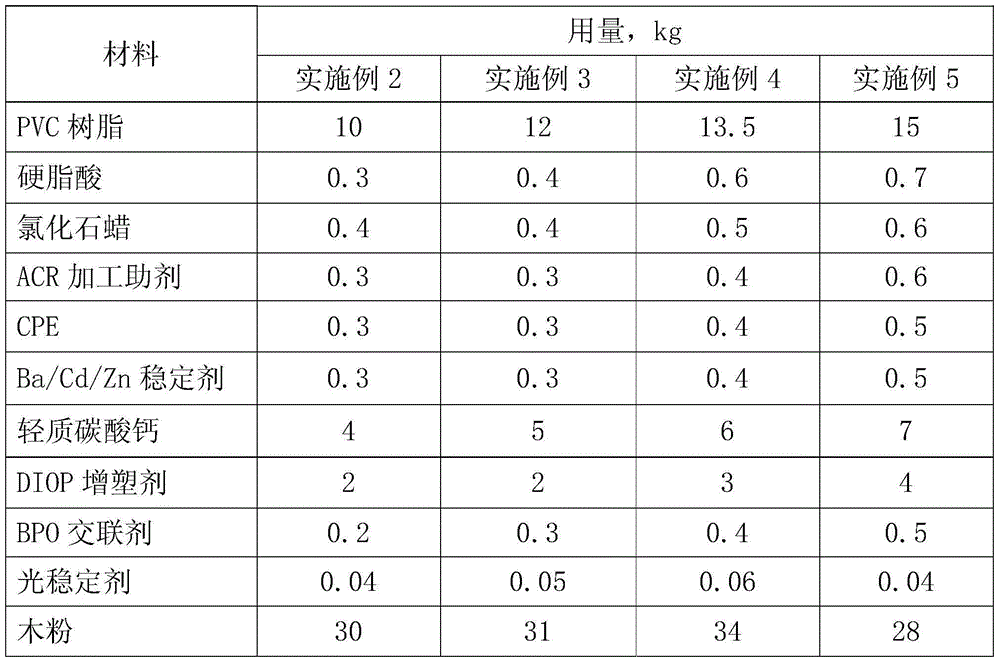
[0033] Table 1- Raw material dosage ratio table

[0034]

[0035]

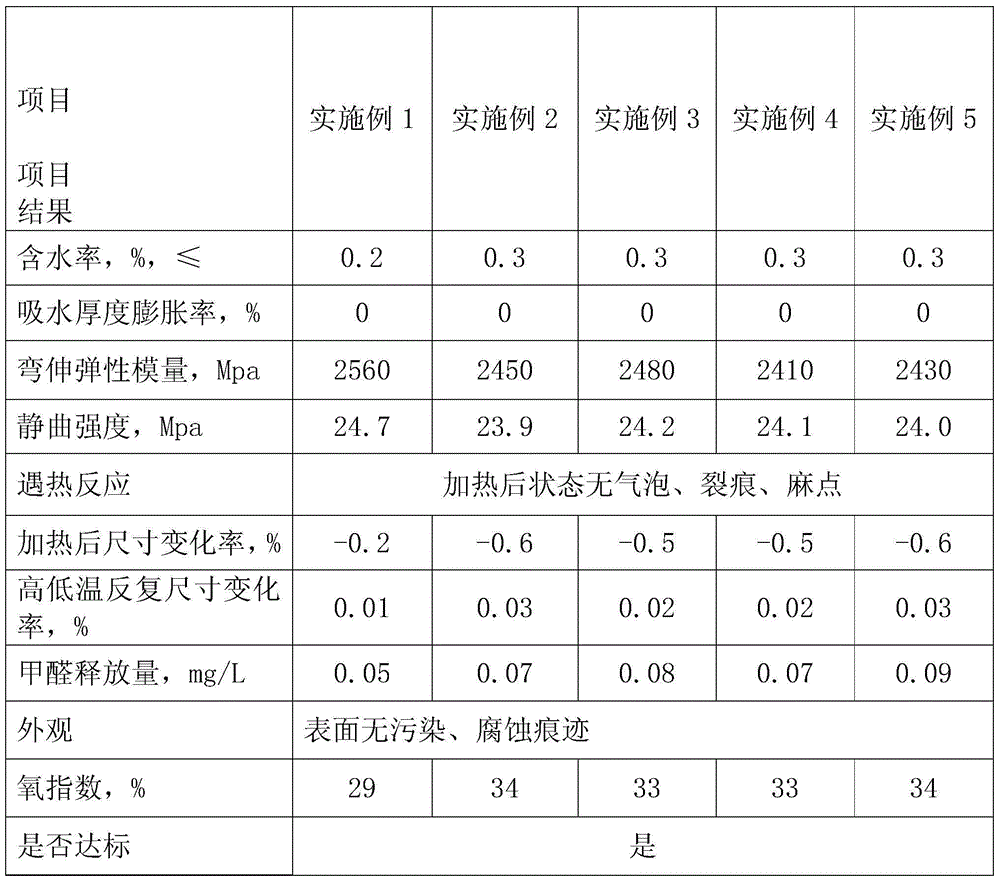
[0036] Prepare materials according to the above proportions, and then use the same production process as in Example 1 for preparation, the difference is that: according to the conversion of specific raw materials, the corresponding temperature change value is appropriately adjusted.