Check patentability & draft patents in minutes with Patsnap Eureka AI!

Method for sending response message, access point (AP) and station

A response message, access point technology, applied in the direction of error prevention/detection, electrical components, wireless communication, etc. using the return channel, can solve the problem of not being able to choose sleep to save power, not knowing that the AP uses multi-user response messages, etc.

Active Publication Date: 2016-11-09
HUAWEI TECH CO LTD
View PDF6 Cites 4 Cited by
  • Summary
  • Abstract
  • Description
  • Claims
  • Application Information

AI Technical Summary

Problems solved by technology

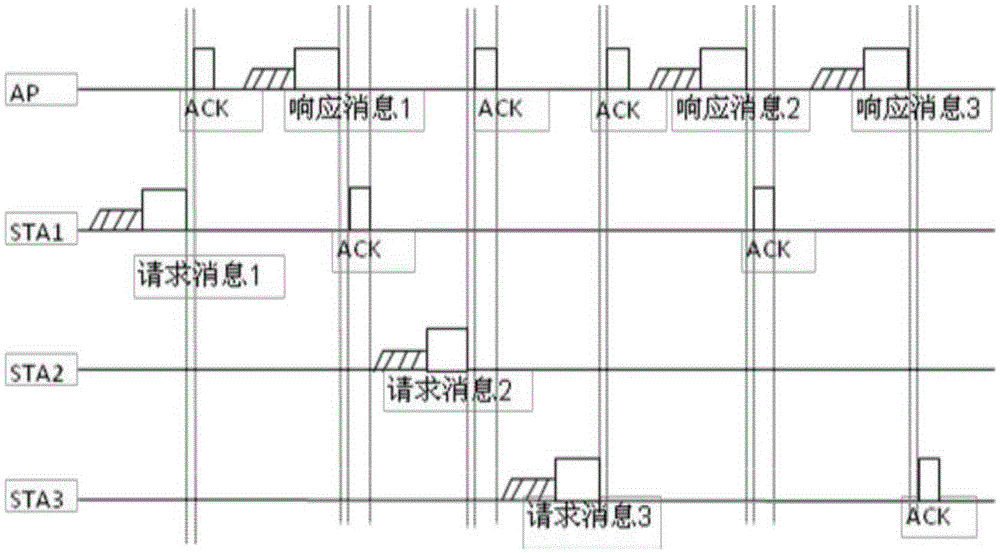
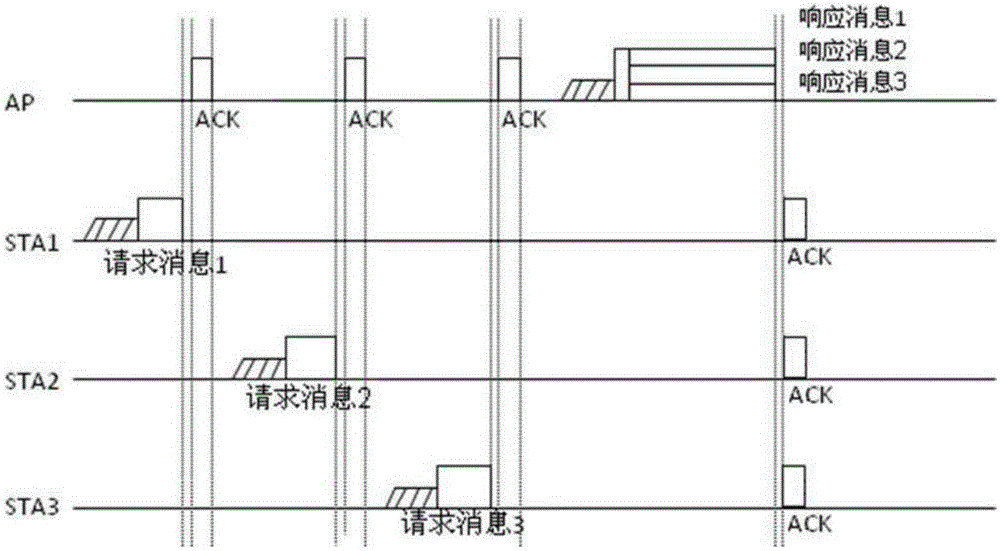
Since the STA does not know that the AP uses the multi-user response message and how long it takes to send the multi-user response message except for receiving the ACK frame to confirm that the AP has received the request message, it can only stay awake, and the STA is waiting to receive the AP to send the response message During this period, you cannot communicate with other devices, and you cannot choose to sleep to save power

Method used

the structure of the environmentally friendly knitted fabric provided by the present invention; figure 2 Flow chart of the yarn wrapping machine for environmentally friendly knitted fabrics and storage devices; image 3 Is the parameter map of the yarn covering machine
View more

Image

Smart Image Click on the blue labels to locate them in the text.
Viewing Examples
Smart Image
  • Method for sending response message, access point (AP) and station
  • Method for sending response message, access point (AP) and station
  • Method for sending response message, access point (AP) and station

Examples

Experimental program
Comparison scheme
Effect test

Embodiment 1

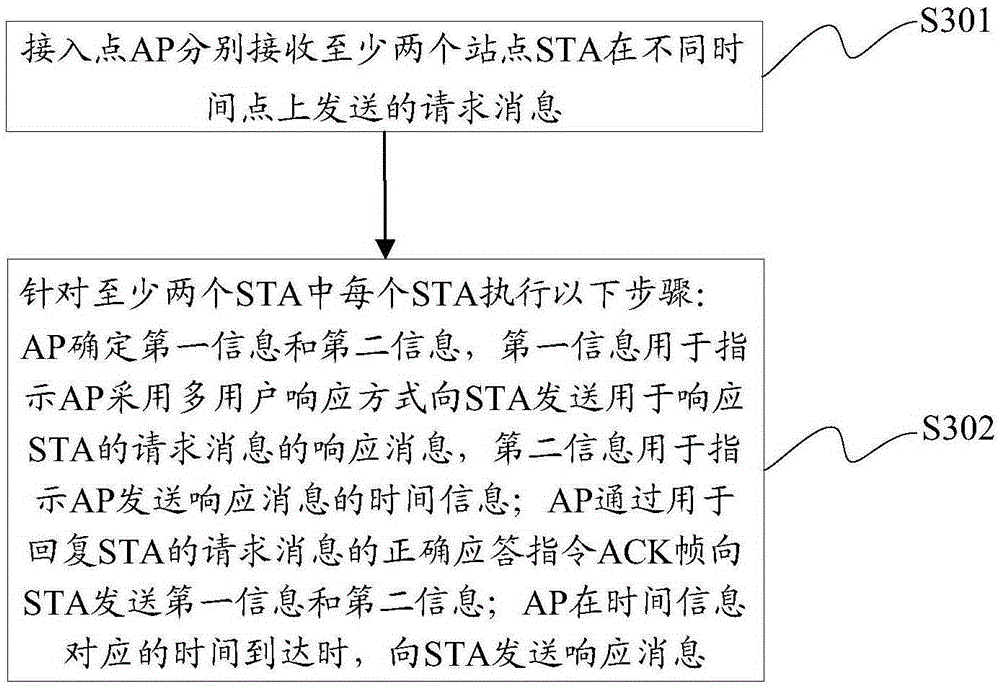
[0157] Such as image 3 As shown, the embodiment of the present invention provides a method for using a multi-user response message, the method is executed by an AP, and the method includes:

[0158] S301. The access point AP respectively receives request messages sent by at least two station STAs at different time points;

[0159] S302. Perform the following steps for each STA in at least two STAs:

[0160] The AP determines first information and second information, the first information is used to instruct the AP to send a response message to the STA in response to the request message of the STA in a multi-user response mode, and the second information is used to indicate time information for the AP to send the response message; The AP sends the first information and the second information to the STA through the correct response instruction ACK frame for replying to the request message of the STA; when the time corresponding to the time information arrives, the AP sends a r...

example 1

[0172] For the four idle fields in the ACK frame, use any one of the idle fields to carry the first information, and use the remaining three idle fields to carry the second information. That is to say, any one of the idle fields is used as a multi-user response indication (English: Multiple Response Indication, referred to as: MRI) field. When the MRI is the first value (0), it means that the AP does not use the multi-user response message, and the MRI is the second value (1). indicates that the AP uses a multi-user response message, and uses the remaining three free fields to indicate the time information for the AP to send a multi-user response message. The STA needs to wait before the time for the AP to send a multi-user response message. During this waiting time, the STA can It is in the dormant state, so the remaining three idle fields can indicate the dormant time of the STA (referred to as DT in this article, and the full name of DT is Deferred Time).

[0173] The sleep...

example 2

[0179] The four idle bits in the ACK frame are taken as a whole to jointly carry the first information and the second information. In order to distinguish it from the DT field in Example 1, the field synthesized by the four idle bits is called an extended DT (EDT, Extended DT) field. It can be seen that since the EDT has four bits, its value range is 0-15. When the value of the EDT field is 0, the four idle bits in the ACK frame are all set to 0, which means that the AP does not use the multi-user response message; when the value of the EDT field is 1 to 15, it means that the AP uses For the multi-user response message, the time before the AP sends the multi-user response message is the sleepable time of the STA, and the sleepable time of the STA can be the value of the EDT field minus 1. It can also be regarded as 0 time unit when the value of the EDT field is 15, and the value of 1 to 14 indicates the actual sleeping time of the STA.

[0180] Since the value range of the E...

the structure of the environmentally friendly knitted fabric provided by the present invention; figure 2 Flow chart of the yarn wrapping machine for environmentally friendly knitted fabrics and storage devices; image 3 Is the parameter map of the yarn covering machine
Login to View More

PUM

No PUM Login to View More

Abstract

The invention provides a method and a device for sending a response message. The method comprises the following steps that: an access point (AP) receives request messages which are sent by at least two stations (STA) at different time points; and the following step is executed specific to each STA in the at least two STAs: the AP determines first information and second information, transmits the first information and the second information to the STAs through an ACK (Acknowledge) frame for replying to the request messages of the STAs, and sends response messages to the STAs at the arrival of time corresponding to time information.

Description

technical field [0001] The invention relates to the field of wireless communication, in particular to a method for sending a response message, an access point and a station. Background technique [0002] Wireless Fidelity (English: Wireless Fidelity, referred to as: WiFi) technical standard "IEEE802.11-2012" is a wireless communication standard based on time division and competition. The standard points out that in any case, a station preparing to send a message ( English: Station, referred to as: STA) or access point (English: Access Point, referred to as: AP) needs to adopt a competition mechanism to send messages. [0003] The process of sending messages by STA or AP using the competition mechanism is called the back-off process, and the purpose is to avoid the problem that the communication cannot be carried out due to the conflict caused by two WiFi devices sending messages at the same time. However, the backoff process cannot completely avoid the occurrence of message...

Claims

the structure of the environmentally friendly knitted fabric provided by the present invention; figure 2 Flow chart of the yarn wrapping machine for environmentally friendly knitted fabrics and storage devices; image 3 Is the parameter map of the yarn covering machine
Login to View More

Application Information

Patent Timeline
no application Login to View More
Patent Type & Authority Applications(China)
IPC IPC(8): H04W74/08H04L1/16
Inventor 丁志明树贵明杜振国
Owner HUAWEI TECH CO LTD
Features
  • R&D
  • Intellectual Property
  • Life Sciences
  • Materials
  • Tech Scout
Why Patsnap Eureka
  • Unparalleled Data Quality
  • Higher Quality Content
  • 60% Fewer Hallucinations
Social media
Patsnap Eureka Blog
Learn More