
Lotus root, lily and loquat porridge
A loquat and lotus root technology, applied in the field of nutritional porridge, can solve the problems of folic acid instability and loss, achieve the effects of retaining nutritional value, avoiding the loss of nutrients, and shortening the gelatinization time
- Summary
- Abstract
- Description
- Claims
- Application Information
AI Technical Summary
Problems solved by technology
Method used
Image

Examples
Embodiment 1
[0024] Millet is planted in Songjiazhuang Town, Yuxian County, Zhangjiakou, Hebei Province (the place belongs to the warm temperate continental monsoon climate area, with an altitude of 850-1200) using the No. 5 seed of Jizhanggu;
[0025] Sowing from late April to mid-May, ferrous ammonium phosphate is used in the base fertilizer and topdressing to partially replace ordinary phosphate and nitrogen fertilizers. The total amount of ferrous ammonium phosphate is about 40 kg per mu;
[0026] And 45 days before harvest, start to cover the top of the planting plot with sunshade nets, and at the same time ensure ventilation to avoid mildew;
[0027] Harvested from late September to early October, threshed and shelled to get millet.
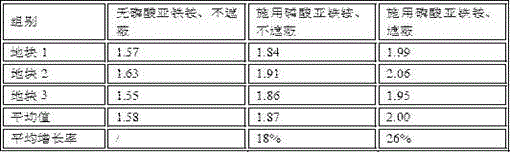
[0028] Under the same other conditions, the folic acid content in millet obtained by different planting methods in the same plot is shown in the table below:
[0029] Folic acid content in the sample (μg / g)
[0030]
[0031] It can be seen that the...
Embodiment 2
[0041] Millet is planted in Nuanquan Town, Yuxian County, Zhangjiakou, Hebei Province using the No. 5 seed of Jizhanggu;
[0042] Sowing from late April to mid-May, ferrous ammonium phosphate is used in base fertilizer and topdressing to partially replace ordinary phosphate fertilizer and nitrogen fertilizer. The total amount of ferrous ammonium phosphate is about 50 kg per mu;
[0043] And 45 days before harvest, start to cover the top of the planting plot with sunshade nets, and at the same time ensure ventilation to avoid mildew;
[0044] Harvesting from late September to early October, threshing and shelling the millet, the average folic acid content is about 1.88μg / g.
[0045] Then take 100 copies of the obtained millet;
[0046] Soak in baking soda water for 3 hours first, and the amount of baking soda water should ensure that all the millet is submerged; baking soda water is made by mixing clean water and sodium bicarbonate at a mass ratio of 10:0.5;
[0047] Then pla...
Embodiment 3
[0054] Millet is planted in Taohua Town, Yuxian County, Zhangjiakou, Hebei Province using the No. 5 seed of Jizhanggu;
[0055] Sowing from late April to mid-May, ferrous ammonium phosphate is used in the base fertilizer and topdressing to partially replace ordinary phosphate and nitrogen fertilizers. The total amount of ferrous ammonium phosphate is about 30 kg per mu;
[0056] And 50 days before harvest, start to cover the top of the planting plot with sunshade nets, and at the same time ensure ventilation and avoid mildew;
[0057] It is harvested from late September to early October, and the millet obtained by threshing and shelling has an average folic acid content of about 1.76 μg / g.
[0058] Then take 100 copies of the obtained millet;
[0059] Soak in baking soda water for 3 hours first, and the amount of baking soda water should ensure that all the millet is submerged; baking soda water is made by mixing clean water and sodium bicarbonate at a mass ratio of 10:0.5; ...
PUM
 Login to View More
 Abstract
Description
Claims
Application Information
 Login to View More