Dispersion and surface treatment method of a nano-sized mineral admixture
What is AI technical title?
AI technical title is built by PatSnap AI team. It summarizes the technical point description of the patent document.
A mineral admixture and nano-sized technology, applied in the field of cement concrete admixture, can solve the problems of poor dispersion and serious particle agglomeration, achieve stable dispersion effect and promote full contact effect
Active Publication Date: 2018-11-06
SOUTHEAST UNIV
View PDF6 Cites 0 Cited by
Summary
Abstract
Description
Claims
Application Information
AI Technical Summary
This helps you quickly interpret patents by identifying the three key elements:
Problems solved by technology
Method used
Benefits of technology
Problems solved by technology
[0006] The purpose of the present invention is to provide a method for dispersing and surface treating nanometer-sized mineral admixtures, so as to solve the shortcomings of common nanometer-sized mineral admixtures, such as serious particle agglomeration and poor dispersibility, and at the same time have a greater impact on the secondary hydration reaction of the particles. Small
Method used
the structure of the environmentally friendly knitted fabric provided by the present invention; figure 2 Flow chart of the yarn wrapping machine for environmentally friendly knitted fabrics and storage devices; image 3 Is the parameter map of the yarn covering machine
View more
Image
Smart Image Click on the blue labels to locate them in the text.
Viewing Examples
Smart Image
Click on the blue label to locate the original text in one second.
Reading with bidirectional positioning of images and text.
Smart Image
Examples
Experimental program
Comparison scheme
Effect test
Embodiment 1
[0035] (1) Take 15 grams of silica fume powder purchased in the market, add it to 500 milliliters of water, and ultrasonically disperse it for 30 minutes;
[0036] (2) Add 3 grams of γ-aminopropyltriethoxysilane dropwise to the dispersion in step (1), while mechanically stirring for 20 hours at a temperature of 65 degrees Celsius at a stirring rate of 400 rpm ;
[0037] (3) Weighing 15 grams of polyacrylic acid with a molecular weight of 3000, slowly added to the dispersion solution in step (2), while mechanically stirring for 1 hour at a temperature of 65 degrees Celsius at a stirring rate of 400 rpm;
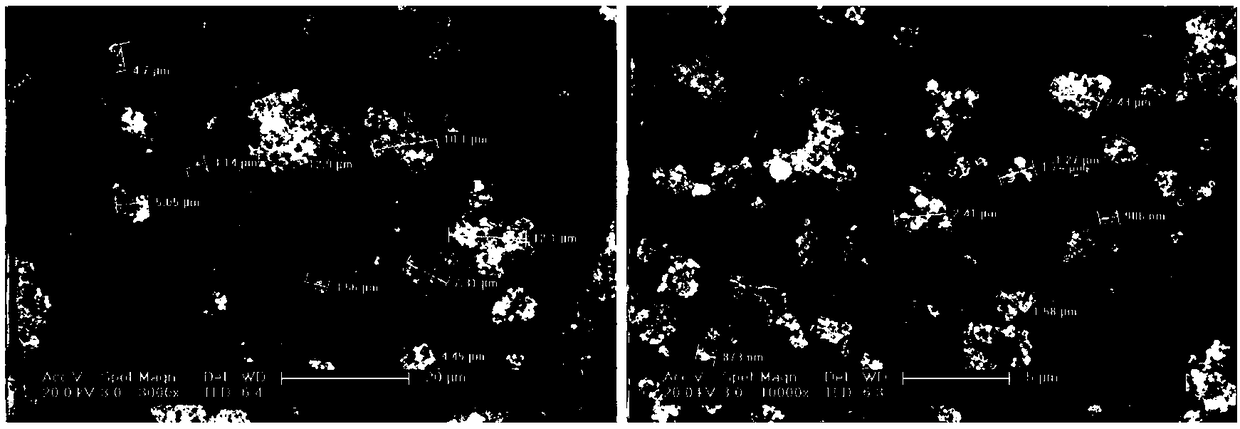
[0038] (4) Suction filter the dispersion solution with filter paper, wash with distilled water and absolute ethanol three times respectively, and dry in a drying oven at 40 degrees Celsius for 24 hours to obtain a surface-treated silica fume powder. figure 2 Among them, (a) is the SEM morphology of the particles before surface treatment, and (b) is the SEM morphology after s...
Embodiment 2
[0040] (1) Take by weighing 15 grams of silica fume powder purchased in the market, add to 500 milliliters of water, and mechanically stir for 30 minutes;
[0041] (2) Add 2 grams of γ-aminopropyltrimethoxysilane dropwise to the dispersion in step (1), while mechanically stirring for 16 hours at a temperature of 65 degrees Celsius at a stirring rate of 600 rpm;
[0042] (3) Weigh 9 grams of polymethacrylic acid and slowly add it to the dispersion solution in step (2), while mechanically stirring for 2 hours at a temperature of 65 degrees Celsius at a stirring rate of 600 rpm;
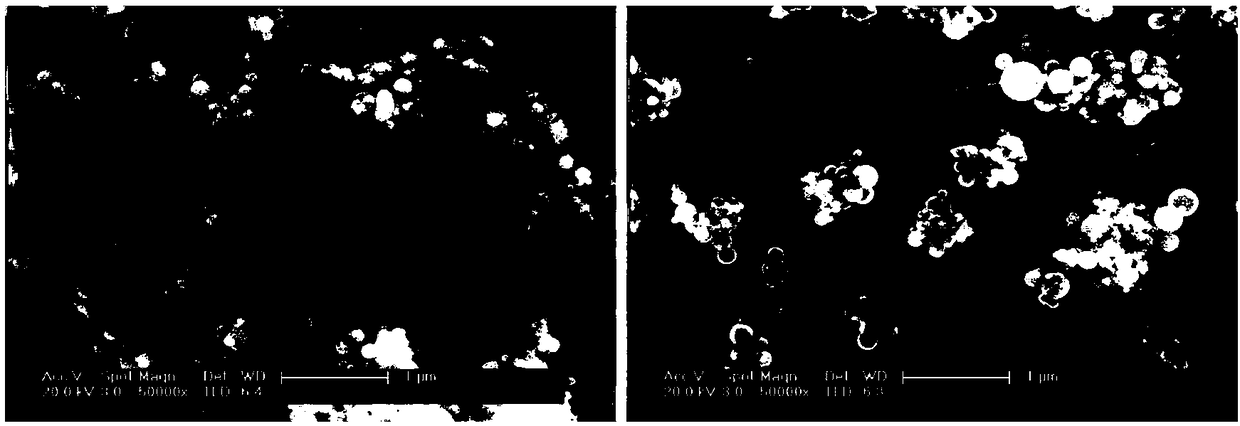
[0043] (4) Suction filter the dispersion solution with filter paper, wash with distilled water and absolute ethanol three times respectively, and dry in a drying oven at 50 degrees Celsius for 24 hours to obtain a surface-treated silica fume powder. image 3 Among them, (a) is the SEM morphology of the particles before surface treatment, and (b) is the SEM morphology after surface treatment.
the structure of the environmentally friendly knitted fabric provided by the present invention; figure 2 Flow chart of the yarn wrapping machine for environmentally friendly knitted fabrics and storage devices; image 3 Is the parameter map of the yarn covering machine
Login to View More
PUM
Login to View More
Abstract
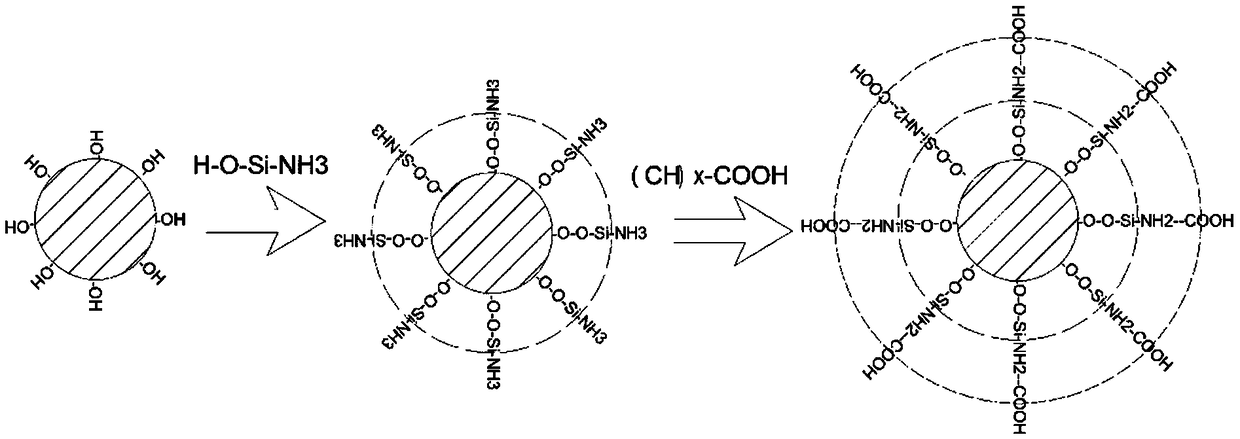
The invention discloses a dispersion and surface treatment method of a nano-sized mineral admixture. The dispersion and surface treatment method comprises the following steps: (1) fully dispersing the nano-sized mineral admixture to be treated in water to obtain dispersion liquid; (2) adding amino silane into the dispersion liquid in the step (1), so that the hydrolyzed amino silane is combined with a hydroxyl group on the surface of a nano particle of the nano-sized mineral admixture; (3) then adding a polycarboxylic acid polymer containing a carboxyl branched chain, so that an organic group of the hydrolyzed polycarboxylic acid polymer is combined with an amino group on the surface of the amino silane; (4) extracting the nano-sized mineral admixture in the dispersion liquid in the step (3), cleaning the un-reacted amino silane and polycarboxylic acid polymer on the surface, and drying so as to obtain the nano-sized mineral admixture after surface treatment. The nano-sized mineral admixture treated by the method disclosed by the invention has the advantages of stable dispersion effect, full contact with an aqueous solution and smaller resistance to pozzolanic reaction of particles selves.
Description
technical field [0001] The invention relates to a dispersion and surface treatment method of a nano-sized mineral admixture, belonging to the field of cement concrete admixtures. Background technique [0002] As an important building material, cement-based materials play an indispensable role in production and life. With the development of global population and economy, the demand for cement-based materials is developing rapidly, and people's performance requirements for materials are also constantly improving. The green and ecological sustainable development direction of cement-based materials has become the focus of people's attention. Mineral admixtures are usually secondary products or solid wastes in industrial production. The active siliceous or aluminum components contained in them can undergo pozzolanic reactions in the alkaline environment of cement hydration to produce calcium silicate hydrate gel . In engineering applications, the use of mineral admixtures to p...
Claims
the structure of the environmentally friendly knitted fabric provided by the present invention; figure 2 Flow chart of the yarn wrapping machine for environmentally friendly knitted fabrics and storage devices; image 3 Is the parameter map of the yarn covering machine
Login to View More
Application Information
Patent Timeline
Application Date:The date an application was filed.
Publication Date:The date a patent or application was officially published.
First Publication Date:The earliest publication date of a patent with the same application number.
Issue Date:Publication date of the patent grant document.
PCT Entry Date:The Entry date of PCT National Phase.
Estimated Expiry Date:The statutory expiry date of a patent right according to the Patent Law, and it is the longest term of protection that the patent right can achieve without the termination of the patent right due to other reasons(Term extension factor has been taken into account ).
Invalid Date:Actual expiry date is based on effective date or publication date of legal transaction data of invalid patent.



 Login to View More
  Login to View More