Anti-loose electric power supply plug device

A technology for electric power supply and plug-in devices, which is applied to parts of connection devices, coupling devices, circuits, etc., can solve problems such as the danger of electric shock, failure to supply power, and impact on power supply, so as to improve the safety of use and improve accuracy. Sexuality, the effect of conveniently connecting wires

CN106654712AActive Publication Date: 2017-05-10南京士帅电子科技有限公司
5 Cites 24 Cited by

Patent Information

Authority / Receiving Office
CN · China
Patent Type
Applications(China)
Current Assignee / Owner
Publication Date
2017-05-10

Smart Images

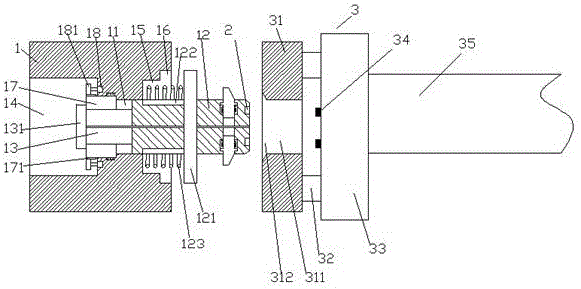
  • Figure 1
    Figure 1
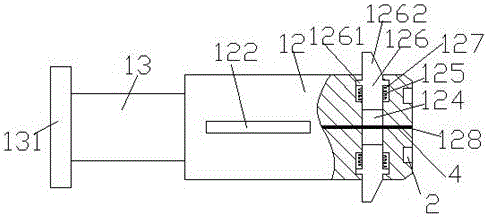
  • Figure 2
    Figure 2
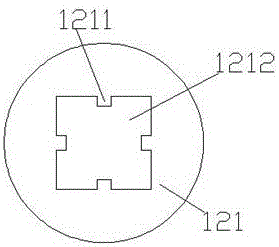
  • Figure 3
    Figure 3
Patent Text Reader

Abstract

The invention discloses an anti-loose electric power supply plug device, which comprises a plug mechanism, a socket mechanism and a fixed base, wherein the plug mechanism comprises a tensioning piece, a plug piece, a power transmission line and a shaft rod arranged between the tensioning piece and the plug piece; a control cavity is arranged in the socket mechanism; a hollow mechanism is arranged in the socket mechanism at the left side of the control cavity; a first cavity is arranged in the socket mechanism at the right side of the control cavity; a second cavity is arranged at the right side of the first cavity; the control cavity is internally connected to a plug projecting tongue piece in a sliding manner; a stud is fixedly arranged at the end face of the left side of the plug projecting tongue piece; the right side end of the plug projecting tongue piece penetrates through the first cavity and the second cavity and stretches out of the right outer wall of the socket mechanism; the plug projecting tongue piece is connected to a resisting piece in a sliding manner; a sliding groove is arranged at the outer circle of the left section of the plug projecting tongue piece; through holes are arranged in the right section of the plug projecting tongue piece vertically and equally; a locking groove is arranged in each through hole; and a lock pin is arranged in each locking groove.
Need to check novelty before this filing date? Find Prior Art

Description

technical field

[0001] The invention relates to the field of electric power, in particular to an anti-loosening electric power supply plug-in device. Background technique

[0002] Currently, power supply devices are often used in the electric power field. In the first-line power equipment, the power components in the power equipment are often powered by the connection of the plug and the socket, so the stability of the connection between the plug and the socket is the key to determine whether the power components can operate normally. All of them are powered on through the plug inserted into the socket. Since there is no locking structure between the plug and the socket, it is easy to cause loose connection, which makes it impossible to normally supply power to the power components in the power equipment, which not only seriously affects the power supply, but also When it is loose, it is very easy to cause the danger of electric shock, and there is a great potential safety ...

Examples

Embodiment Construction

[0020] Such as Figure 1-Figure 4 As shown, a kind of anti-loosening power supply plug-in device of the present invention comprises a plug mechanism 3 and a socket mechanism 1, and the plug mechanism 3 is composed of a tensioning member 31, a plug member 33, a power line 35 and an The shaft 32 between the tight part 31 and the plug part 33 is formed. The socket mechanism 1 is provided with a control cavity 11, and the socket mechanism 1 on the left side of the control cavity 11 is provided with a hollow mechanism 14. The socket mechanism 1 on the right side of the cavity 11 is provided with a first cavity 15, and the right side of the first cavity 15 is provided with a second cavity 16, and the control cavity 11 is slidably connected with a plug tongue. 12. A stud 13 is fixed on the left end surface of the insertion tongue member 12, and the right end of the insertion tongue member 12 penetrates the first cavity 15 and the second cavity 16 and protrudes out of the first cavity...