
Supervised neighborhood preserving embedding method based on kernel function
A technology of neighbor preservation and kernel function, which is applied in the direction of instruments, character and pattern recognition, computer components, etc., can solve the problem of not using known sample data category information, etc., and achieve the effect of high recognition rate and good separability
- Summary
- Abstract
- Description
- Claims
- Application Information
AI Technical Summary
Problems solved by technology
Method used
Image


Examples
Embodiment Construction
[0028] Below in conjunction with accompanying drawing, technical scheme of the present invention is described in further detail:
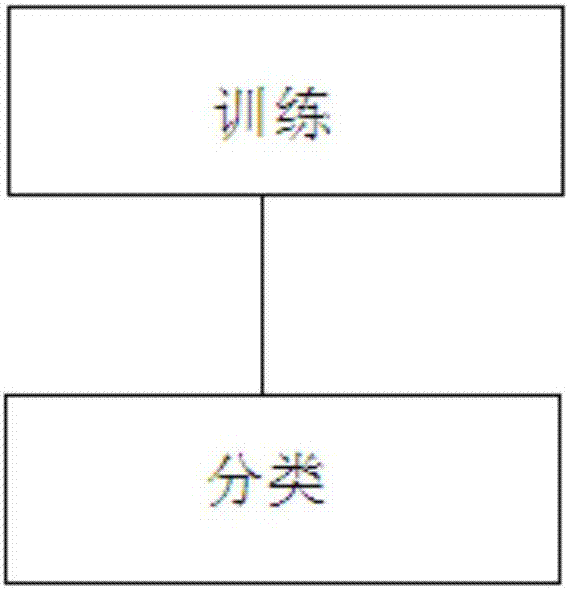
[0029] Such as figure 1 As shown, a supervised neighbor-preserving embedding method based on kernel function, including training and classification;
[0030] The training specifically includes the following steps:
[0031] Step 1, kernel function mapping:
[0032] Suppose the training sample set in the original space is Among them, c i is x i category label, c represents the number of categories, N represents the total number of training samples, and d represents the dimension of the training samples; the kernel function can explore the inherent geometric structure of the nonlinear space, through the function φ:∈R d →F maps the original d-dimensional data to a nonlinear feature space; where the function φ is K(x i ,x j )=i ),φ(x j )>;
[0033] Step 2, training data preprocessing:
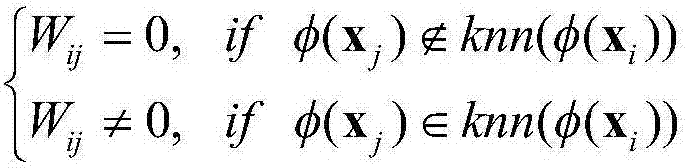
[0034] For the spatial samples mapped by the kernel func...
PUM
 Login to View More
 Abstract
Description
Claims
Application Information
 Login to View More