
Kit for detecting polymorphism of APOE gene and SLCO1B1 gene
A detection kit and gene polymorphism technology, applied in the field of molecular biology, can solve the problems of difficult clinical promotion, low sensitivity, and long operation time, and achieve the effects of easy clinical promotion, low equipment requirements, and high sensitivity
- Summary
- Abstract
- Description
- Claims
- Application Information
AI Technical Summary
Problems solved by technology
Method used
Image

Examples
Embodiment 1
[0085] Example 1 Optimization experiment of primers and quality control housekeeping gene primers for detection of APOE and SLCO1B1 gene polymorphisms
[0086]The present invention designs multiple pairs of ARMS primers, and compares the detection efficiencies of the primers, that is, the comparison of the Ct values of the PCR amplification curves. The smaller the Ct value, the higher the efficiency of the primers and the higher the detection sensitivity. The primers suffixed with D in Table 5 are another primer designed for the same detection gene locus. The housekeeping gene primer suffixed with D is another designed primer. The downstream primers at the same site are the same primer.
[0087] table 5
[0088]
[0089]
[0090] When the reaction system is formed, the present invention has 4 reaction systems, and each system has 6 primers. If there is no optimization and improvement between the primers, there will inevitably be pairing or other mismatches between th...
Embodiment 2
[0127] Embodiment 2 Assembly of APOE and SLCO1B1 gene polymorphism detection kit of the present invention
[0128] 1. Primer synthesis: specific primers determined in Example 1. The primers were prepared as 100uM stock solution for storage.
[0129] 2. Preparation of internal reference system: 4 pairs of internal reference primers designed for the human genome determined in Example 1, the primer pair sequences are ACTB-1F and ACTB-1R, ACTB-2F and ACTB-2R, ACTB-3F and ACTB-3R, ACTB -4F and ACTB-4R; the internal reference primers were respectively prepared into 100 μM mother solution for storage.
[0130] 3. Prepare a positive control substance and a blank control substance. The positive control substance contains 4 kinds of plasmid DNA, and these plasmid DNAs contain APOE 388T, APOE 388C, APOE 526C, APOE 526T, SLCO1B1 388A, SLCO1B1 388G, SLCO1B1 521T, SLCO1B1 521C , the internal reference plasmid ACTB of the housekeeping gene, the selection and design of this plasmid are well...
Embodiment 3
[0138] The APOE and SLCO1B1 gene polymorphism detection kit prepared in Example 2 was used to detect the samples to be tested. 1. Prepare the reaction mixture (Mix) for each site, and prepare according to the table below;
[0139] Table 9
[0140] Element
per reaction volume
N share system
2X Master mix
12.5ul
N×12.5ul
add water
10.5ul
N×10.5ul
[0141] 2. Fluorescent quantitative PCR detection of samples
[0142] Take 2 μl of the extracted qualified DNA samples and add them to the 23 μl Mix1, Mix2, Mix3, and Mix4 detection reaction systems of the kit in Example 2, so that the total volume of the four reaction systems is 25 μl, and put them into the fluorescence quantitative PCR instrument, set the PCR reaction program as follows to carry out the amplification reaction:
[0143] 50°C for 2min; 95°C for 2min; 95°C for 10s, 56°C for 45s, 45 cycles; collect the fluorescence signal of SYBR after each cycle.
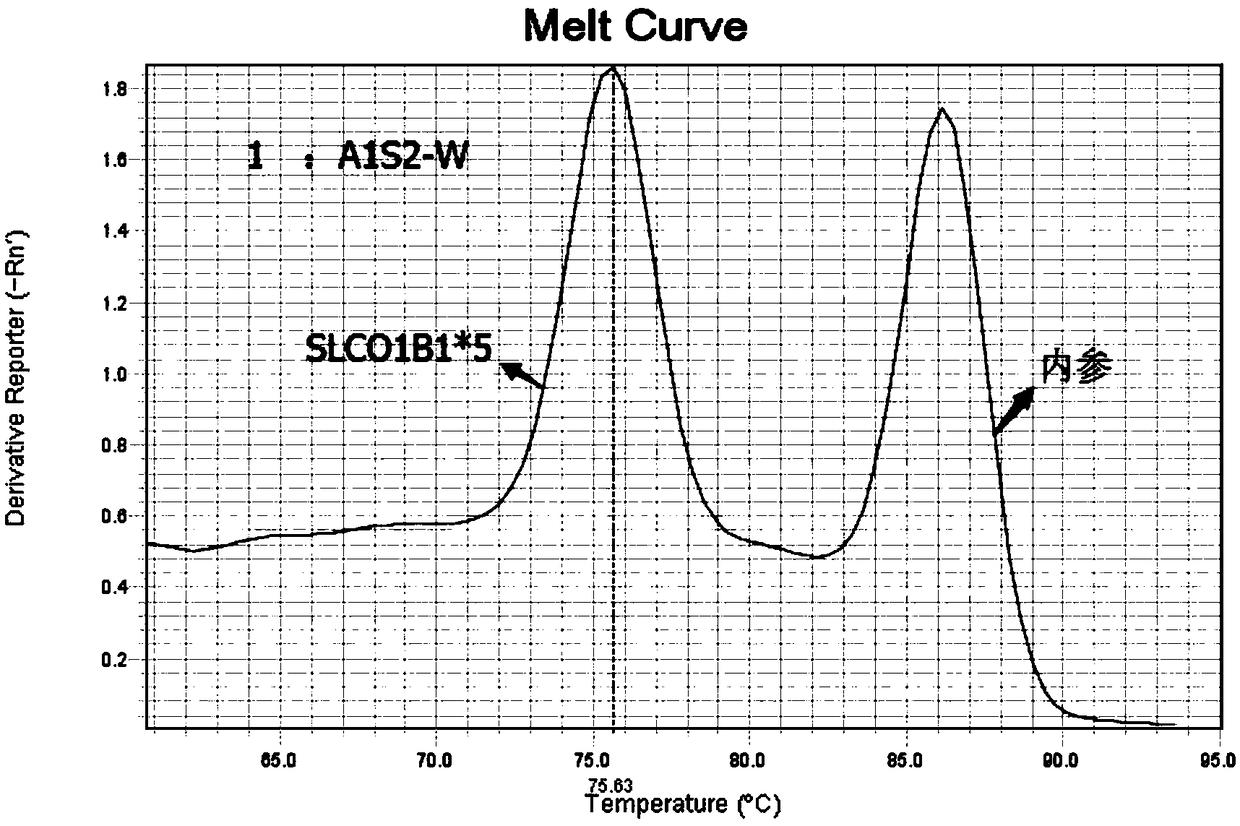
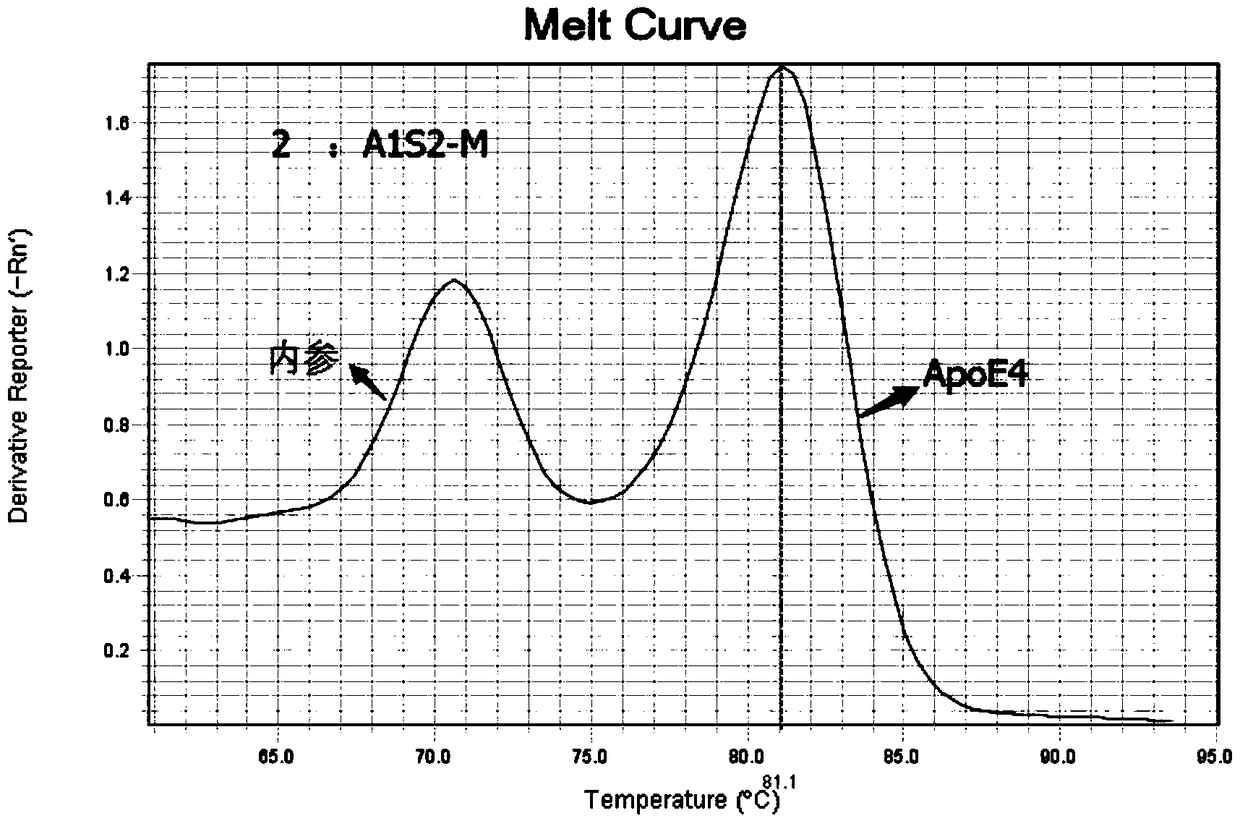
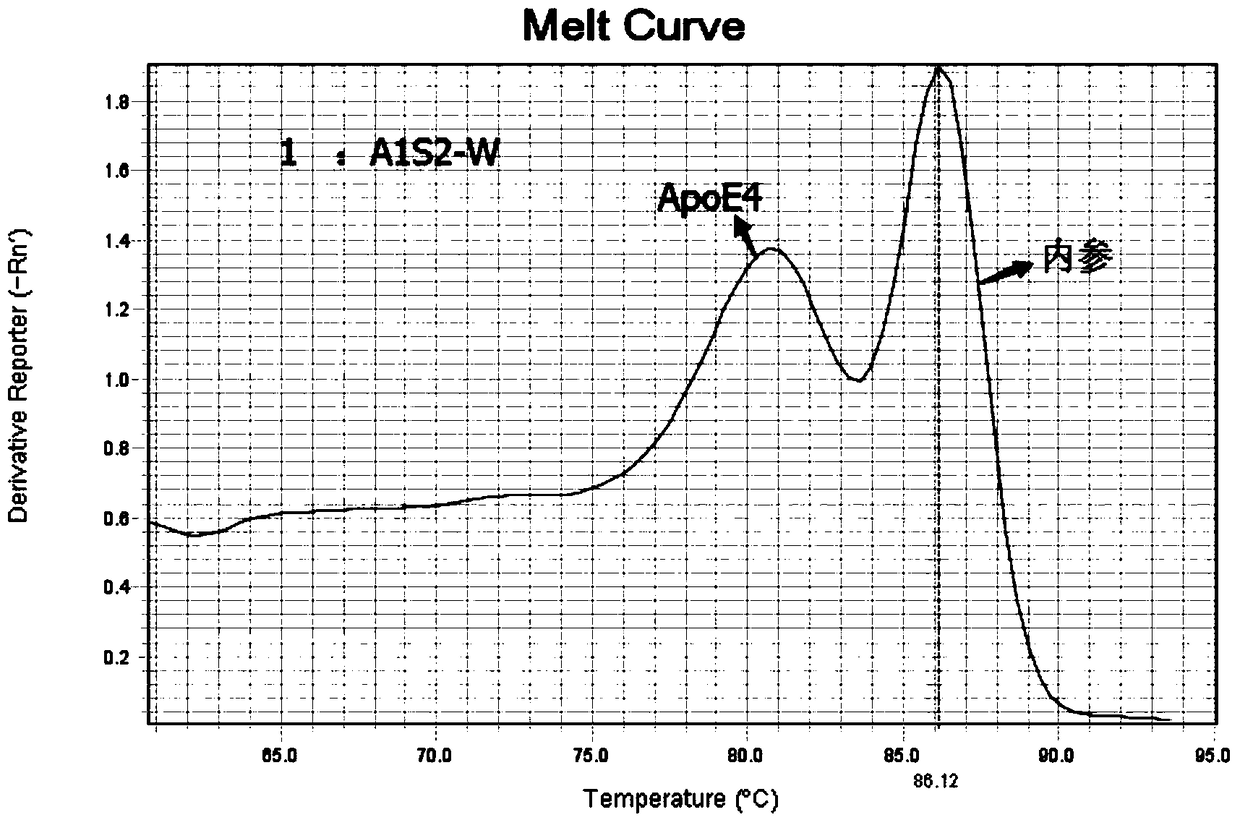
[0144] Melting cur...
PUM
 Login to View More
 Abstract
Description
Claims
Application Information
 Login to View More