
Method of preparing bioactive phospholipid from tuna eyes
A bioactive, tuna-based technology, applied in the field of food processing, can solve problems such as phospholipid research that has not been reported, and achieve the effect of enriching market space and promoting healthy development
- Summary
- Abstract
- Description
- Claims
- Application Information
AI Technical Summary
Problems solved by technology
Method used
Image


Examples
Embodiment 1
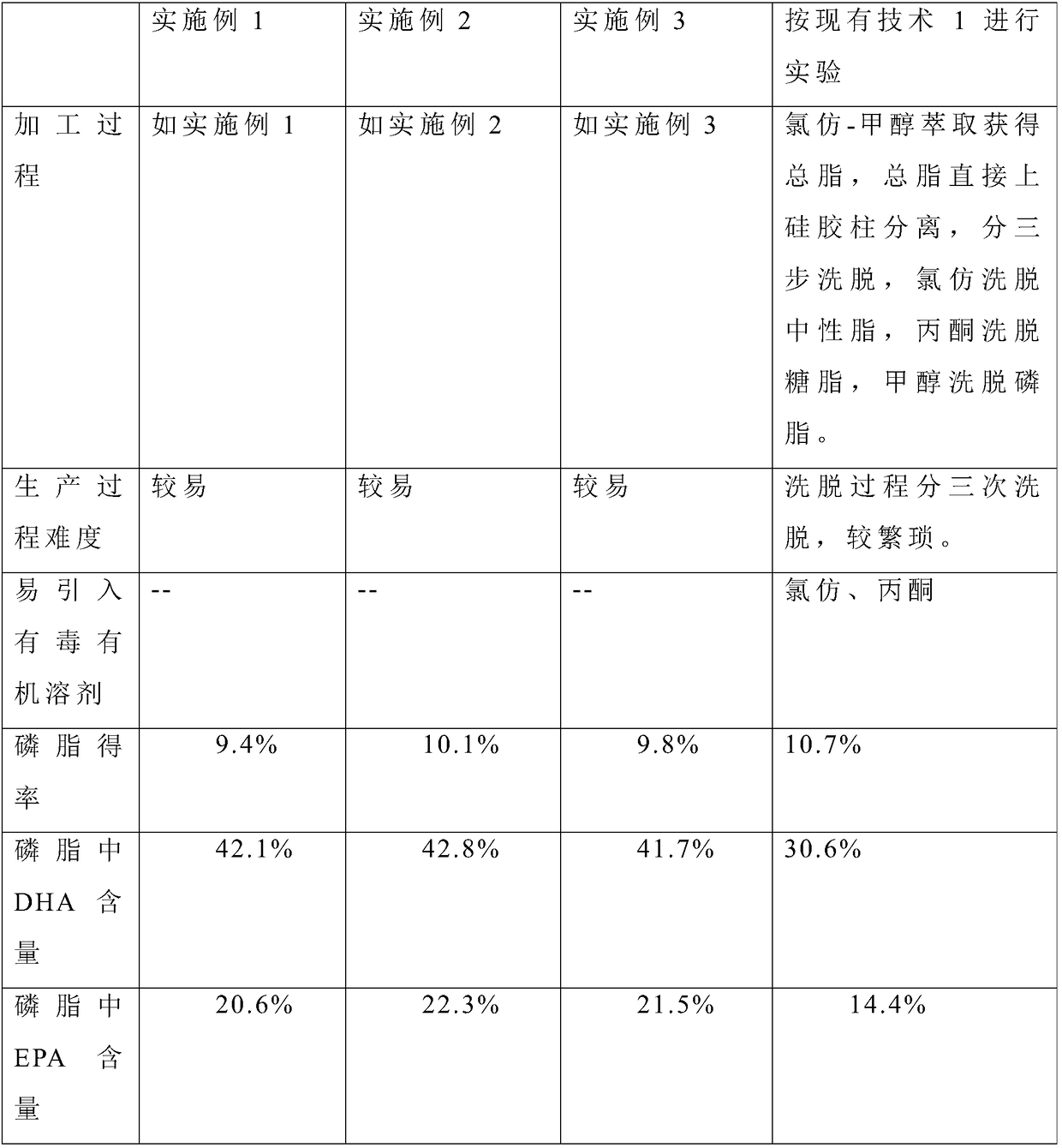
[0040] This implementation case shows a method for preparing highly bioactive phospholipids from tuna eyes according to the following steps:
[0041]Take tuna eyes (10 times the diameter of tuna fish eyes), remove fish bones, add 95% alkaline ethanol solution (fish eye weight: solution volume is 1:5), homogenize at 4 °C for 15 minutes, in which 95% alkali The neutral ethanol solution is to add NaOH to 95% ethanol to make it pH 10.0. Under the action of ultrasonic waves, stir and extract the phospholipid-containing lipids in the eyes of tuna. The extraction time is 2 hours, and the extraction temperature is 40°C. During the extraction period, ultrasonic-assisted extraction is performed intermittently every 30 minutes. 60W / cm 2 , the ultrasonic frequency is 25kHz. After the extraction, filter with three layers of gauze and three layers of filter paper respectively, take the filtrate and distill it under reduced pressure at 40°C to collect the lipid fraction, and the ethanol ca...
Embodiment 2
[0043] This implementation case shows a method for preparing highly bioactive phospholipids from tuna eyes according to the following steps:
[0044] Take the tuna eye (12 times the diameter of the tuna fish eye), remove the fish bones, add 95% alkaline ethanol solution (fish eye weight: solution volume is 1:8), homogenize at 4 ° C for 18 minutes, in which 95% alkali The neutral ethanol solution is to add NaOH to 95% ethanol to make it pH 10.5. Under the action of ultrasonic waves, stir and extract the phospholipid-containing lipids in the eyes of tuna. The extraction time is 3 hours, and the extraction temperature is 50°C. During the extraction period, ultrasonic-assisted extraction is performed intermittently every 30 minutes. 80W / cm 2 , the ultrasonic frequency is 25kHz. After the extraction, filter with three layers of gauze and three layers of filter paper respectively, take the filtrate and distill it under reduced pressure at 42°C to collect the lipid fraction, and th...
Embodiment 3
[0046] This implementation case shows a method for preparing highly bioactive phospholipids from tuna eyes according to the following steps:
[0047] Take tuna eyes (15 times the diameter of tuna fish eyes), remove the fish bones, add 95% alkaline ethanol solution (fish eye weight: solution volume is 1:10), homogenize at 4 °C for 20 minutes, in which 95% alkali The neutral ethanol solution is to add NaOH to 95% ethanol to make it pH 11.0. Under the action of ultrasonic waves, stir and extract the phospholipid-containing lipids in the eyes of tuna. The extraction time is 5 hours, and the extraction temperature is 60°C. During the extraction period, ultrasonic-assisted extraction is performed intermittently every 30 minutes. 100W / cm 2 , the ultrasonic frequency is 25kHz. After the extraction, filter with three layers of gauze and three layers of filter paper respectively, take the filtrate and distill it under reduced pressure at 45°C to collect the lipid fraction, and the eth...
PUM
 Login to View More
 Abstract
Description
Claims
Application Information
 Login to View More