A method for catalytic diesel hydrogenation conversion to aromatics

A catalytic diesel and hydrogenation conversion technology, which is applied in the fields of hydrotreating process, hydrocarbon oil treatment, petroleum industry, etc., can solve the problem of poor selectivity of single-ring aromatics, achieve high selectivity of single-ring aromatics, reduce processing costs, and improve Effect of Hydrogen Utilization Efficiency

CN109777514BActive Publication Date: 2021-07-09CHINA PETROLEUM & CHEM CORP +1
8 Cites 0 Cited by

Patent Information

Authority / Receiving Office
CN · China
Patent Type
Patents(China)
Current Assignee / Owner
Publication Date
2021-07-09

Smart Images

  • Figure 1
    Figure 1
  • Figure 2
    Figure 2
  • Figure 3
    Figure 3
Patent Text Reader

Abstract

The invention discloses a method for producing aromatics by catalytic diesel hydrogenation conversion, which comprises the following steps: (1) high aromatics catalytic diesel oil is mixed with circulating hydrogen and enters I hydrorefining reaction zone for reaction; (2) the product obtained in step (1) Oil and circulating hydrogen are mixed into II hydrofinishing reaction zone for further reaction, the reaction temperature is 30~120℃ higher than I hydrofinishing reaction zone, and the liquid hourly volume space velocity is 0.2~1.5h lower than I hydrofining reaction zone ‑1 ; (3) The generated oil obtained in step (2) is mixed with circulating hydrogen into the hydrocracking reaction zone for hydrocarbon hydroconversion reaction; (4) The generated oil obtained in step (3) is passed through a separation and fractionation system to obtain gas, light Naphtha, heavy naphtha, diesel fraction, part of the diesel is recycled back to the II hydrorefining reaction zone, and part of the diesel is sent out of the unit; (5) The heavy naphtha fraction obtained in step (4) enters the aromatics extraction system to obtain aromatics products. The method provides a coupled hydrocracking-aromatics extraction process for processing catalytic diesel raw materials, which can effectively increase the production of aromatics.
Need to check novelty before this filing date? Find Prior Art

Description

technical field

[0001] The invention relates to the field of petroleum refining. Specifically, it relates to a method for producing aromatics from catalytic diesel oil by coupling hydrocracking-aromatics extraction process. Background technique

[0002] Catalytic cracking is currently the most important secondary processing process in the petroleum refining industry, and it is also the core process of lightening heavy oil. As the world's oil becomes increasingly heavy, the processing capacity of the FCC unit is also continuously improved. Using various heavy oils as raw materials, high-octane gasoline, the main product, is obtained through catalytic cracking reactions, and a large amount of sulfur, nitrogen, and aromatics are produced at the same time. Catalytic diesel oil with high content, low cetane number or cetane index, and extremely poor stability. Moreover, the requirements of environmental protection regulations are becoming more and more stringent, and the indica...

Examples

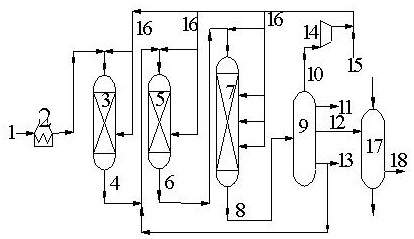
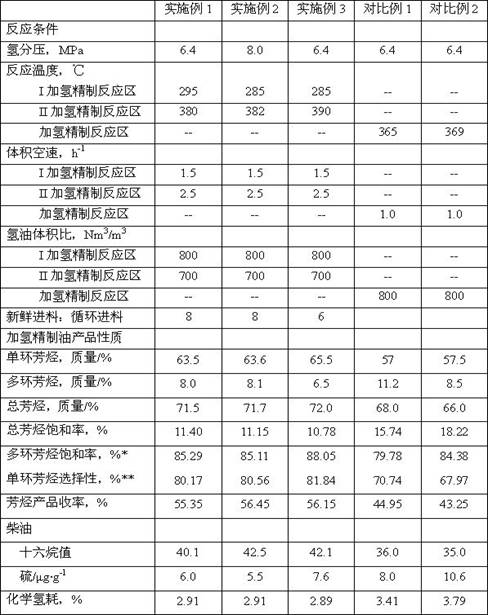
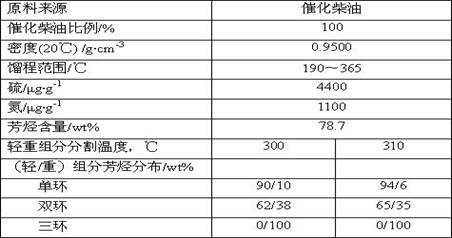
Embodiment 1~3

[0040] Embodiment 1~3 all adopts flow process of the present invention, figure 1 The combined process flow shown. After being heated by the heating furnace, the high-aromatic catalytic diesel oil is mixed with circulating hydrogen and enters the I hydrorefining reaction zone for hydrodesulfurization, polycyclic aromatic hydrocarbons selective hydrogenation saturation and other reactions; the obtained oil is mixed with circulating hydrogen and enters II hydrorefining reaction zone The reaction zone carries out further hydrodesulfurization reaction and aromatics selective reaction; the obtained oil is mixed with circulating hydrogen and enters the hydrocracking reaction area for hydrocarbon hydroconversion reaction; the obtained oil is separated and fractionated to obtain gas, pumice Naphtha, heavy naphtha, diesel fractions. Part of the diesel is recycled back to the II hydrorefining reaction zone, and part of the diesel is sent out of the unit. The gas is recycled through the...