
Medium for cucurbita pepo L cultivation in solar greenhouse and cultivation method
A solar greenhouse and zucchini technology, which is applied in the direction of planting substrate, cultivation, culture medium, etc., can solve the problems of tediousness and high one-time input costs, and achieve the effects of increasing accumulation, improving the quality of zucchini, and saving costs
Inactive Publication Date: 2019-06-18
新疆生产建设兵团第十二师农业科学研究所
View PDF4 Cites 0 Cited by
- Summary
- Abstract
- Description
- Claims
- Application Information
AI Technical Summary
Problems solved by technology
In view of the high one-time investment cost of facility substrate cultivation and cumbersome nutrient solution management, we use cheap edible fungus waste and develop edible fungus waste into a new substrate substitute through fermentation technology. Based on the principle of quantity, cleanliness, efficiency, ecology, and sustainability, promote the structural adjustment, transformation and upgrading of facility agriculture, carry out years of improvement, experimentation, demonstration and promotion of new substrate cultivation, and explore an organic ecological substrate that is acceptable to farmers and easy to promote. and new cultivation techniques
Method used
the structure of the environmentally friendly knitted fabric provided by the present invention; figure 2 Flow chart of the yarn wrapping machine for environmentally friendly knitted fabrics and storage devices; image 3 Is the parameter map of the yarn covering machine
View moreImage
Smart Image Click on the blue labels to locate them in the text.
Smart ImageViewing Examples



Examples
Experimental program
Comparison scheme
Effect test
Embodiment
[0024] 1.1 Experimental materials
[0025] The variety of zucchini is 'Yuedong Hanyu', provided by Guangzhou Danong Gardening Seed Co., Ltd.
[0026] 1.2 Experimental design
[0027] 1.2.1 Matrix ratio
[0028] It is prepared from the following raw materials in parts by weight: 100 parts of mushroom matrix waste, 1 part of cow dung, 1 kg of urea to adjust the carbon-nitrogen ratio, adding water to control the humidity at 60-70%, adding fermenting bacteria to build a heap, and fermenting for 30-40 days. Then expose to the sun for 5 days, and finally compound according to the ratio of mushroom substrate waste after fermentation: peat: perlite = 7:7:6.
[0029] 1.2.2 Overview of the test site
the structure of the environmentally friendly knitted fabric provided by the present invention; figure 2 Flow chart of the yarn wrapping machine for environmentally friendly knitted fabrics and storage devices; image 3 Is the parameter map of the yarn covering machine
Login to View More PUM
 Login to View More
 Abstract
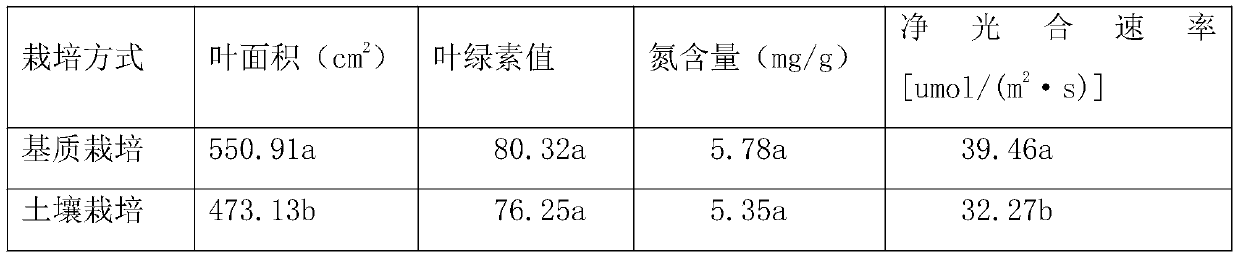
The invention discloses a medium for cucurbita pepo L cultivation in a solar greenhouse. The medium is obtained by compounding fermented waste mushroom medium materials, peat and perlite according tothe mass ratio of (5-10):7:(5-8), and a preparation method for the fermented waste mushroom medium materials comprises the steps that by weight, 0.5-2 parts of cow dung and 0.5-2 parts of urea are added into 100 parts of waste mushroom medium materials, water is added to control the humidity to be 60-70%, then zymophyte is added to build a heap, fermentation lasts for 30-40 d, and the heap is exposed to the blazing sun for 5 d; the invention discloses a method for cultivating the cucurbita pepo L in the solar greenhouse by adopting the medium. By adopting the medium, the transplanting survivalrate can be increased by 11.64%, the cost is reduced, cucurbita pepo L seedlings enter the seedling recovering period 3 days in advance, and growth and development of the cucurbita pepo L cultivatedby adopting the medium are significantly superior to those of cucurbita pepo L cultivated by adopting soil, the bad fruit rate of the cucurbita pepo L adopting medium cultivation is reduced by 4.69% compared with the bad fruit rate of the cucurbita pepo L adopting soil cultivation, the commercial fruit rate is effectively increased, the quality of the cucurbita pepo L is improved, and the yield ofthe cucurbita pepo L adopting medium cultivation is significantly higher than that of the cucurbita pepo L adopting soil cultivation.
Description
technical field [0001] The invention relates to a substrate for cultivating zucchini in a solar greenhouse and a cultivation method. Background technique [0002] Zucchini (Cucurbita pepo L.) belongs to the family Cucurbitaceae and belongs to the genus Cucurbita. It is native to southern North America. It was introduced and cultivated in China from Europe in the middle of the 19th century, and it is distributed all over the world. It is an annual creeping herb, and there are three major strains: dwarf, semi-climbing and trailing. It has strong water absorption and drought resistance, low temperature and weak light resistance, strong root system, strong adaptability, fruit storage and transportation resistance, and high planting benefits. Zucchini contains more nutrients such as vitamin C and glucose, which has the effects of relieving restlessness and thirst, moistening the lungs and relieving cough, clearing away heat and diuresis, and reducing swelling and stagnation. Th...
Claims
the structure of the environmentally friendly knitted fabric provided by the present invention; figure 2 Flow chart of the yarn wrapping machine for environmentally friendly knitted fabrics and storage devices; image 3 Is the parameter map of the yarn covering machine
Login to View More Application Information
Patent Timeline
 Login to View More
 Patent Type & AuthorityApplications(China)
IPC IPC(8): A01G24/20A01G24/28A01G24/15A01G24/30A01G31/00
CPCA01G31/00A01G24/10A01G24/15A01G24/20A01G24/28
Inventor郑剑超董飞智雪萍陈烨华
Owner新疆生产建设兵团第十二师农业科学研究所