Semi-supervised learning method for GAN model training

A semi-supervised learning and model training technology, applied in the field of deep learning, can solve problems such as the inability to correctly guide the generator and update parameters

A semi-supervised learning and model training technology, applied in the field of deep learning, can solve problems such as the inability to correctly guide the generator and update parameters

CN110569842AActive Publication Date: 2019-12-13江苏艾佳家居用品有限公司

Image

Smart Image Click on the blue labels to locate them in the text.
Viewing Examples
Smart Image
  • Semi-supervised learning method for GAN model training
  • Semi-supervised learning method for GAN model training
  • Semi-supervised learning method for GAN model training

Examples

Experimental program
Comparison scheme
Effect test

Embodiment Construction

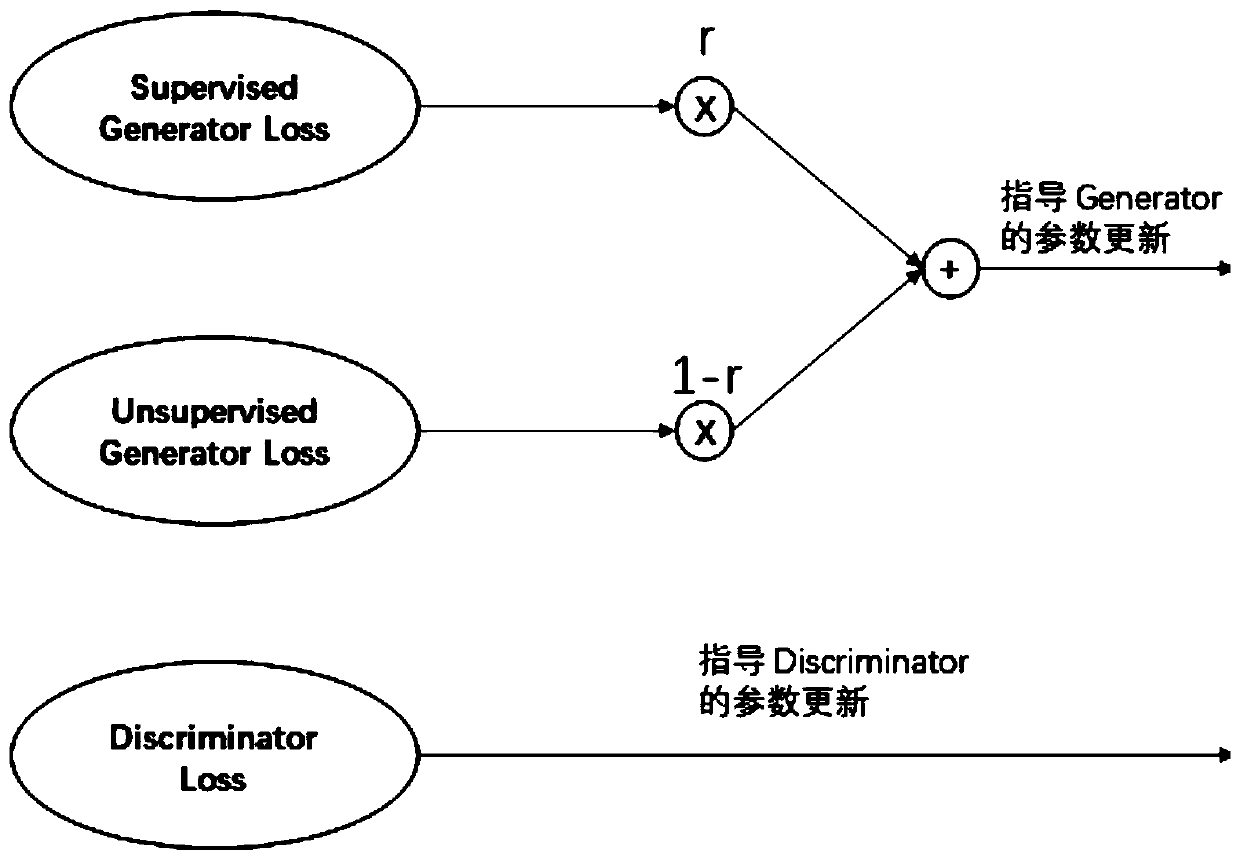
[0046] In the GAN model (generated confrontation network model), there are two models that compete with each other, one is the generator and the other is the discriminator. The abbreviated generator is the function G(.), and the adversarial is the function D(.). The general generator loss function is defined as follows:

[0047] L G =∑(1-D(G(n)))

[0048]Among them, n is the input seed of the generator, denote the generator as G(.), and denote the adversarial as D(.).

[0049] The loss function of the adversarial is defined as follows:

[0050] L D =∑(D(real)-D(G(n)))

[0051] Among them, real is a real case.

[0052] During the training process of the GAN model, the value of the generator loss function guides the parameter update of the generator, and the guiding method can be an optimizer such as Adam. Likewise, the loss function value of the adversarial device guides the parameter update of the adversarial device.

[0053] The semi-supervised learning method for GAN...

the structure of the environmentally friendly knitted fabric provided by the present invention; figure 2 Flow chart of the yarn wrapping machine for environmentally friendly knitted fabrics and storage devices; image 3 Is the parameter map of the yarn covering machine
Login to View More

PUM

No PUM Login to View More

Abstract

The invention discloses a semi-supervised learning method for GAN model training through adaptive supervised ratio control. According to the method, the problem that the authenticity identification rule obtained by adversarial device learning in the GAN model training process is insufficient to guide a generator to generate a high-precision case is effectively solved; through the self-adaptive supervision ratio, the model automatically controls the amount of fused label information, the data information is effectively utilized, and the generated case meets the diversity and fidelity at the same time.

Description

technical field [0001] The invention relates to a GAN model training method in the field of deep learning, in particular to a semi-supervised GAN learning method for controlling the degree of supervision through an adaptive supervision ratio. Background technique [0002] Generative Adversarial Networks (GAN, Generative Adversarial Networks) is a deep learning model. GAN models are widely used in image generation, speech generation, text generation and other fields. For the training of GAN models, unsupervised training methods are generally used, so that a large amount of unlabeled natural data can be used; when there is partly labeled data, the semi-supervised learning framework can be used to obtain the input code and label of the generator. Correspondence, complete the training of C-GAN. However, these general methods have the following problems: 1. The data information, especially the label information, cannot be fully utilized; 2. The authenticity rules learned by the ...

Claims

the structure of the environmentally friendly knitted fabric provided by the present invention; figure 2 Flow chart of the yarn wrapping machine for environmentally friendly knitted fabrics and storage devices; image 3 Is the parameter map of the yarn covering machine
Login to View More

Application Information

Patent Timeline
13 Dec 2019
Publication
CN110569842A
IPC
G06K9/32; G06K9/62; G06N3/08
CPC
G06N3/08; G06V10/25; G06F18/253; Y02P90/30
Inventors
陈旋; 吕成云