Unlock instant, AI-driven research and patent intelligence for your innovation.
Unmanned surface vehicle trajectory tracking control method under time-lag asymmetric time-varying full-state constraints
What is Al technical title?
Al technical title is built by PatSnap Al team. It summarizes the technical point description of the patent document.
A trajectory tracking and control method technology, applied in the field of control, can solve problems such as poor control effect and no consideration of time-delay constraints
Active Publication Date: 2020-10-02
HARBIN ENG UNIV
View PDF18 Cites 10 Cited by
Summary
Abstract
Description
Claims
Application Information

AI Technical Summary
This helps you quickly interpret patents by identifying the three key elements:
Problems solved by technology
Method used
Benefits of technology
Problems solved by technology
[0004] In order to solve the problem that the existing USV trajectory tracking control method does not consider the time lag constraint, the control effect is not good.
Method used
the structure of the environmentally friendly knitted fabric provided by the present invention; figure 2 Flow chart of the yarn wrapping machine for environmentally friendly knitted fabrics and storage devices; image 3 Is the parameter map of the yarn covering machine
View more
Image
Smart Image Click on the blue labels to locate them in the text.
Viewing Examples
Smart Image
Click on the blue label to locate the original text in one second.
Reading with bidirectional positioning of images and text.
Smart Image
Examples
Experimental program
Comparison scheme
Effect test
specific Embodiment approach 1
[0072] This embodiment is a method for tracking and controlling the trajectory of an unmanned surface vehicle under the constraint of time-delay asymmetric time-varying full state, including the following steps:
[0073] 1. Establish a closed-loop system for surface unmanned vehicles:
[0074] A 3-degree-of-freedom surface unmanned vehicle dynamics model with multiple inputs and multiple outputs is expressed as follows:
[0075]
[0076] in, Including the position in the geodetic coordinate system (η x , η y ) and heading angle (η ψ ). Including surge velocity v x , the swaying speed v y , Yaw velocity v ψ . is a symmetric positive definite inertial matrix, represents centripetal force and Coriolis torque, is the damping matrix, g(η) represents the restoring force caused by gravity, ocean current and buoyancy, and w is the external disturbance. J(η) is a non-singular transformation matrix, the non-singular transformation matrix J(η) from satellite coordinate...
Embodiment
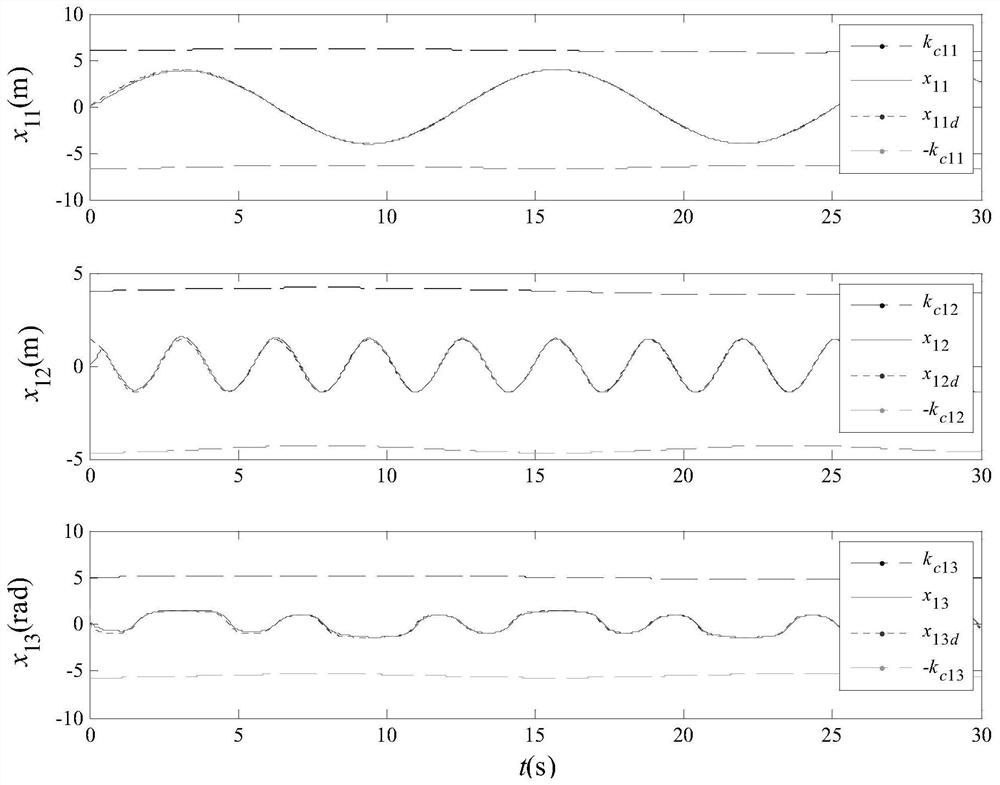
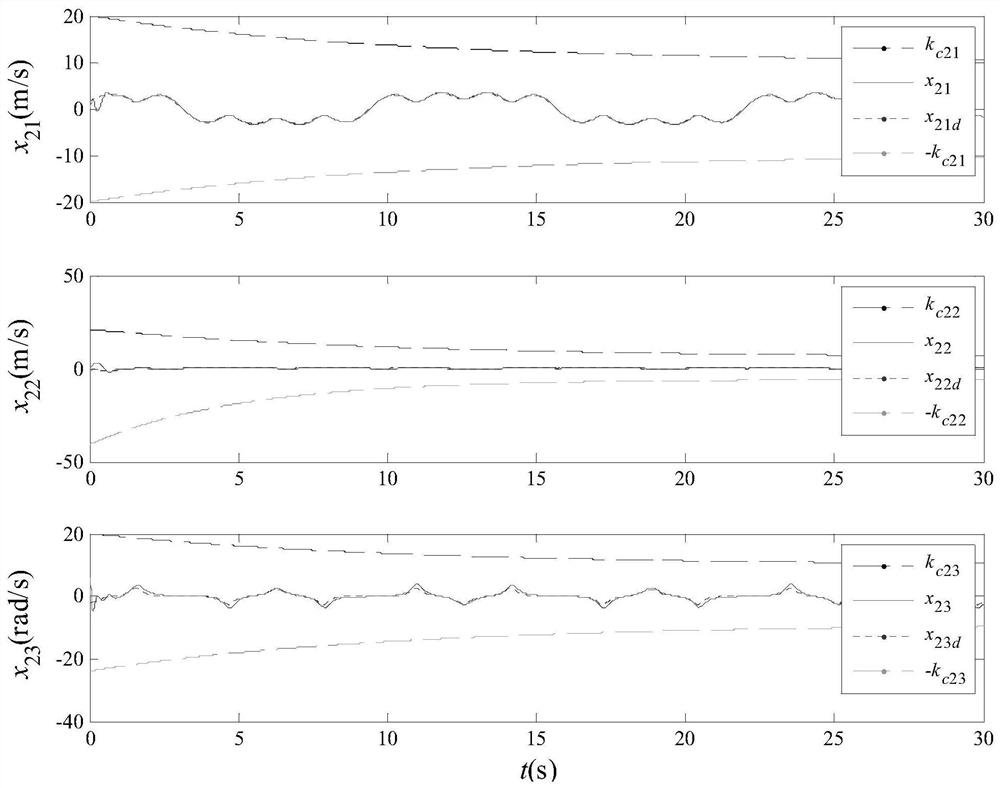
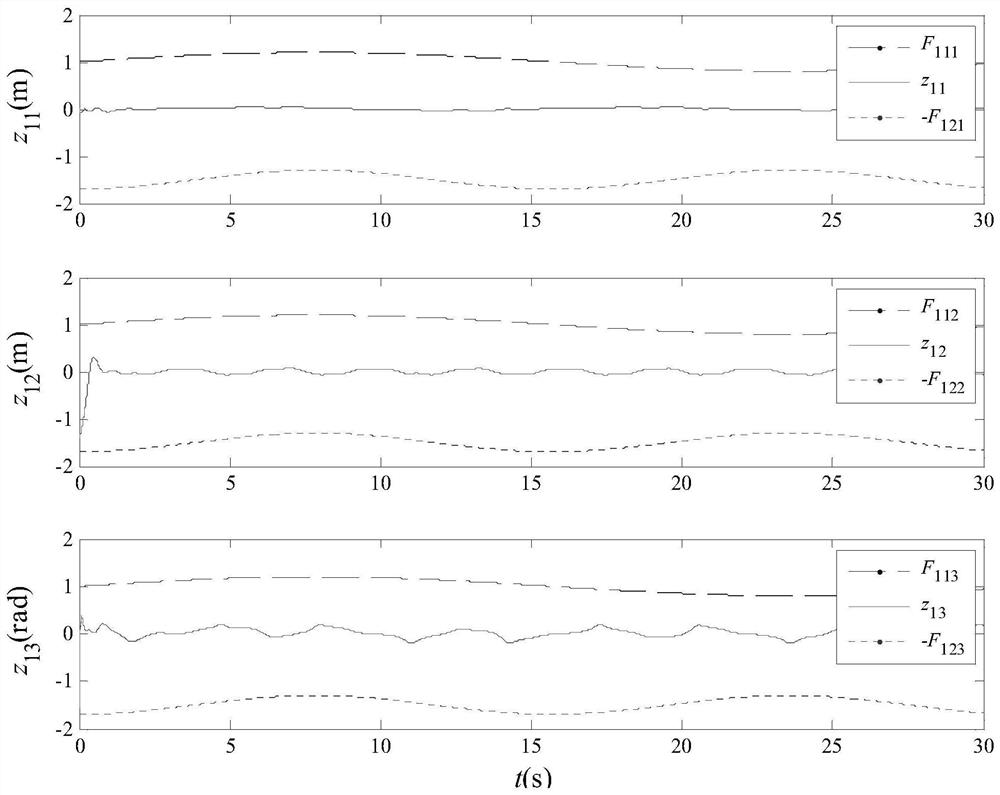
[0272] In order to verify the effectiveness of the semi-globally uniformly bounded control method and the finite-time control method proposed in the present invention, simulations are carried out using the scheme of the specific embodiment 1.
[0273] The present invention uses the model ship Cybership II, a 1:70 replica of a survey ship built by the Norwegian University of Science and Technology's Marine Control Laboratory.
[0274] The desired trajectory chosen is as follows:
[0275] x 1d (t)=[x 1xd (t),x 1yd (t),x 1ψd (t)] T
[0276]
[0277]
[0278] External disturbances are assumed as follows:
[0285] Corresponding hydrodynamic parameter among the present invention is as follows: m=23.8, I z =1.76,x g =0.046,X u =...
the structure of the environmentally friendly knitted fabric provided by the present invention; figure 2 Flow chart of the yarn wrapping machine for environmentally friendly knitted fabrics and storage devices; image 3 Is the parameter map of the yarn covering machine
Login to View More
PUM
Login to View More
Abstract
The invention discloses an unmanned surface vehicle trajectory tracking control method under time-lag asymmetric time-varying full-state constraints, and belongs to the technical field of control. Theobjective of the invention is to solve the problem of poor control effect caused by the fact that the existing USV trajectory tracking control method does not consider time lag constraints. Accordingto the invention, a shift function is used for achieving the displacement conversion of the error variable of the unmanned surface vehiclesystem; meanwhile, an asymmetric obstacle Lyapunov functionis designed, and a corresponding control law and an adaptive law are designed, so it is guaranteed that the final consistent bounded tracking control effect can be achieved no matter what initial conditions are, and time-lag asymmetric time-varying constraints can be achieved after limited time. The method is mainly used for trajectory tracking control of the unmanned surface vehicle.
Description
technical field [0001] The invention belongs to the technical field of control, and in particular relates to a tracking control method for an unmanned water surface vehicle. Background technique [0002] With the advancement of science and technology, the research on maritime unmanned vehicles has developed rapidly, and many different control strategies have emerged. For example, "A novel adaptive second orders sliding mode path following control for a portable AUV" by G.C.Zhang, H.Huang et al., "Three-dimensional path following of an underactuated AUV based on fuzzybackstepping sliding mode control" by X.Liang et al. And "Output-feedback path-following control of autonomous underwater vehicles based on an extended state observer and projection neural networks" by Z.H.Peng et al. studied the path-following control of autonomous underwater vehicles (AUVs). W.Xing et al. "Convergence analysis on multi-auv systems with leader-follower architecture" proposed a multi-AUV coopera...
Claims
the structure of the environmentally friendly knitted fabric provided by the present invention; figure 2 Flow chart of the yarn wrapping machine for environmentally friendly knitted fabrics and storage devices; image 3 Is the parameter map of the yarn covering machine
Login to View More
Application Information
Patent Timeline
Application Date:The date an application was filed.
Publication Date:The date a patent or application was officially published.
First Publication Date:The earliest publication date of a patent with the same application number.
Issue Date:Publication date of the patent grant document.
PCT Entry Date:The Entry date of PCT National Phase.
Estimated Expiry Date:The statutory expiry date of a patent right according to the Patent Law, and it is the longest term of protection that the patent right can achieve without the termination of the patent right due to other reasons(Term extension factor has been taken into account ).
Invalid Date:Actual expiry date is based on effective date or publication date of legal transaction data of invalid patent.