
Product, method and application for simultaneously detecting mycoplasma gallisepticum and mycoplasma synoviae
A technology of mycoplasma synovialum and mycoplasma gallisepticum, applied in biochemical equipment and methods, measuring devices, microbe determination/inspection, etc., can solve the problems of interfering with the normal amplification of PCR, affecting the sensitivity and specificity of PCR, and achieving Improve the detection rate, eliminate mutual interference, and high sensitivity
- Summary
- Abstract
- Description
- Claims
- Application Information
AI Technical Summary
Problems solved by technology
Method used
Image

Examples
Embodiment 1
[0043] Embodiment 1, screening and primer design of Mycoplasma gallisepticum and Mycoplasma gallisepticum common antigen
[0044] 1. Screening of common antigens
[0045] Obtain all membrane protein data of Mycoplasma gallisepticum and Mycoplasma gallisepticum through the online protein database, and further screen for strong antigenicity (according to the website http: / / www.violinet.org / vaxign / The outer membrane protein whose antigen parameter is above 0.5) compares the shared proteins of the two pathogens and analyzes the homology of the proteins. For example, the following shared proteins are obtained: WP_041352022.1, WP_041352020.1, WP_041351882.1, WP_011283540. 1. The homology of WP_020003021.1, WP_081420552.1, and WP_041352050.1 is 97.21%, 94.72%, 93.82%, 63.2%, 60%, 40%, and 35.89% respectively; select the homology at 96% The outer membrane protein of the above WP_041352022.1 (as shown in SEQ ID No.4 in its amino acid sequence) was used as the research object, and it...
Embodiment 2
[0051] Embodiment 2, optimization of PCR reaction conditions
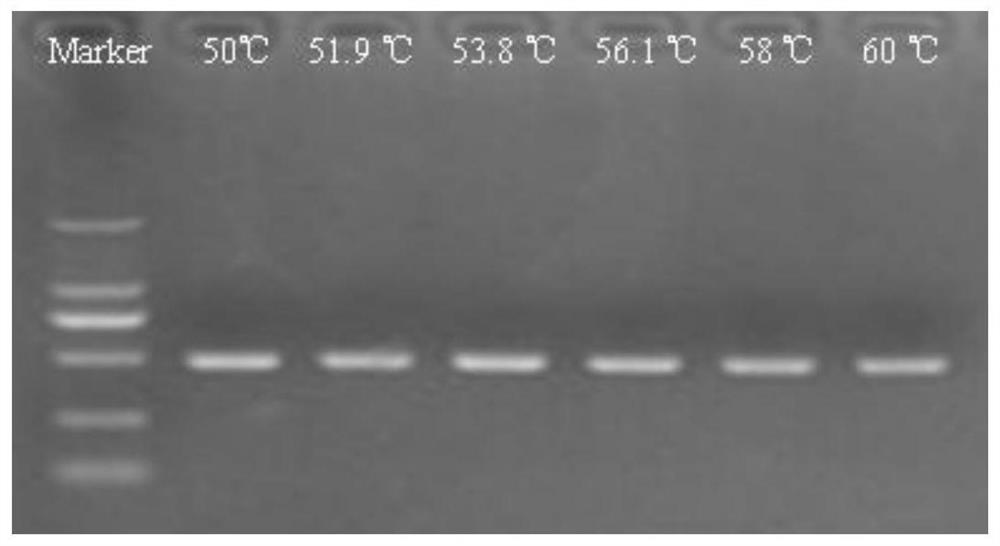
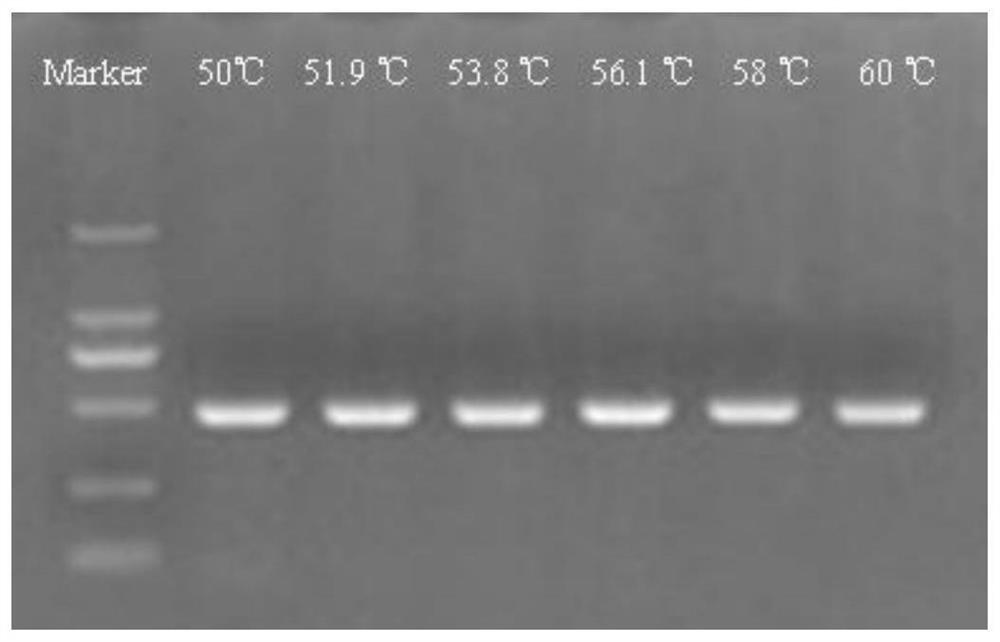
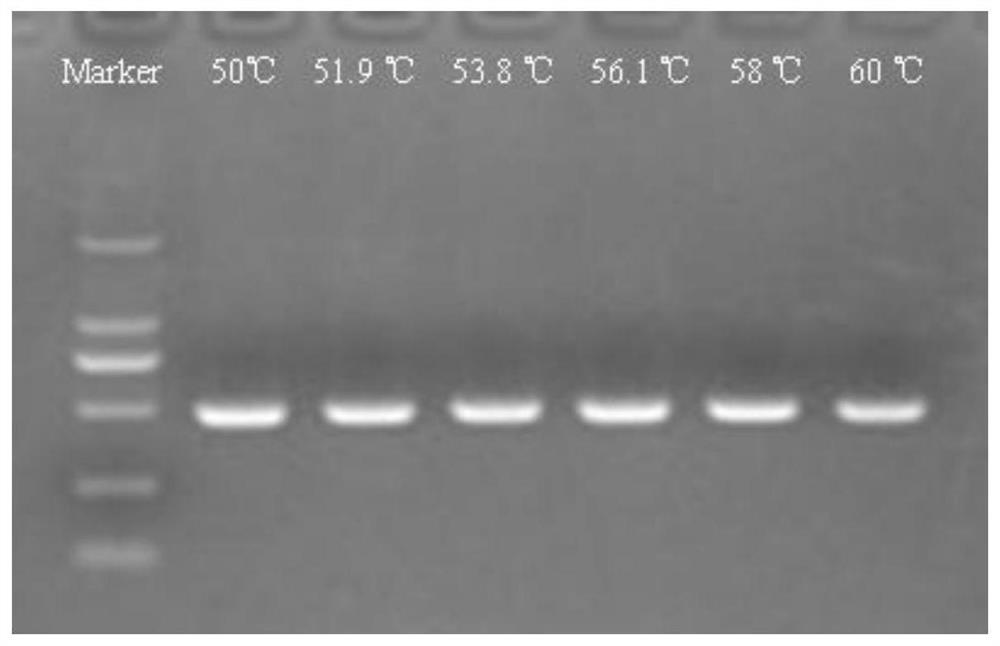
[0052] Method: The optimal annealing temperature was optimized with the DNA template of Mycoplasma gallisepticum, the DNA template of Mycoplasma gallisepticum, the DNA template of Mycoplasma gallisepticum+the DNA template of Mycoplasma gallisepticum, among which,
[0053] The PCR reaction system is as follows:
[0054] GENESTAR 2×PCR mix (including DNA polymerase and dNTP) 10 μL, template 0.1 μL (concentration 30 ng / μL), upstream primer F 1 μL (concentration 0.15 μg / μL), downstream primer R 1 μL (concentration 0.15 μg / μL), water supplement to 20 μL.
[0055] The PCR reaction conditions are as follows:
[0056] Pre-denaturation at 95°C for 5 minutes, denaturation at 95°C for 40s, annealing at 50°C-60°C for 40s, extension at 72°C for 30s, 30 cycles, and final extension at 72°C for 10 minutes;
[0057] The product was detected by agarose gel electrophoresis.
[0058] Result: if figure 1 , figure 2 and image 3...
Embodiment 3
[0059] Embodiment 3, specific detection
[0060] Method: Mycoplasma gallisepticum vaccine strain F36, st-11 strain and 6 / 85 strain, Mycoplasma gallisepticum vaccine strain H strain and Mycoplasma synovial bursa ATCC25204, Mycoplasma gallisepticum vaccine strain (F36) + chicken synovial bursa Mycoplasma vaccine strain (H strain), Mycoplasma bovis, Mycoplasma hyopneumoniae vaccine strain (RM48), Mycoplasma ovis, Escherichia coli, Salmonella, Staphylococcus, Streptococcus, Pasteurella, chicken infectious bronchial virus, chicken infection Laryngotracheitis virus, Newcastle disease virus, chicken influenza virus, and Haemophilus paragallinarum were used as templates, and PCR amplification was performed according to the reaction conditions and reaction system in Example 2, and the products were detected by agarose gel electrophoresis.
[0061] Results: Mycoplasma gallisepticum, Mycoplasma gallisepticum, and Mycoplasma gallisepticum + Mycoplasma gallisepticum can all amplify the tar...
PUM
 Login to View More
 Abstract
Description
Claims
Application Information
 Login to View More