
A zwitterionic hydrophilic chromatographic stationary phase and preparation method thereof
A technology of amphoteric ion and hydrophilic chromatography, which is applied in the field of new hydrophilic interaction chromatography stationary phase, can solve the problem that there is no fixed phase of amphoteric ion hydrophilic chromatography, and achieve simple and reliable preparation process, wide application range and good separation selectivity Effect
- Summary
- Abstract
- Description
- Claims
- Application Information
AI Technical Summary
Problems solved by technology
Method used
Image

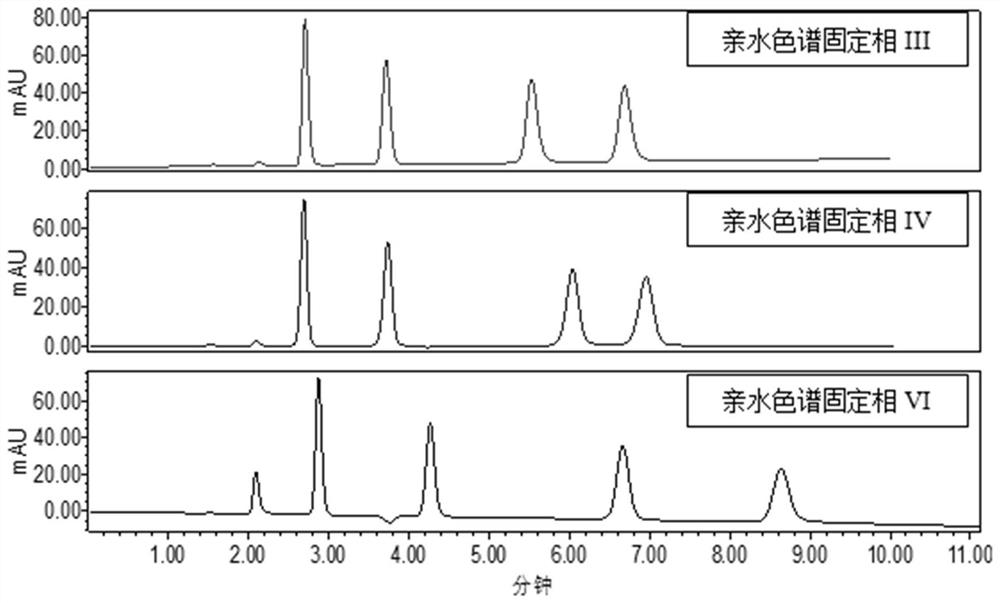
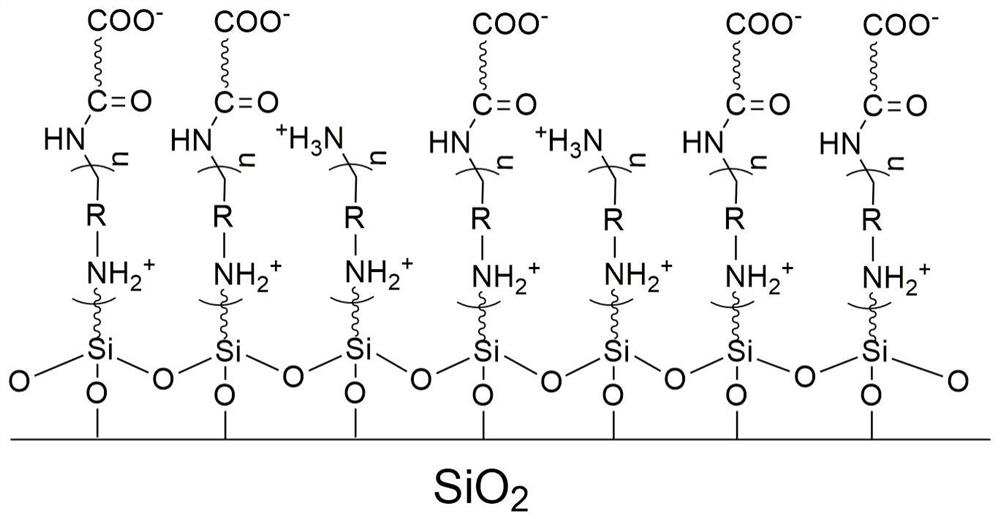
Examples
Embodiment 1
[0040] Weigh 10g spherical silica gel (particle size is 5μm, pore size is 10nm, specific surface area is 305m 2 / g), placed in a 250mL glass flask, added 150mL of 10% hydrochloric acid solution by volume, heated to reflux for 12 hours, cooled to room temperature, filtered, washed with water until neutral, and dried at 150°C for 24 hours. Put the dried silica gel in a three-necked flask, and add 80 mL of dry toluene to the silica gel under the condition of nitrogen gas, stir well, and then add N-(β-aminoethyl-γ-aminopropyl)methyl Dimethoxysilane 1mL, stirred reaction at 110°C and refluxed for 3 hours, filtered under reduced pressure and washed with toluene, dichloromethane, water, tetrahydrofuran, methanol in sequence, and dried at 60°C to constant weight to obtain polyaminosilica gel . Weigh 10g of polyamino silica gel, add 50mL of N,N-dimethylformamide, 1g of succinic anhydride, 0.1g of 4-dimethylaminopyridine and 0.1g of pyridine, stir at room temperature for 3h, after the ...
Embodiment 2
[0042] Weigh 10g spherical silica gel (particle size is 5μm, pore size is 10nm, specific surface area is 305m 2 / g), placed in a 250mL glass flask, added 200mL of 20% hydrochloric acid solution, heated to reflux for 24 hours, cooled to room temperature, filtered, washed with water until neutral, and dried at 80°C for 24 hours. Put the dried silica gel in a three-necked flask, add 200mL of dry toluene to the silica gel under the condition of blowing nitrogen, stir evenly, and then add N-(β-aminoethyl-γ-aminopropyl)methyl Dimethoxysilane 50mL, stirred reaction at 120°C and refluxed for 24 hours, filtered under reduced pressure and washed with toluene, dichloromethane, water, tetrahydrofuran, methanol in sequence, and dried at 80°C to constant weight to obtain polyaminosilica gel . Weigh 10g polyamino silica gel, add 200mL N,N-dimethylformamide, 100g succinic anhydride, 10g 4-dimethylaminopyridine and 10mL pyridine, stir at room temperature for 3h, after reaction, filter under r...
Embodiment 3
[0044] Weigh 10g spherical silica gel (particle size is 5μm, pore size is 10nm, specific surface area is 305m 2 / g), placed in a 250mL glass flask, added 150mL of 10% hydrochloric acid solution by volume, heated to reflux for 12 hours, cooled to room temperature, filtered, washed with water until neutral, and dried at 150°C for 24 hours. Put the dried silica gel in a three-necked flask, and add 80 mL of dry toluene to the silica gel under the condition of nitrogen gas, stir evenly, and then add N-(β-aminoethyl-γ-aminopropyl) trimethoxy Silane 3mL, stirred at 110°C for reflux for 6 hours, filtered under reduced pressure and washed with toluene, dichloromethane, water, tetrahydrofuran, methanol, and dried at 60°C to constant weight to obtain polyaminosilica gel. Weigh 10g polyamino silica gel, add 60mL N,N-dimethylformamide, 8g succinic anhydride, 0.8g 4-dimethylaminopyridine and 2mL pyridine, stir and react at room temperature for 24h, vacuum filter after reaction and use Wash...
PUM
| Property | Measurement | Unit |
|---|---|---|
| wavelength | aaaaa | aaaaa |
Abstract
Description
Claims
Application Information
 Login to View More