ST IRF3/IRF7 KO cell line and construction method and application thereof
What is AI technical title?
AI technical title is built by Patsnap AI team. It summarizes the technical point description of the patent document.
A construction method and cell line technology, applied in the field of STIRF3/IRF7KO cell line and its construction
Active Publication Date: 2021-11-30
YANGZHOU UNIV
View PDF0 Cites 1 Cited by
Summary
Abstract
Description
Claims
Application Information
AI Technical Summary
This helps you quickly interpret patents by identifying the three key elements:
Problems solved by technology
Method used
Benefits of technology
Problems solved by technology
[0004] Although researchers have established a PK15 cell line that knocks out the IRF3 gene, the pig-derived cell line that double knocks out the IRF3 and IRF7 genes is still blank
Method used
the structure of the environmentally friendly knitted fabric provided by the present invention; figure 2 Flow chart of the yarn wrapping machine for environmentally friendly knitted fabrics and storage devices; image 3 Is the parameter map of the yarn covering machine
View more
Image
Smart Image Click on the blue labels to locate them in the text.
Viewing Examples
Smart Image
Click on the blue label to locate the original text in one second.
Reading with bidirectional positioning of images and text.
Smart Image
Examples
Experimental program
Comparison scheme
Effect test
experiment example 1
[0225] Experimental case 1: Determination of cell growth curve
[0226] In order to compare the difference between the growth rate of deleted cells and normal cells, ST IRF3 / IRF7 KO cells and ST cells with the same number were replaced, and the cell growth curve was determined by MTT method. The specific method is as follows:
[0227] (1) Digest well-growing cells with 0.25% trypsin, and then dilute with DMEM.
[0228] (2) Inoculate 2000 cells per well into a 96-well plate with a volume of 200 μL per well. Four replicate wells were set up in each group, and DMEM was used as a negative control.
[0229] (3) After culturing for 0.5d, 1d, 1.5d, 2d, 3d, 4d, 5d, and 6d, 20 μL of MTT solution (5 mg / mL) was added, and the culture was continued for 4 hours.
[0230] (4) Carefully suck off the supernatant in the wells, add 150 μL DMSO solution to each well, and shake on a shaker for 10 minutes.
[0231] (5) Select a wavelength of 490 nm, and measure the OD value of each well on a m...
experiment example 2
[0234] Experimental case 2: Study on virus growth characteristics
[0235] In order to study the effect of IRF3 and IRF7 genes on virus growth and replication at the cellular level, SVA, PSV, and GETV were infected with ST, ST IRF3 / IRF7 KO, respectively, and the virustiter was determined. The specific method is as follows:
[0236] (1) Spread ST and ST IRF3 / IRF7 KO cells in a 6-well plate one day in advance. When the confluence of the cells reaches 80%-90%, discard part of the supernatant, and only keep the ones that can cover the bottom of the well;
[0237] (2) SVA, PSV, and GETV were used to infect ST IRF3 / IRF7 KO cells at MOI=0.01, and ST cells were used as negative controls;
[0238] (3) Place the culture plate at 37°C, 5% CO 2 After incubation in a virus incubator for 2 hours, the supernatant was completely discarded, and washed 2-3 times with 1×PBS;
[0239] (4) Add 2 mL of incomplete medium containing 2% FBS, and place in a constant temperature virus incubator to con...
the structure of the environmentally friendly knitted fabric provided by the present invention; figure 2 Flow chart of the yarn wrapping machine for environmentally friendly knitted fabrics and storage devices; image 3 Is the parameter map of the yarn covering machine
Login to View More
PUM
Login to View More
Abstract
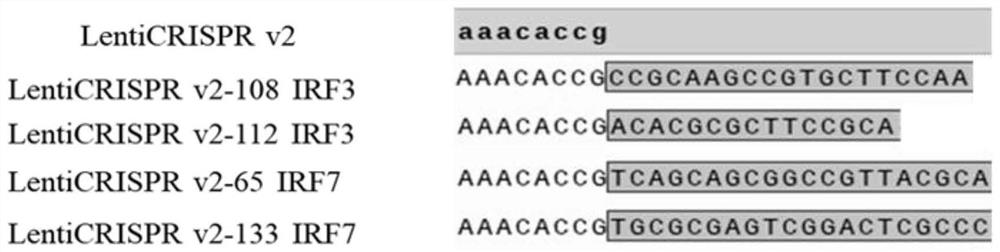
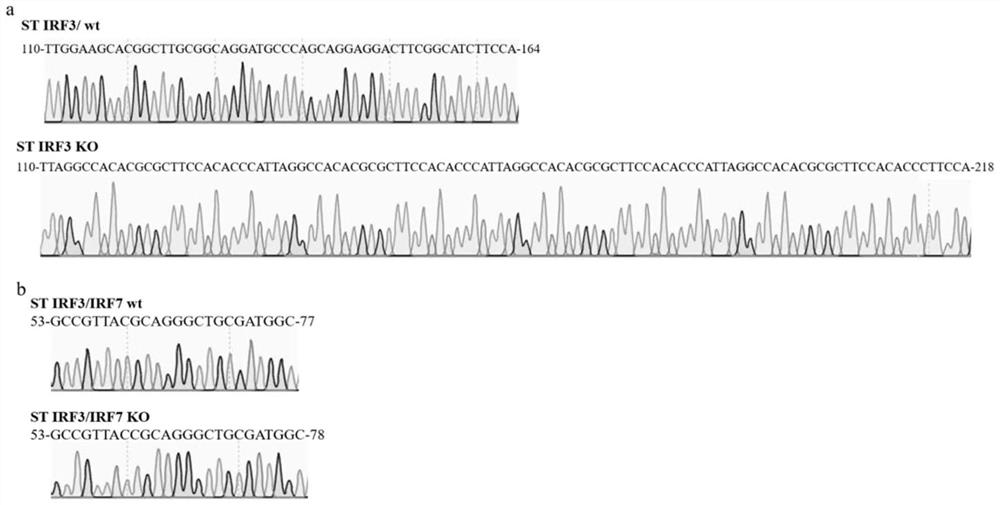
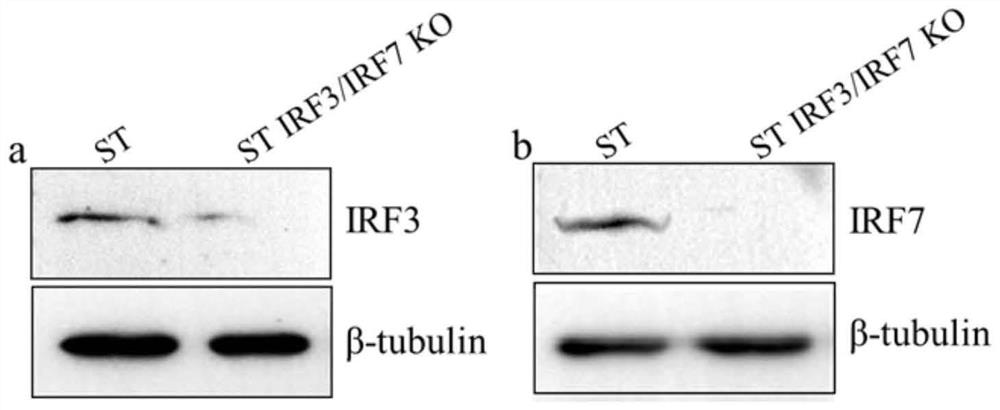
The invention belongs to the field of molecular biology, and relates to an ST IRF3 / IRF7KO cell line and a construction method and application thereof. Specific sgRNA is designed for exons of porcine IRF3 and IRF7 gene sequences and inserted into a vector lentiCRISPR v2, and lentiviral vectors lentiCRISPR v2-IRF3 and lentiCRISPR v2-IRF7 are obtained. After HEK293T cells are transfected by the recombinant plasmids, lentivirus infected ST cells are collected. Successfully infected cells are screened out through antibiotics, sequencing is carried out, and Western Blotverification is carried out. The ST IRF3 / IRF7KO cell line disclosed by the invention can be applied to basic and application research of swine viruses, and a valuable new material is provided for selection of cell lines in production of viral vaccines.
Description
technical field [0001] The invention belongs to the field of molecular biology, and relates to ST IRF3 / IRF7 KO cell line and its construction method and application. Background technique [0002] The CRISPR / Cas9 system is an adaptive immune defensesystem formed during the long-term development of archaea and bacteria, which can be used to fight against invading viruses and foreign DNA. CRISPR / Cas9 gene editing technology is an efficient nucleic acidcutting tool. In recent years, this technology has become an important method for site-specific editing due to its strong operability, high efficiency, and wide application range, and is widely used in gene site-specific modification of pigs, rabbits, and mice. At present, CRISPR / Cas9-based gene editing technology has shown great application prospects in the application field of gene therapy for a series of diseases. [0003] Interferon regulatory factors (Interferon regulatory factors, IRFs) are involved in the regulation of ...
Claims
the structure of the environmentally friendly knitted fabric provided by the present invention; figure 2 Flow chart of the yarn wrapping machine for environmentally friendly knitted fabrics and storage devices; image 3 Is the parameter map of the yarn covering machine
Login to View More
Application Information
Patent Timeline
Application Date:The date an application was filed.
Publication Date:The date a patent or application was officially published.
First Publication Date:The earliest publication date of a patent with the same application number.
Issue Date:Publication date of the patent grant document.
PCT Entry Date:The Entry date of PCT National Phase.
Estimated Expiry Date:The statutory expiry date of a patent right according to the Patent Law, and it is the longest term of protection that the patent right can achieve without the termination of the patent right due to other reasons(Term extension factor has been taken into account ).
Invalid Date:Actual expiry date is based on effective date or publication date of legal transaction data of invalid patent.


 Login to View More
  Login to View More