Unlock instant, AI-driven research and patent intelligence for your innovation.

Self-media language sentiment analysis method based on unsupervised unlisted word recognition

A technology of unregistered words and sentiment analysis, applied in semantic analysis, natural language data processing, neural learning methods, etc., can solve the problems of reduced usability, inability to efficiently extract background information, lack of formalized background information, etc., and achieve improved Analyze performance effects

Pending Publication Date: 2022-01-11
BEIJING UNIV OF POSTS & TELECOMM
View PDF0 Cites 0 Cited by
  • Summary
  • Abstract
  • Description
  • Claims
  • Application Information

AI Technical Summary

Problems solved by technology

[0007] 1. The text of the self-media platform lacks formal background information, and this method cannot efficiently extract background information, resulting in reduced usability
[0008] 2. We-media language has the obvious characteristics of non-standard terms due to colloquialism, abbreviations, Internet words, etc., and the characteristics of containing a large number of emoticons, resulting in the adverse consequences of texts being unable to be properly segmented by mainstream word segmentation systems
This method does not design the improvement of the word segmentation system, nor does it introduce the processing of emoticons, so this method cannot fully obtain the information of the self-media text, thus affecting the performance of its method

Method used

the structure of the environmentally friendly knitted fabric provided by the present invention; figure 2 Flow chart of the yarn wrapping machine for environmentally friendly knitted fabrics and storage devices; image 3 Is the parameter map of the yarn covering machine
View more

Image

Smart Image Click on the blue labels to locate them in the text.
Viewing Examples
Smart Image
  • Self-media language sentiment analysis method based on unsupervised unlisted word recognition
  • Self-media language sentiment analysis method based on unsupervised unlisted word recognition
  • Self-media language sentiment analysis method based on unsupervised unlisted word recognition

Examples

Experimental program
Comparison scheme
Effect test

Embodiment 1

[0041] The embodiments of the present invention are aimed at the sentiment analysis of the self-media network platform, mainly based on the insufficient performance of the prior art on the self-media platform: mainstream word segmentation tools are not suitable for self-media language, in order to obtain as accurate a word segmentation effect as possible, It must be operated with the help of other algorithms on top of word segmentation tools. The emotional semantic information that can be expressed in pure text is limited, and the information including emoticons can be used to more accurately infer the user's emotional tendency. The present invention researches technical strategies aiming at the above two shortcomings, and realizes the goal of improving the performance of the emotion analysis model.

[0042] The embodiment of the present invention provides a self-media language sentiment analysis scheme based on unsupervised unregistered word recognition and fine-grained emoti...

the structure of the environmentally friendly knitted fabric provided by the present invention; figure 2 Flow chart of the yarn wrapping machine for environmentally friendly knitted fabrics and storage devices; image 3 Is the parameter map of the yarn covering machine
Login to View More

PUM

No PUM Login to View More

Abstract

The invention provides a self-media language sentiment analysis method based on unsupervised unlisted word recognition. The method comprises the following steps: simulating a combination between characters to construct an unsupervised unlisted word recognizer, and performing unsupervised unlisted word recognition on a to-be-analyzed self-media language by using the unsupervised unlisted word recognizer to obtain a representation of the to-be-analyzed self-media language; and analyzing the representation of the to-be-analyzed self-media language by using a self-media multi-mode sentiment analysis model to obtain the sentiment tendency of the to-be-analyzed self-media language. According to the invention, unlisted word recognition and emoticon semantic fusion are realized, the analysis performance of an emotion model oriented to a self-media platform is improved, and the method adapts to the development trend of the self-media platform. Meanwhile, in the aspect of analyzing the semantic emotion of the platform user, indexes such as accuracy are superior to those in the prior art.

Description

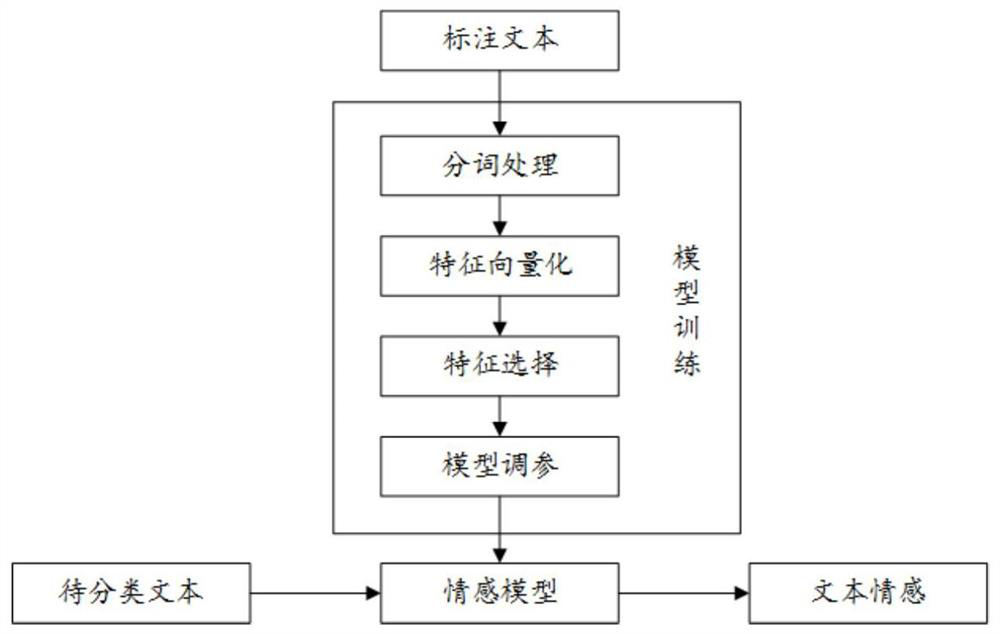
technical field [0001] The invention relates to the technical field of text emotion, in particular to a self-media language emotion analysis method based on unsupervised recognition of unregistered words. Background technique [0002] The text sentiment analysis model is the process of analyzing, processing, inducing and inferring emotionally subjective texts, dividing texts into two types of praise or derogation according to the meaning and emotional information expressed in the text or other self-defined ones Several types are the division of the author's tendency, viewpoint, and attitude, so it is also called tendency analysis. [0003] At present, the existing traditional machine learning sentiment analysis process such as figure 1 As shown, the emotion model is constructed through word segmentation processing, feature vectorization, and feature selection. Feature engineering is the core of this type of research content. The features commonly used in sentiment classifi...

Claims

the structure of the environmentally friendly knitted fabric provided by the present invention; figure 2 Flow chart of the yarn wrapping machine for environmentally friendly knitted fabrics and storage devices; image 3 Is the parameter map of the yarn covering machine
Login to View More

Application Information

Patent Timeline
no application Login to View More
IPC IPC(8): G06F40/289G06F40/211G06F40/30G06V10/764G06V10/82G06N3/04G06N3/08
CPCG06F40/289G06F40/211G06F40/30G06N3/04G06N3/088G06F18/241
Inventor 吴岳辛范春晓邹俊伟闫振常思藤
Owner BEIJING UNIV OF POSTS & TELECOMM