AI technical title is built by Patsnap AI team. It summarizes the technical point description of the patent document.
A query method, a sparse technique, applied in the field of spatial databases and social networks
Pending Publication Date: 2022-04-08
SUN YAT SEN UNIV +1
View PDF0 Cites 0 Cited by
Summary
Abstract
Description
Claims
Application Information
AI Technical Summary
This helps you quickly interpret patents by identifying the three key elements:
Problems solved by technology
Method used
Benefits of technology
Problems solved by technology
However, this patent does not involve any reports on achieving a certain sparsity between users and minimizing the distance sum of the user to the query location
Method used
the structure of the environmentally friendly knitted fabric provided by the present invention; figure 2 Flow chart of the yarn wrapping machine for environmentally friendly knitted fabrics and storage devices; image 3 Is the parameter map of the yarn covering machine
View more
Image
Smart Image Click on the blue labels to locate them in the text.
Viewing Examples
Smart Image
Click on the blue label to locate the original text in one second.
Reading with bidirectional positioning of images and text.
Smart Image
Examples
Experimental program
Comparison scheme
Effect test
Embodiment 1
[0031] A location-based sparse group query method, comprising the following steps:
[0032] S1: use the distance order to the query point to traverse the users and combine them;
[0033] S2: During the query process, some invalid user combinations are cut by distance pruning.
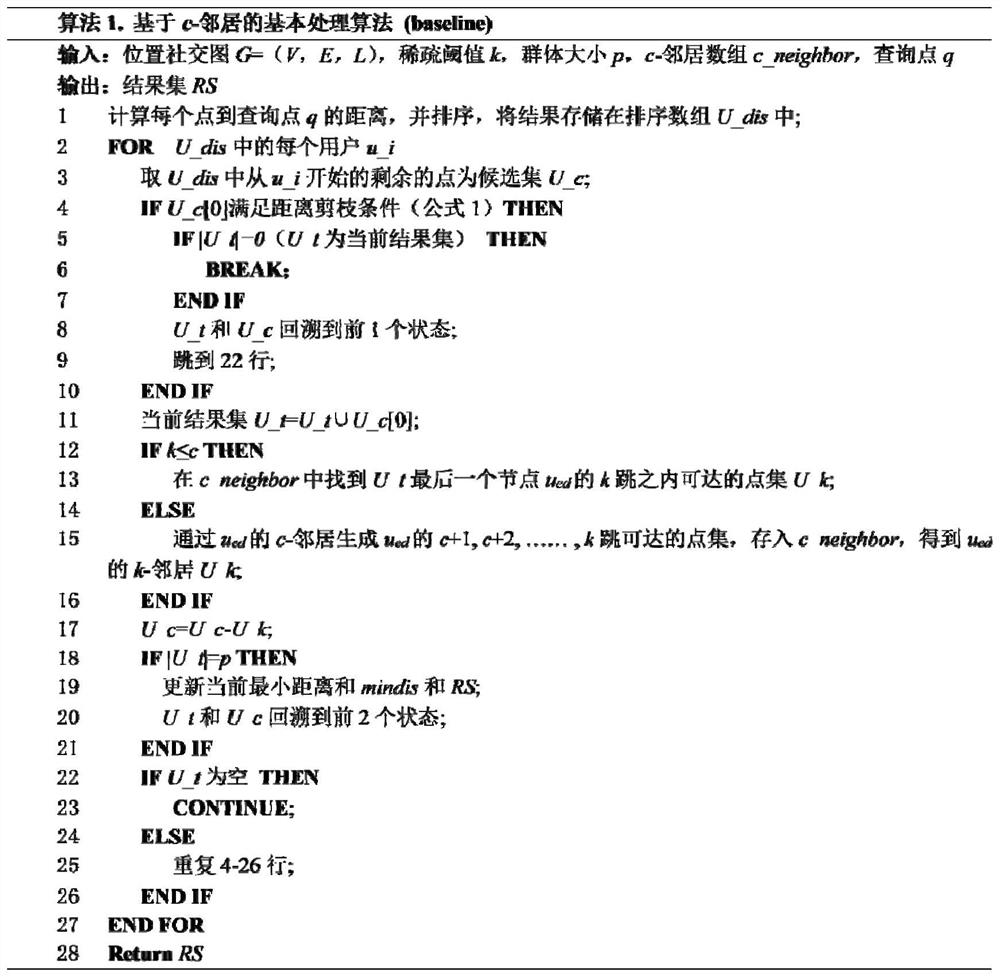
[0034] In step S1, in order to quickly find the neighbors beyond the k-hops of each user, the c-neighbors of each user are pre-calculated before the query arrives; when the sparsity threshold k≤c, it is possible to determine which nodes are the current nodes The neighbors beyond the k-hop, but when k>c, according to the information of the c-neighbors, it is impossible to judge which neighbors are beyond the k-hops. In this case, it is necessary to calculate the k-neighbors through the information of the c-neighbors , where, for a given social network graph G=(V,E), the c-neighborhood of point v is expressed as: the set of points u satisfying social_dis(u,v)≤c in graph G.
[0035] In step S1, the dista...
Embodiment 2
[0046] A location-based sparse group query method, comprising the following steps:
[0047] S1: use the distance order to the query point to traverse the users and combine them;
[0048] S2: During the query process, some invalid user combinations are cut by distance pruning.
[0049] In step S1, in order to quickly find the neighbors beyond the k-hops of each user, the c-neighbors of each user are pre-calculated before the query arrives; when the sparsity threshold k≤c, it is possible to determine which nodes are the current nodes The neighbors beyond the k-hop, but when k>c, according to the information of the c-neighbors, it is impossible to judge which neighbors are beyond the k-hops. In this case, it is necessary to calculate the k-neighbors through the information of the c-neighbors , where, for a given social network graph G=(V,E), the c-neighborhood of point v is expressed as: the set of points u satisfying social_dis(u,v)≤c in graph G.
[0050] In step S1, the dista...
Embodiment 3
[0062] The invention provides a location-based sparse group query method. Before the problem definition of the location-based sparse group query is given, the concept of a location-based social network graph is first given.
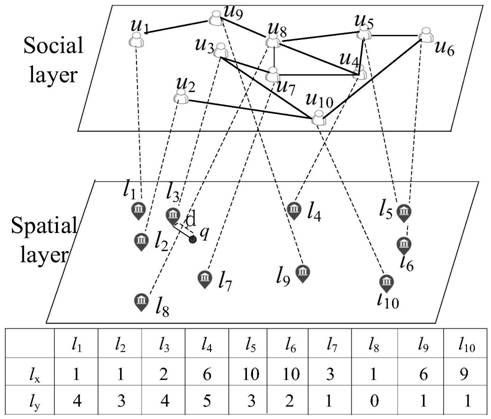
[0063] Definition 1 (location-based social network graph) For a location-based social network graph G=(V,E,L), each point v in V represents a user, and e(u,v)∈E represents u , There is a social relationship between v, l(u) represents the geographic location coordinates of user u, and L is the set of location coordinates of all users.
the structure of the environmentally friendly knitted fabric provided by the present invention; figure 2 Flow chart of the yarn wrapping machine for environmentally friendly knitted fabrics and storage devices; image 3 Is the parameter map of the yarn covering machine
Login to View More
PUM
Login to View More
Abstract
The invention provides a position-based sparse group query method, which comprises the following steps of: firstly, proposing a c-neighbor-based basic processingalgorithm, and mainly utilizing stored c-neighbor information and distance pruning to help to quickly obtain a query result; however, the space consumption of the baseline algorithm is too large, and the baseline algorithm is at a sparse threshold parameter kgt; and c, the query efficiency is not high. In order to solve the problems, the invention further provides a query optimization algorithm (ICN for short) based on c-neighbors and reverse c-neighbors, and not only the stored c-neighbors but also the reverse c-neighbors are utilized to process parameters kgt; therefore, the query result can be quickly obtained according to the condition of k, c, so that certain sparsity (namely, the social distance between the users is greater than k) between the users is met, and the sum of the distances between the users and the query position is minimized.
Description
technical field [0001] The present invention relates to the field of spatial database and social network, and more specifically, relates to a sparse group query method based on location. Background technique [0002] There are many studies on finding special groups in social networks. Most of the current research mainly focuses on finding dense groups. These dense groups usually represent groups or communities with common interests or similar behaviors. Many community detection algorithms (CDA for short) have been proposed, such as the module density measurement proposed by Singh et al. in the paper "Network community detection using modular density measures" in 2017, and Guimer et al. in the paper "Functional cartography of complex metabolic networks" in 2005. The proposed GA algorithm based on simulated annealing, the fast algorithm proposed by Blonde et al. in the paper "Fast unfolding of communities in large networks" in 2008, etc. In the paper "Geo-Social Group Queri...
Claims
the structure of the environmentally friendly knitted fabric provided by the present invention; figure 2 Flow chart of the yarn wrapping machine for environmentally friendly knitted fabrics and storage devices; image 3 Is the parameter map of the yarn covering machine
Login to View More
Application Information
Patent Timeline
Application Date:The date an application was filed.
Publication Date:The date a patent or application was officially published.
First Publication Date:The earliest publication date of a patent with the same application number.
Issue Date:Publication date of the patent grant document.
PCT Entry Date:The Entry date of PCT National Phase.
Estimated Expiry Date:The statutory expiry date of a patent right according to the Patent Law, and it is the longest term of protection that the patent right can achieve without the termination of the patent right due to other reasons(Term extension factor has been taken into account ).
Invalid Date:Actual expiry date is based on effective date or publication date of legal transaction data of invalid patent.



 Login to View More
  Login to View More