Precise positioning using time of arrival with pseudo-synchronized anchor nodes
a technology of precise positioning and anchor nodes, applied in the field of ranging, can solve the problems of introducing additional overhead in terms of channel usage, twr based methods cannot cope well with a large number of mobile stations, and known limitations of transceiver nodes
- Summary
- Abstract
- Description
- Claims
- Application Information
AI Technical Summary
Benefits of technology
Problems solved by technology
Method used
Image



Examples
Embodiment Construction
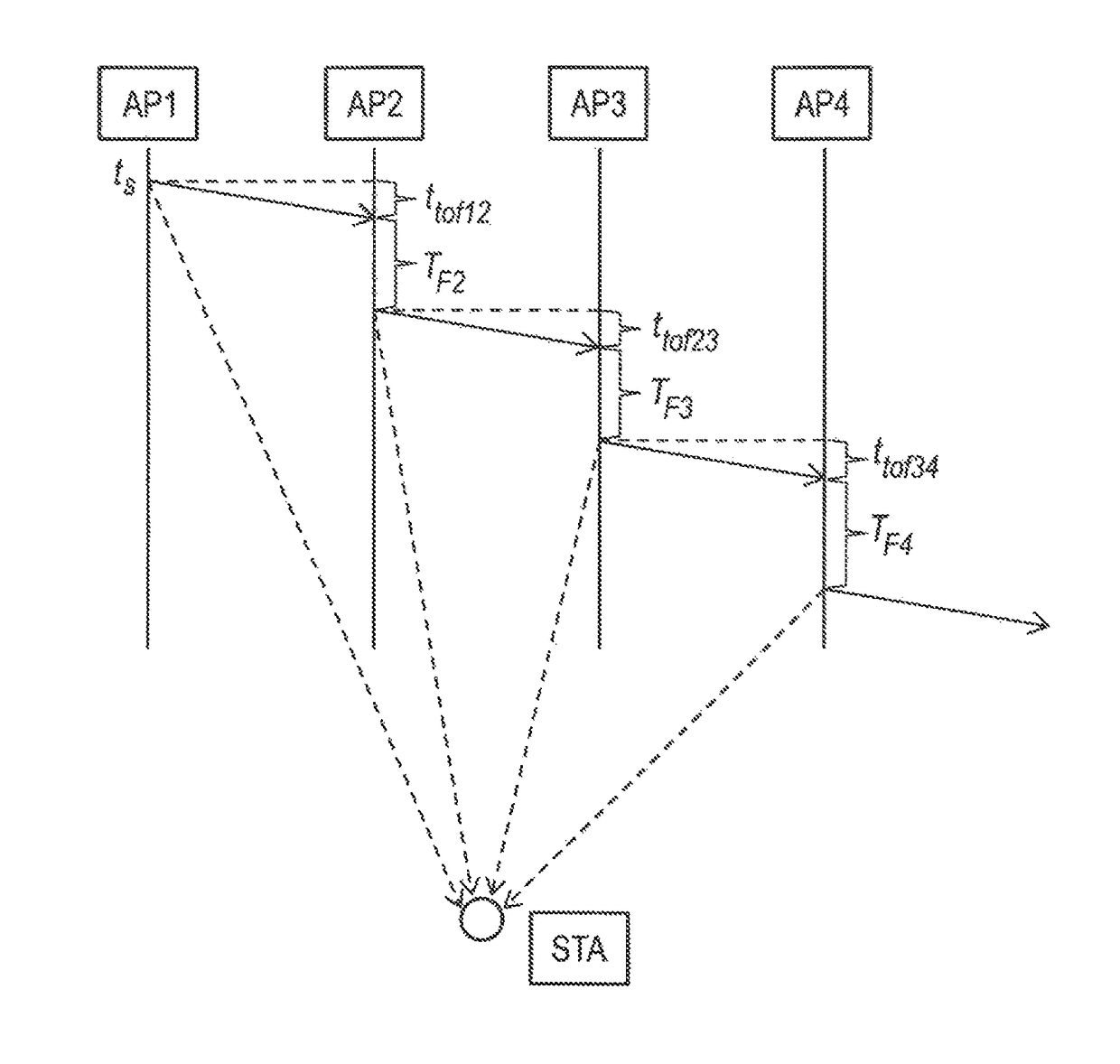
[0136]The methods of the first and second aspect of the invention allow for localization of transceiver nodes such as mobile stations (STA). The methods are particularly advantageous for applications using a wireless communication channel for providing the positioning frames, such as in a wireless network. The at least one transceiver node receives the positioning frames from anchor nodes. The positioning frames can be simple, in some embodiments merely providing signals allowing the determination of a time of reception (arrival), if the positioning sequence performed by the anchor nodes is known to all nodes involved in performing the method. The anchor nodes may also be called access points (AP) with the same meaning. The methods allow estimating an unknown position of the transceiver node, using the Time of Arrival (ToA) approach. It is a particular advantage of the method that the anchor nodes do not have to be synchronized.
[0137]The infrastructure to be provided for performing ...
PUM
 Login to View More
 Abstract
Description
Claims
Application Information
 Login to View More