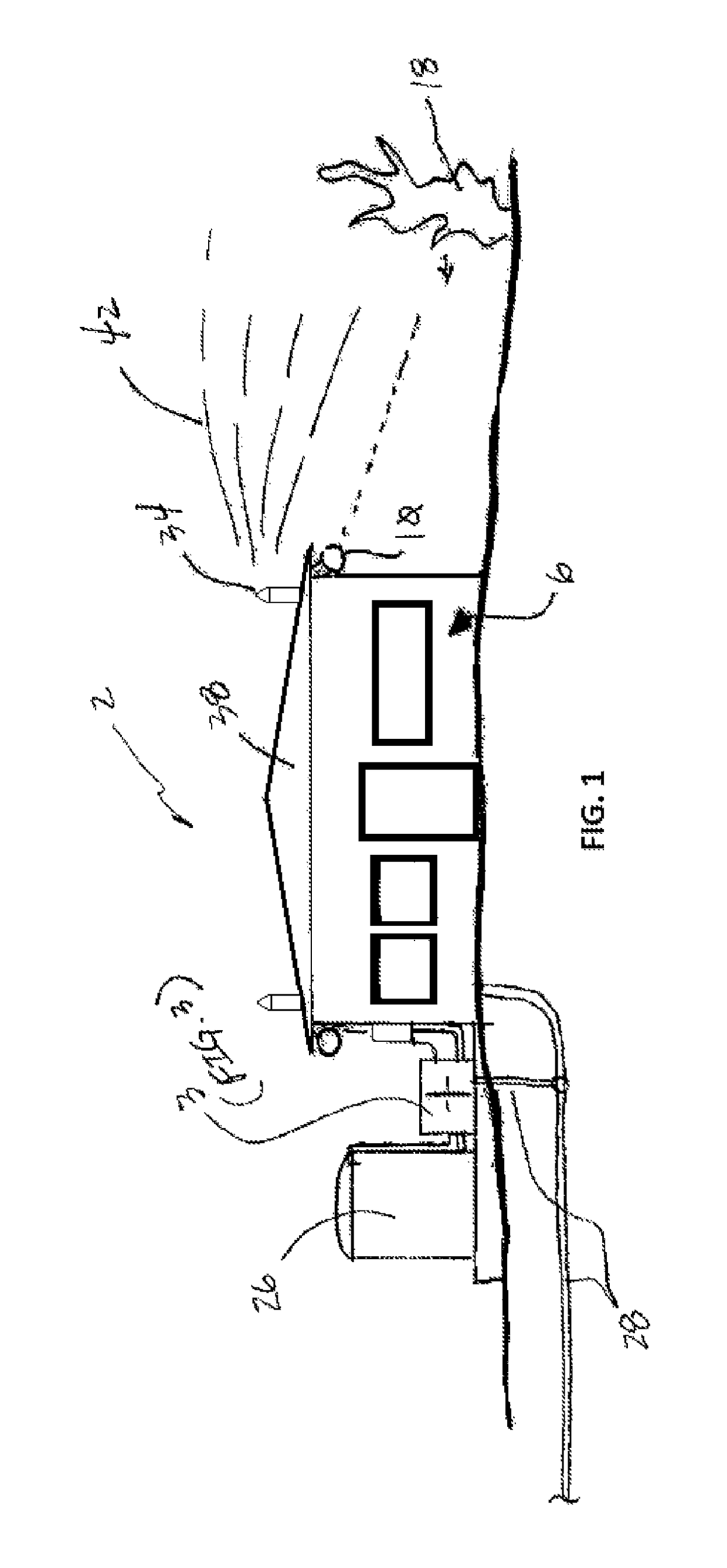
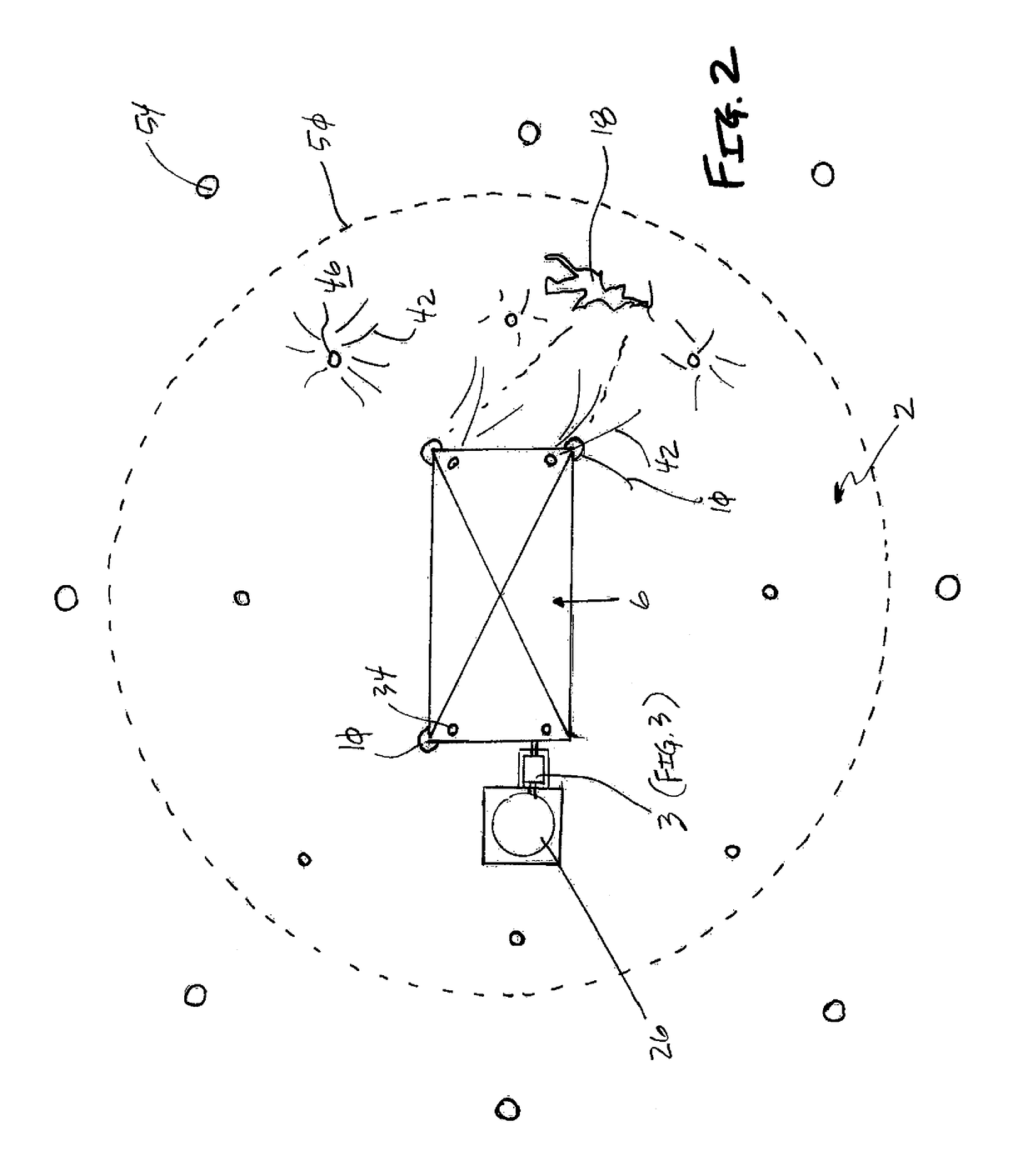
[0005]Sprinklers, although commonly applied for protecting interior structure, is one of the newest technologies in wildfire control and fire protection. Unlike interior sprinkler systems, exterior sprinkler systems are not primarily intended to extinguish a fire, but instead function to mitigate a fire. Exterior sprinkler systems are used to wet specific areas, which render combustibles (buildings and surrounding landscape) much less likely to ignite from contact with embers and exposure to intense heat generated by a nearby fire. Exterior sprinklers are also designed to soak the surrounding landscape with water and fire retardant so that moisture is released into the air to lower the ambient temperature and increase the humidity of the immediate area, and provide the added protection against ignition of combustibles within the immediate area. These mitigating effects extend some distance above ground level which helps direct the advancing wildfire away from the structure or predetermined area. Thus external sprinkler systems are most effective when in continual operation before the fire arrives.
[0011]It is a related aspect of embodiments of the present invention to provide a hydro fire mitigation system that can be automatically initiated, because often during a fire the structure's owners are evacuated before the fire becomes an imminent danger. The controller will activate the sprinklers if the fire comes within a predetermined distance from the structure with no human intervention. The owner can set parameters to dictate when the hydro fire mitigation system will be activated. Alternatively, the system can be activated manually and remotely through a software application accessible by the owner's mobile device, a remote computer, etc. It is also contemplated that local fire authorities may be given access to the controller so they can activate the controller to initiate fluid flow to the sprinklers if necessary.
[0015]The controller of one embodiment of the present invention has diagnostic capabilities and can monitor and assess the health of the system's main components, such as storage tank water level, sensor functionality, pump readiness, sprinkler system readiness, etc. If a component is not working properly, the owner is notified through an email, automated call or text, or through a notification application on their mobile device. Alternatively, the local fire department may be notified. Some embodiments of the present invention can “self heal,” reboot, or reroute functionality to a redundant system to address a fault issue. Other embodiments of the present invention may run a system test initiated by the owner at the controller. This system test activates the sprinkler system and may inject a small amount of fire retardant.
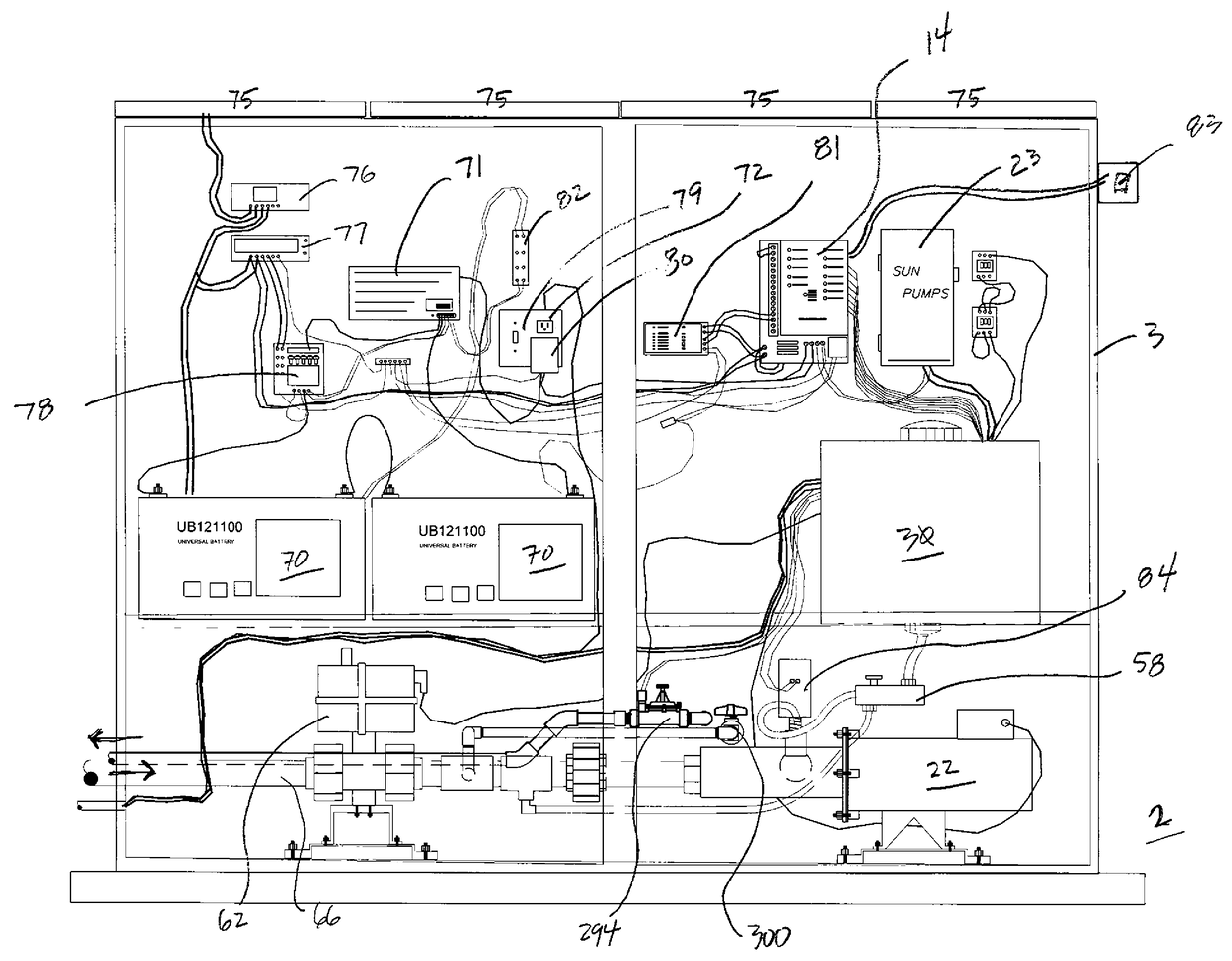
[0021]The power system of one embodiment of the present invention is based on battery power. The batteries may be recharged using the structure's municipal power supply. In other embodiments of the present invention, the batteries are charged by solar power. To provide an autonomous system, the system is solely based on solar power. To insure the batteries remain charged, the control system may continuously or periodically monitor battery power consumption and charge level. Battery status information is sent to a user interface of the control system that allows the user to quickly assess the status of the hydro fire mitigation system. Some other embodiments of the present invention will actively notify the owner if system power level is below a predetermined threshold. Such notification may be forwarded to remote computer via email, for example, or to the owner's mobile communication device.
[0024]As mentioned above, the water supply of one embodiment of the present invention is interconnected to a storage tank and booster pump that allows the system to supply several sprinkler heads. Thus the pressurized fire mitigating fluid can increase the radius of protection around the structure. Booster pump function is initiated and controlled by the controller which initiates pumping and fluid flow rate. Power needed to operate the booster can be supplied from the batteries, an integrated solar power system, a gas powered generator, or a municipal power supply (if available).


 Login to View More
  Login to View More