
Recombinant obligate anaerobic gram-positive bacteria
a gram-positive bacteria, obligate technology, applied in the direction of bacteria material medical ingredients, antibody medical ingredients, drug compositions, etc., can solve the problems of not achieving remarkable therapeutic effects through clinical trials of these antibodies, and cannot induce the formation of trail receptors, etc., to achieve safe and convenient therapeutic methods, low levels of subject invasiveness, and efficient delivery
- Summary
- Abstract
- Description
- Claims
- Application Information
AI Technical Summary
Benefits of technology
Problems solved by technology
Method used
Image

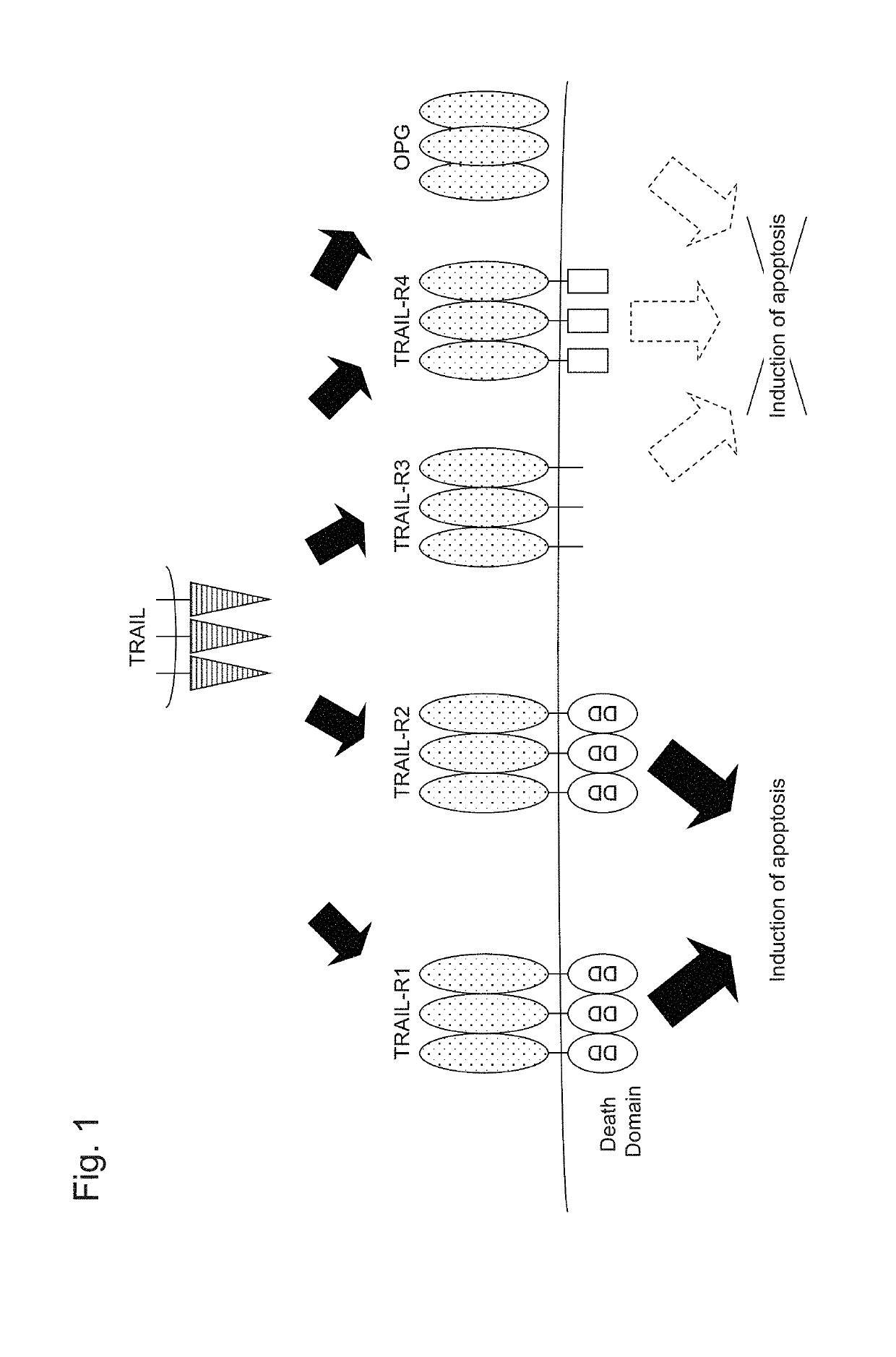
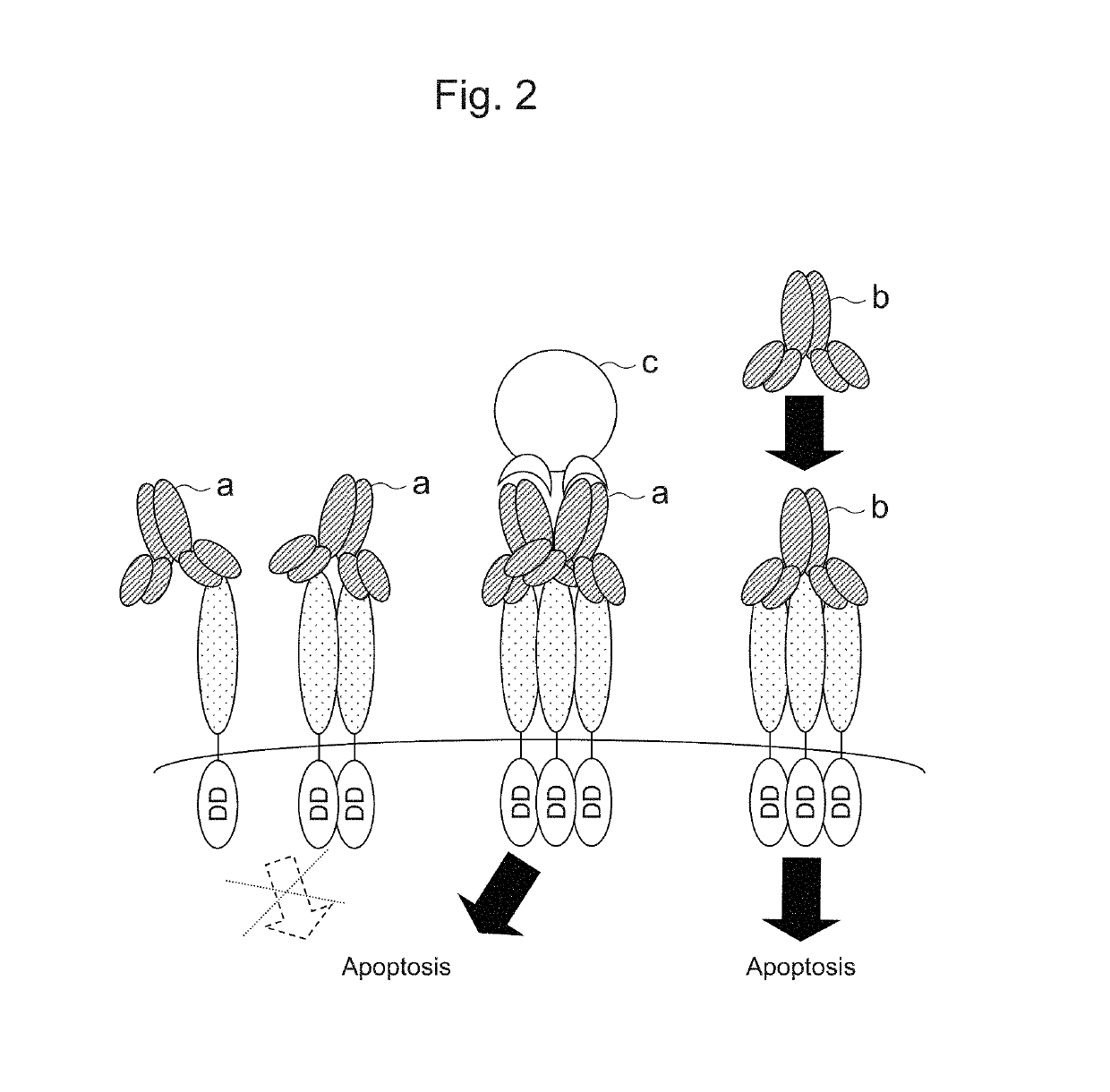
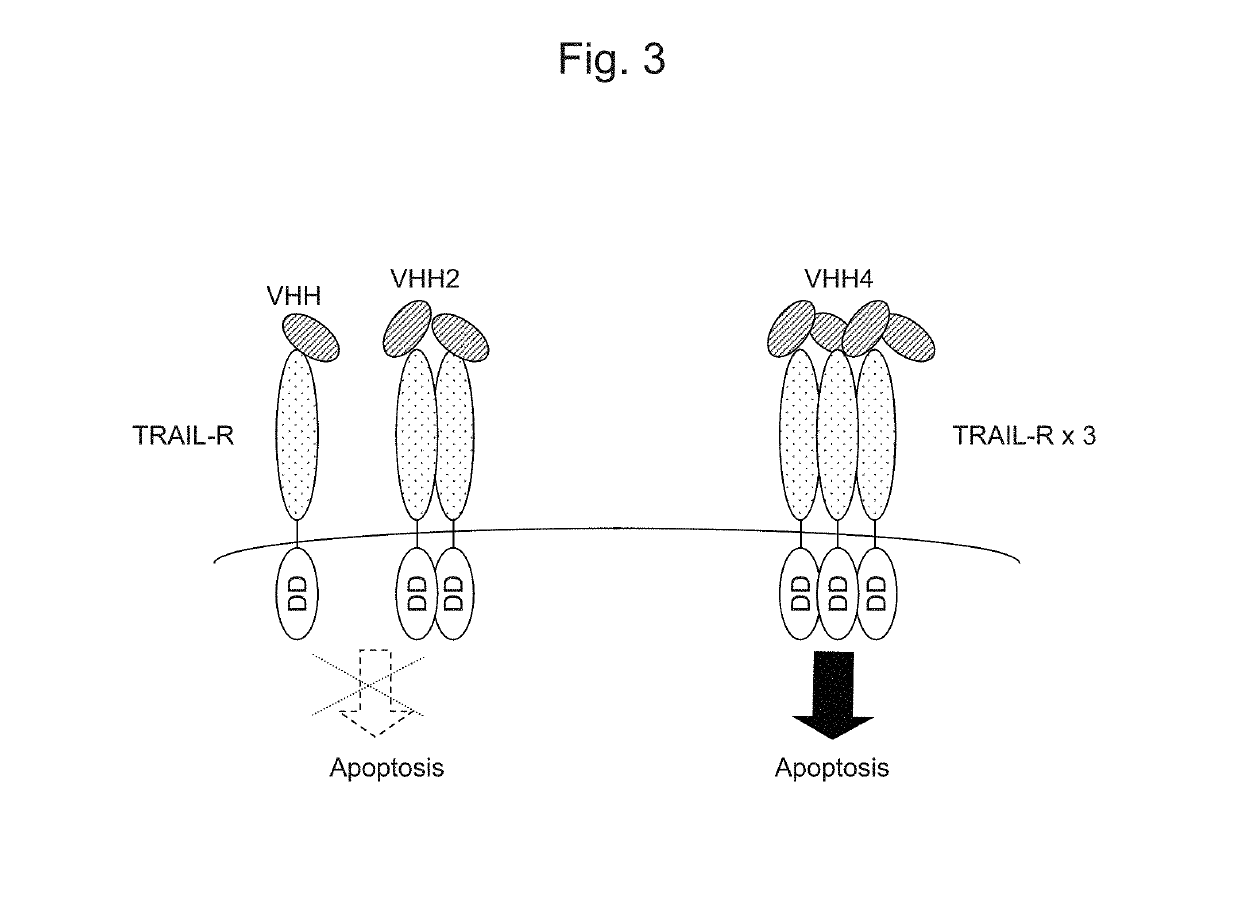
Examples
example 1
Preparation of Anti-Human TRAIL-R2 Gene Expression Cassette to be Expressed in Bifidobacterium
(1) Gene Expression Cassette of Anti-hTRAIL-R2 VHH Antibody Tetramer (4E6 Tetramer) to be Expressed in Bifidobacterium
[0135]A gene (SEQ ID NO: 1) was prepared via DNA synthesis using the promoter region derived from the B. longum hup gene (SEQ ID NO: 25), the usp secretory signal sequence derived from the B. longum (SEQ ID NO: 29), DTY (the insertion sequence following the signal sequence), the amino acid sequence of 4E6 disclosed in WO 2011 / 098520, the linker peptide (GGSGG)2 derived from the 8C7 EGFP gene (SEQ ID NO: 28), and the histone-like protein-derived terminator (HUT) (SEQ ID NO: 26), and DNA encoding the His-Tag sequence was added to the C terminus.
(2) Gene Expression Cassette of Fusion Protein of Anti-hTRAIL-R2 VHH Antibody Dimer and Pseudomonas aeruginosa Exotoxin A Subunit (4E6 Dimer Toxin) to be Expressed in Bifidobacterium
[0136]A gene (SEQ ID NO: 2) was prepared via DNA sy...
example 2
Preparation of Cultured Drosophila Cells that Express and Secrete hTRAIL-R1:Fc, hTRAIL-R2:Fc, and mTRAIL-R2:Fc and Purification of the Recombinant Proteins
(1) Preparation of Gene Expression Cassette
(1-1) Gene Expression Cassette of Human TRAIL-R1:Alpaca Fc (hTRAIL-R1:Fc) to be Expressed in Cultured Drosophila Cells
[0138]DNA comprising the KpnI site, the consensus sequence for translation initiation (Cavener D. R., 1987, Nucleic Acids Res. 15, 1353-1361), the Bip secretory signal (Life Technologies), the hTRAIL-R1 extracellular region (Accession No. AAC51226, amino acids 109 to 239), the IEGRMD linker (SEQ ID NO: 27), the Lama pacos (alpaca) IgG1 Fc (Accession No. AM773729, amino acids 102 to 335), the His-Tag sequence, the termination codon, and the XhoI site was synthesized (SEQ ID NO: 4).
(1-2) Gene Expression Cassette of Human TRAIL-R2:Alpaca Fc (hTRAIL-R2:Fc) to be Expressed in Cultured Drosophila Cells
[0139]DNA comprising the KpnI site, the consensus sequence for translation ini...
example 3
Expression, Purification, and Binding Activity of Recombinant 4E6 Monomeric Protein in E. coli BL21 (DE3)
(1) Preparation of Gene Expression Cassette of Anti-hTRAIL-R2 VHH Antibody / Myc-Tag (4E6 Monomer) to be Expressed in E. coli
[0142]On the basis of the amino acid sequence information regarding the 4E6 VHH monomer disclosed in WO 2011 / 098520, a gene to be expressed in E. coli was prepared via DNA synthesis (SEQ ID NO: 7).
(2) Expression of 4E6 Monomer in E. coli and Purification Thereof
[0143]A vector expressing a 4E6 monomer was obtained by inserting the gene cassette between the NdeI site and the NotI site of pET22b(+). This expression vector (Plasmid DNA) was introduced into E. coli BL21Star™ (DE3) One Shot (Life Technologies). In accordance with the attached instructions, recombinant E. coli cells were cultured in 100 ml of 2YT medium containing 100 μg / ml ampicillin (Sigma-Aldrich) at 37° C., and 0.5 mM IPTG (isopropyl-β-thiogalactopyranoside, TAKARA BIO INC.) was added thereto w...
PUM
| Property | Measurement | Unit |
|---|---|---|
| molecular weight | aaaaa | aaaaa |
| molecular weight | aaaaa | aaaaa |
| molecular weight | aaaaa | aaaaa |
Abstract
Description
Claims
Application Information
 Login to View More