
Key and corresponding lock
a technology for cylinder locks and keys, applied in cylinder locks, building locks, construction, etc., can solve the problems of illegal keys easily being brought into circulation, control points on both sides of keys must be identical, and the effect of hard copy
- Summary
- Abstract
- Description
- Claims
- Application Information
AI Technical Summary
Benefits of technology
Problems solved by technology
Method used
Image

Examples
Embodiment Construction
[0054]The invention is explained in more detail in the following on the basis of non-limiting exemplary embodiments:
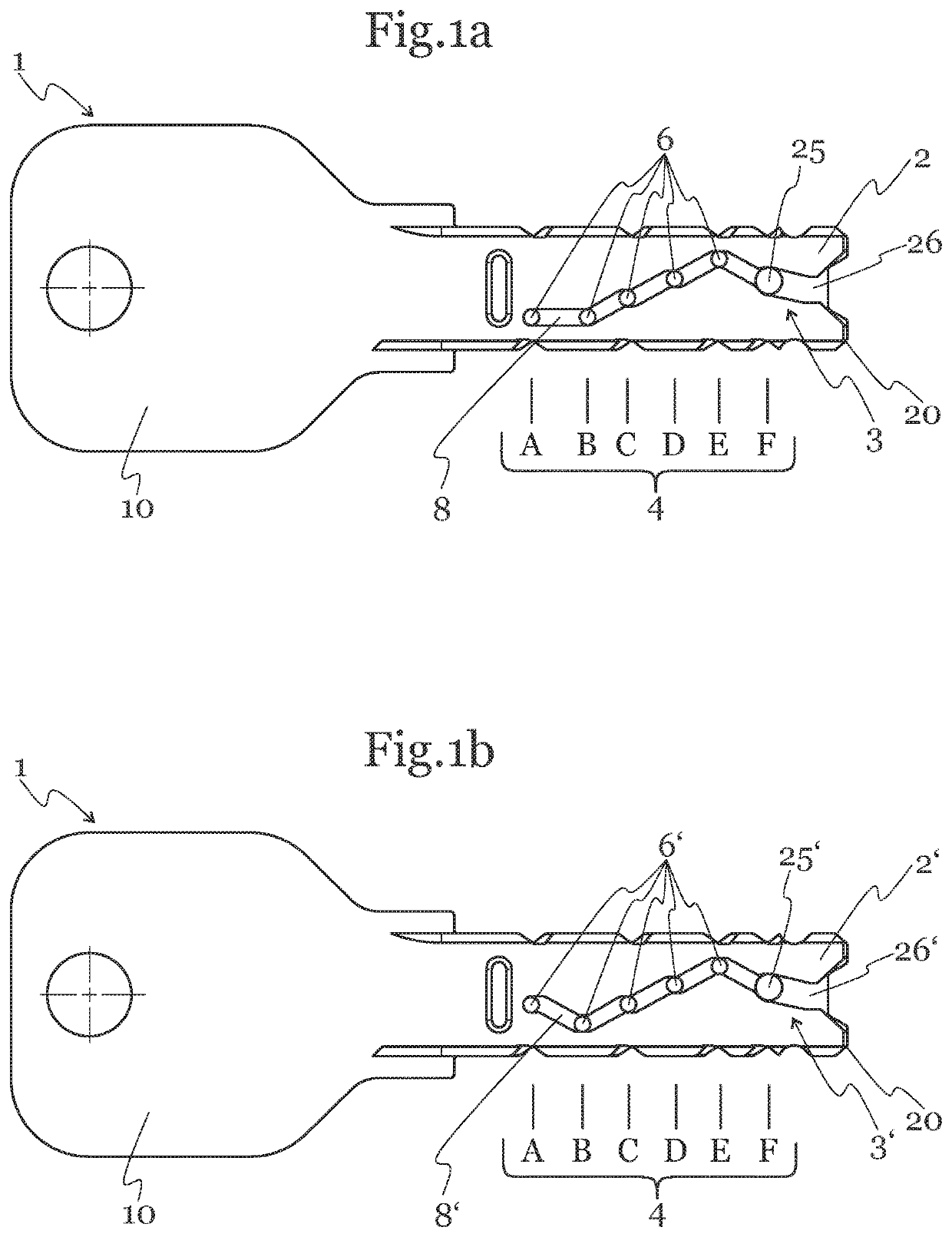
[0055]FIGS. 1a-1b show an exemplary embodiment of a key 1 according to the invention, which is realized as a flat key with a key bow 10 and a key tip 20 and two opposite surfaces 2, 2′. FIG. 1a shows a view of the first surface 2, FIG. 1b shows a view of the second surface 2′. The surfaces 2, 2′ are the key flat sides.
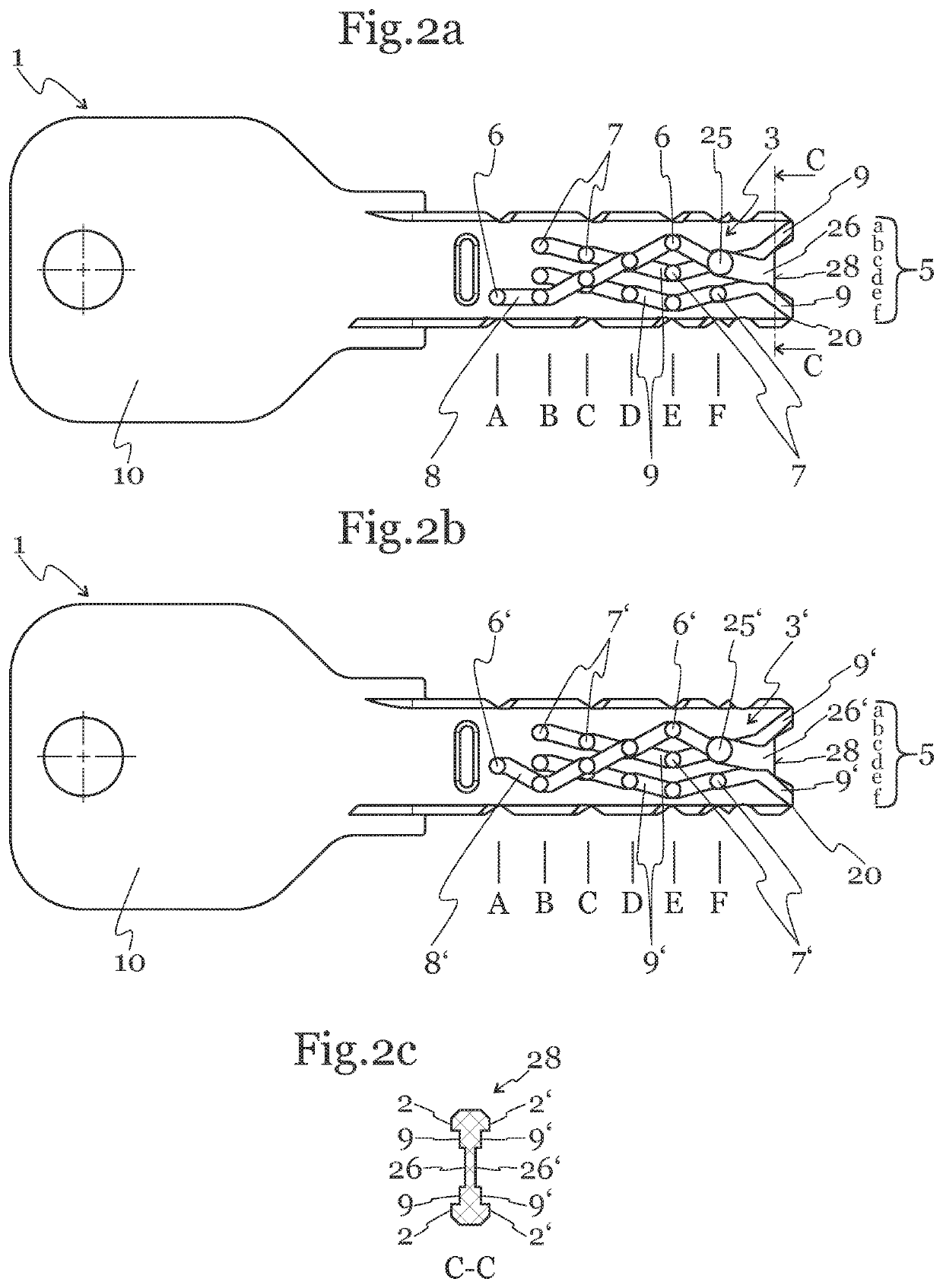
[0056]Sensing positions 4, namely six sensing positions A-F, are provided for both surfaces 2, 2′ along the longitudinal extent of the key 1. A code 3, 3′ is located at each sensing position 4 on both surfaces 2, 2′ of the key 1, wherein the first code 3 is provided on the surface 2 and the second code 3′ is provided on the surface 2′. The codes 3, 3′ comprise control points 6, 6′ which are arranged at certain control heights and are connected to one another by means of control grooves 8, 8′.
[0057]The control points are realized differently on the sensing...
PUM
 Login to View More
 Abstract
Description
Claims
Application Information
 Login to View More