Text independent speaker-verification on a media operating system using deep learning on raw waveforms

a technology of raw waveforms and deep learning, applied in the field of text independent speaker verification on a media operating system using deep learning on raw waveforms, can solve the problem of more challenging text-independent sv

US10699715B1Active Publication Date: 2020-06-30ALPHONSO
32 Cites 6 Cited by

Patent Information

Authority / Receiving Office
US · United States
Current Assignee / Owner
Publication Date
2020-06-30

Smart Images

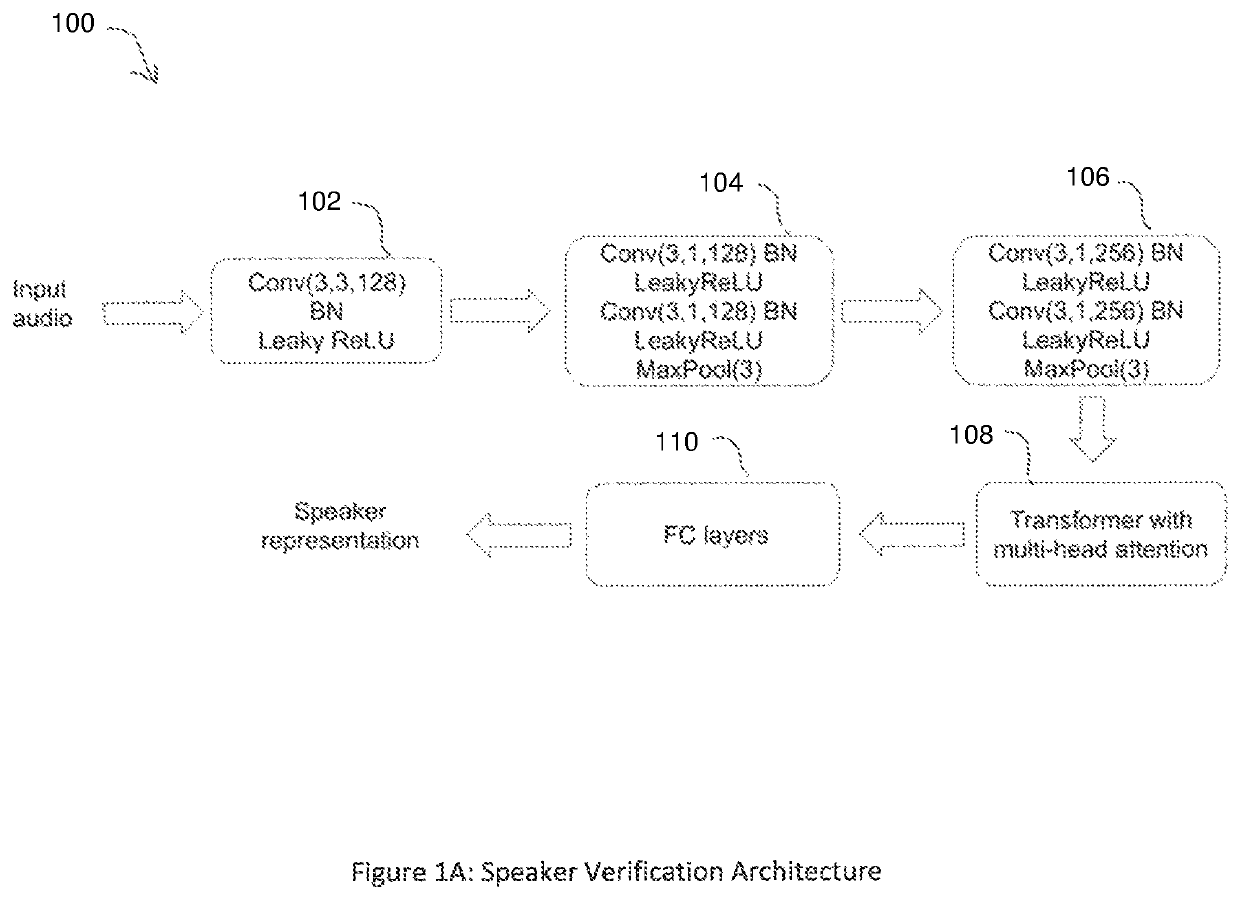
  • Figure 1
    Figure 1
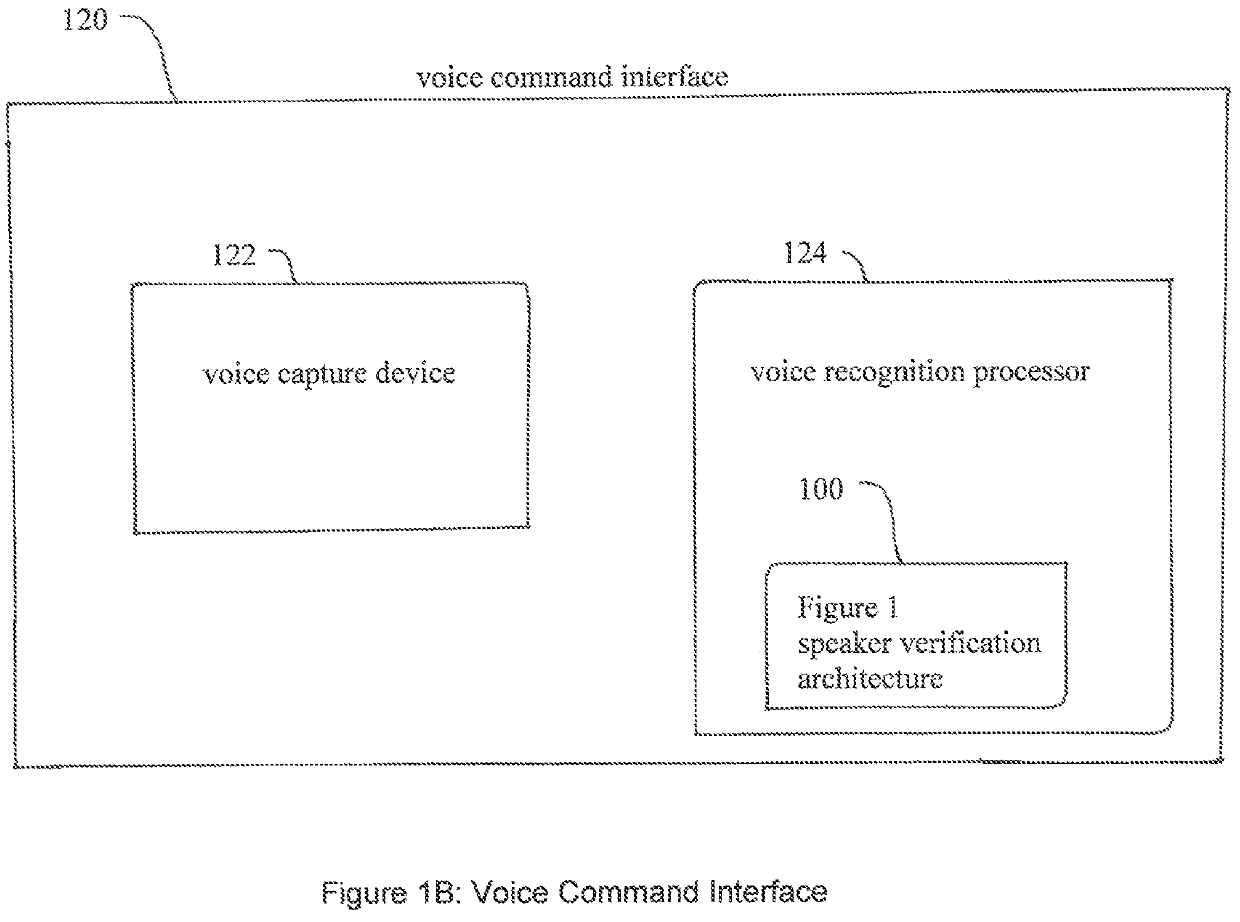
  • Figure 2
    Figure 2
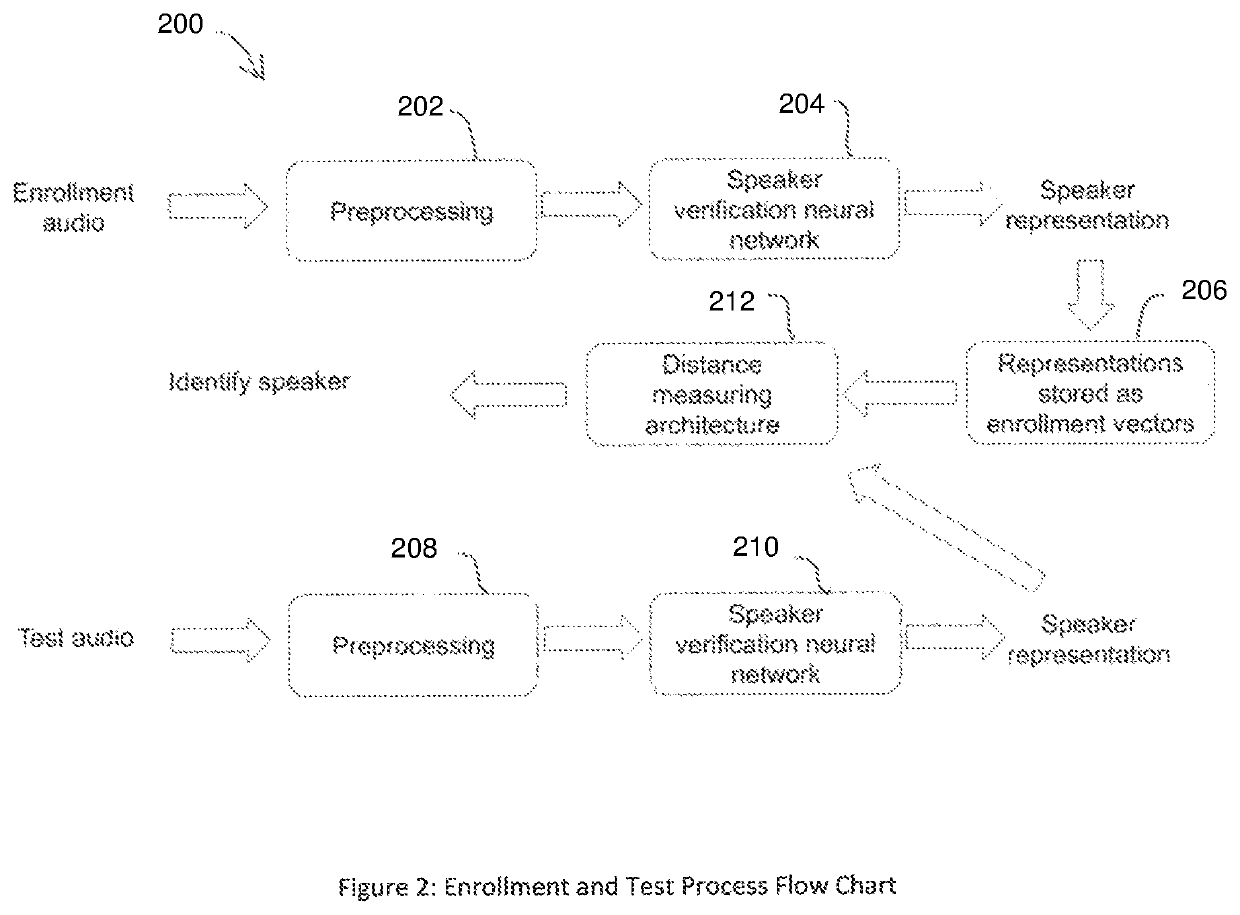
  • Figure 3
    Figure 3
Patent Text Reader

Abstract

An artificial neural network architecture is provided for processing raw audio waveforms to create speaker representations that are used for text-independent speaker verification and recognition. The artificial neural network architecture includes a strided convolution layer, first and second sequentially connected residual blocks, a transformer layer, and a final fully connected (FC) layer. The strided convolution layer is configured to receive raw audio waveforms from a speaker. The first and the second residual blocks both include multiple convolutional and max pooling layers. The transformer layer is configured to aggregate frame level embeddings to an utterance level embedding. The output of the FC layer creates a speaker representation for the speaker whose raw audio waveforms were inputted into the strided convolution layer.
Need to check novelty before this filing date? Find Prior Art

Description

CROSS-REFERENCE TO RELATED APPLICATIONS

[0001] This application claims priority to U.S. Provisional Patent Application No. 62 / 954,130 filed Dec. 27, 2019, which is incorporated by reference herein.BACKGROUND OF THE INVENTION

[0002] Speaker verification (SV) is the process of verifying, based on a speaker's known utterances, whether an utterance belongs to the speaker. The general procedure of speaker verification consists of three phases: development, enrollment, and evaluation. For development, a background model must be created for capturing speaker-related information. In enrollment, the speaker models are created using the background model. Finally, in the evaluation, the query utterances are identified by comparing to existing speaker models created in the enrollment phase.

[0003] Speaker verification can be categorized as text-dependent or text-independent. In text-independent SV, no restriction is imposed on the utterances. In text-dependent SV, all speakers repeat the same phrase....

Examples

Embodiment Construction

[0014]Certain terminology is used herein for convenience only and is not to be taken as a limitation on the present invention.

[0015]The words “a” and “an”, as used in the claims and in the corresponding portions of the specification, mean “at least one.”

I. Definitions

[0016]The following definitions are provided to promote understanding of the present invention.

media device—A media device is any device that outputs media content, such as a television, radio, smartphone, or computer. A media device thus allows for consumption of media content.

[0017]Examples of media devices that output both video-based media content and audio-based media content include a smart TV, smartphone, and a smart multi-media player device.

II. Overview

[0018]Preferred embodiments of the present invention provide a deep learning architecture (also, referred to herein as an “artificial neural network architecture” or “speaker verification (SV) architecture”) for several applications around speaker verification, i...