Supercharge Your Innovation With Domain-Expert AI Agents!

Recycling method of dihydrate gypsum from waste gypsum boards

a technology of waste gypsum and dihydrate gypsum, which is applied in the direction of climate sustainability, solid waste management, sustainable waste treatment, etc., can solve the problems of uniform feeding of slurry, slow particle growth of dihydrate gypsum, and improve energy efficiency of gypsum production

Active Publication Date: 2021-03-16
TOKUYAMA CORP
View PDF7 Cites 0 Cited by
  • Summary
  • Abstract
  • Description
  • Claims
  • Application Information

AI Technical Summary

Benefits of technology

[0007]Preferred embodiments of the present invention reduce the foaming when gypsum granules are dropped into water so that the gypsum granules are promptly dispersed in the slurry.
[0011]On the contrary, at a temperature less than 90° C., gypsum granules float on the liquid surface (see Table 1), and air gradually released from the gypsum granules cause foam on which the gypsum granules adhere. The foam causes cavitation in a slurry pump and makes the supply of the slurry unstable. Further, since the gypsum granules are prevented from dispersing in the water uniformly, the particle growth of dihydrate gypsum is slow, and aggregated particles containing dihydrate gypsum or the like are generated. Dihydrate gypsum particles that are not fully grown include a larger quantity of adhered water, and the energy efficiency of producing gypsum boards from the recycled dihydrate gypsum is lowered. The aggregate particles in the recycled gypsum hinder the production of a uniform gypsum slurry for producing gypsum boards.
[0012]Preferably, the gypsum granules are dropped into the water without pulverization after the calcination. When gypsum granules are further pulverized after calcination, the particle size is smaller, and air in the granules is easily substituted with water. This reduces the foaming, even if the temperature when dropping the gypsum granules is lower. However, according to a preferred embodiment of the present invention, the gypsum temperature just before being dropped is 90° C. or higher in order to prevent the foaming, and fine pulverization after calcination is not needed.

Problems solved by technology

Further, the foam causes cavitation in a slurry pump so that the feeding of the slurry is not uniform.

Method used

the structure of the environmentally friendly knitted fabric provided by the present invention; figure 2 Flow chart of the yarn wrapping machine for environmentally friendly knitted fabrics and storage devices; image 3 Is the parameter map of the yarn covering machine
View more

Image

Smart Image Click on the blue labels to locate them in the text.
Viewing Examples
Smart Image
  • Recycling method of dihydrate gypsum from waste gypsum boards

Examples

Experimental program
Comparison scheme
Effect test

example 1

Preferred Example 1

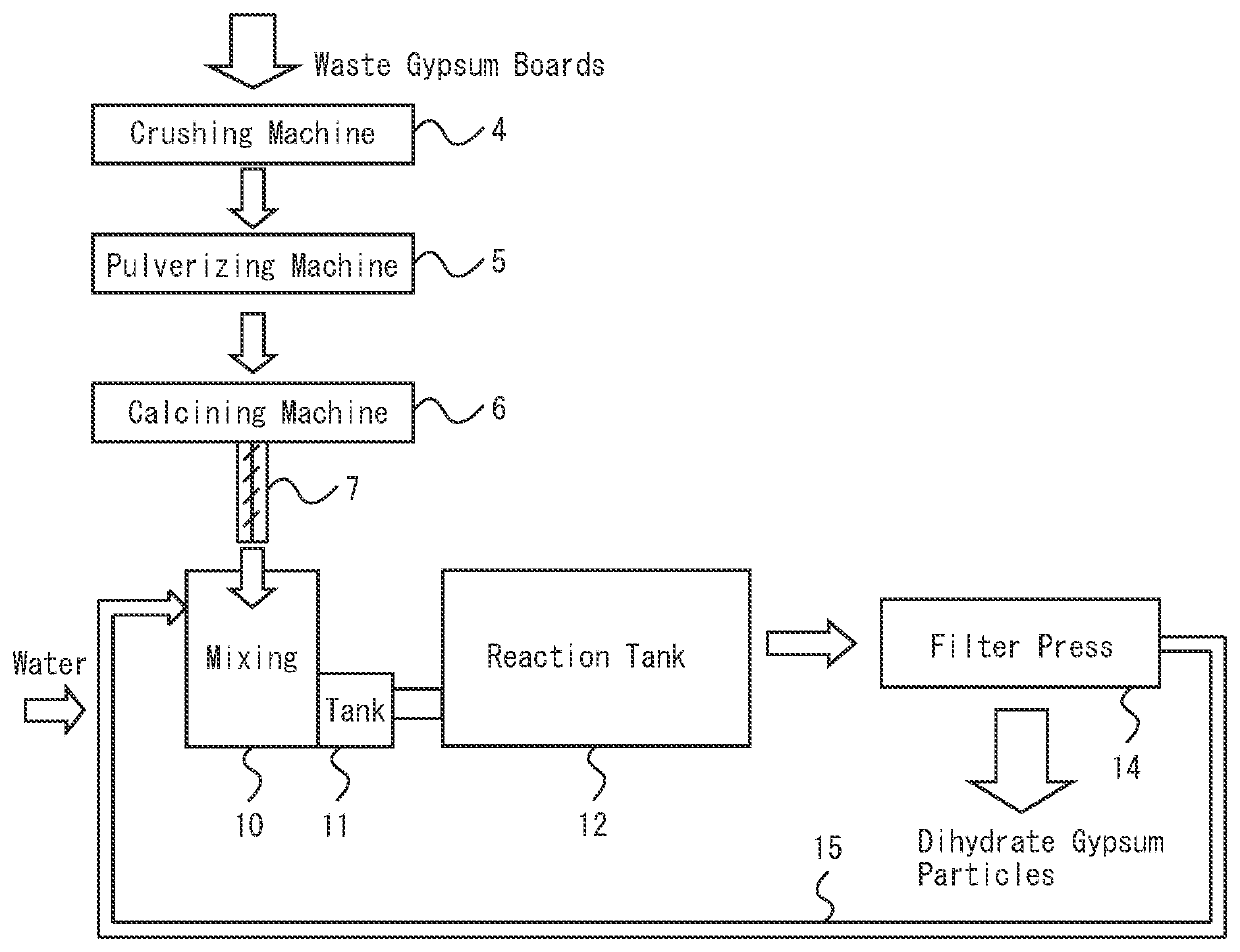
[0026]Dihydrate gypsum waste having an average particle size of 2 mm resulting from crushing and pulverizing waste gypsum boards was heated at a temperature of 130° C. by a hot wind drier and converted into hemihydrate gypsum. The hemihydrate gypsum was dropped at a rate of 100 g / hr and water at a temperature of 60° C. was dropped at a rate of 200 mL / hr into gypsum slurry of 3000 mL having a concentration of 40 mass %. The slurry was always stirred and maintained at 60° C. In a preferred embodiment, the hemihydrate gypsum before being dropped was warmed and the temperature just before being dropped into the slurry was maintained at 105° C. The dropping of gypsum caused nearly no foaming and the hemihydrate gypsum was promptly dispersed in the slurry.

[0027]The feeding of hemihydrate gypsum and water was continued for 40 hours, and then, the slurry was extracted and filtered to separate crystalized dihydrate gypsum particles. By a laser photo-scattering method, the ...

the structure of the environmentally friendly knitted fabric provided by the present invention; figure 2 Flow chart of the yarn wrapping machine for environmentally friendly knitted fabrics and storage devices; image 3 Is the parameter map of the yarn covering machine
Login to View More

PUM

PropertyMeasurementUnit
temperatureaaaaaaaaaa
particle sizeaaaaaaaaaa
Login to View More

Abstract

Gypsum derived from waste gypsum boards is calcined and converted into gypsum granules including hemihydrate and / or anhydrous type III gypsum. The calcined gypsum granules are dropped into water to prepare a gypsum slurry. Then, dihydrate gypsum particles are crystalized in the slurry. The temperature of the gypsum granules just before being dropped into the water is 90° C. or higher.

Description

CROSS REFERENCE TO RELATED APPLICATIONS[0001]This application claims the benefit of priority to Japanese Patent Application No. 2018-199095 filed on Oct. 23, 2018. The entire contents of this application are hereby incorporated herein by reference.BACKGROUND OF THE INVENTION1. Field of the Invention[0002]The present invention relates to a method of recycling dihydrate gypsum from waste gypsum boards.2. Description of the Related Art[0003]The present inventors and others have succeeded in commercially recycling dihydrate gypsum from waste gypsum boards (JP2010-13304A, WO2014 / 141926A, JP6336385B). JP2010-13304A discloses to pulverize and then to calcine waste gypsum boards, to further pulverize the calcined gypsum more finely, and to mix the finely powdered gypsum with water. The slurry of water and the gypsum is cured to crystalize gypsum particles. JP2010-13304A discloses that the fine pulverization makes the average particle size of the crystalized gypsum particles larger.[0004]WO2...

Claims

the structure of the environmentally friendly knitted fabric provided by the present invention; figure 2 Flow chart of the yarn wrapping machine for environmentally friendly knitted fabrics and storage devices; image 3 Is the parameter map of the yarn covering machine
Login to View More

Application Information

Patent Timeline
no application Login to View More
Patent Type & Authority Patents(United States)
IPC IPC(8): C04B11/26C04B11/032
CPCC04B11/262C04B11/032C04B28/14C04B11/26C04B18/167C04B40/0028
Inventor HIRANAKA, SHINGOMATSUO, KENTAROKATAOKA, MAKOTO
Owner TOKUYAMA CORP
Features
  • R&D
  • Intellectual Property
  • Life Sciences
  • Materials
  • Tech Scout
Why Patsnap Eureka
  • Unparalleled Data Quality
  • Higher Quality Content
  • 60% Fewer Hallucinations
Social media
Patsnap Eureka Blog
Learn More