
Medicament
a technology of pulmonary hypertension and medicaments, applied in the field of medicaments for can solve the problems of limited effect of existing therapeutic drugs, poor prognosis of disease, poor treatment effect, etc., and achieve excellent therapeutic effect and improve the prognosis of pulmonary hypertension. , the effect of preventing or treating pulmonary hypertension
- Summary
- Abstract
- Description
- Claims
- Application Information
AI Technical Summary
Benefits of technology
Problems solved by technology
Method used
Image

Examples
example 1
Therapeutic Effect of Compound A′ on Pulmonary Hypertension in Pulmonary Hypertensive Animal Model (Right Ventricular Pressure, Right Ventricular Systolic Pressure, Right Ventricular Hypertrophy, Pulmonary Artery Medial Wall Thickening, Pulmonary Artery Occlusion)
[0099](1) Experimental Method
[0100]Monocrotaline (MCT) was subcutaneously injected at 50 mg / kg (in 50% dimethyl sulfoxide solution) to male Sprague-Dawley rats having a body weight of 250 g ± 10% to prepare pulmonary hypertensive rat models. Compound A′ and the same amount of a vehicle were orally administered to a compound A′ administration group (dose: 1 mg / kg, 3 mg / kg, or 10 mg / kg) and a control group, respectively, every day over 14 days from the 14th day after the MCT administration. This experiment was carried out using these groups each involving 9 rats (12 rats were used only in a vehicle control group).[0101](2) Effect on Right Ventricular Pressure (RVP)
[0102]The right ventricular pressure (RVP) was measured by cat...
example 2
Therapeutic Effect of Compound A′ on Pulmonary Hypertension in Pulmonary Hypertensive Animal Model (Survival Rate)
[0126](1) Experimental Method
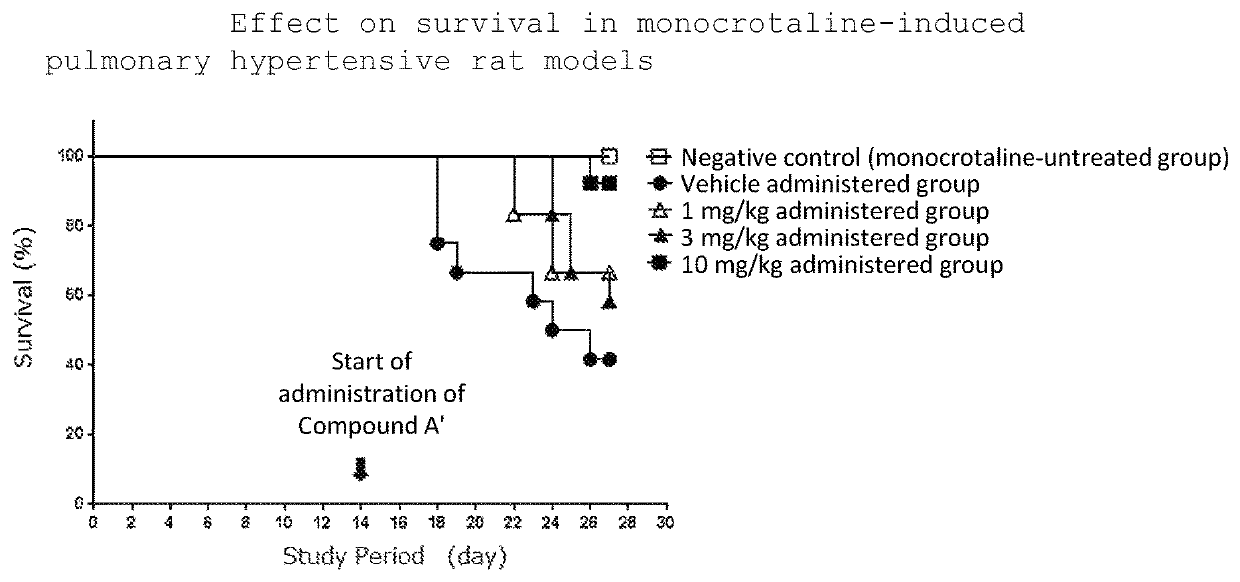
[0127]Monocrotaline (MCT) was subcutaneously injected at 50 mg / kg (in 50% dimethyl sulfoxide solution) to male Sprague-Dawley rats having a body weight of 230 g ± 10 g to prepare pulmonary hypertensive rat models. Compound A′ and the same amount of a vehicle were orally administered to a compound A′ administration group (dose: 1 mg / kg, 3 mg / kg, or 10 mg / kg) and a control group, respectively, once every day over 14 days from the 14th day after the MCT administration. This experiment was carried out using these groups each involving 12 rats.[0128](2) Effect on Survival Rate
[0129]FIG. 1 shows a Kaplan-Meier survival curve obtained from the above experiment.
[0130]As shown in FIG. 1, compound A′ remarkably improved the survival rate of animals after administration.
example 3
Effect on CHP1-NHE1 Interaction
[0131]In addition to CaSR, NHE (Na+-H+ exchange) protein is shown to be an important molecule involved in the pathology of pulmonary hypertension in experiments or the like involving administration of various NHE inhibitory compounds to animal models of pulmonary hypertension induced by, for example, monocrotaline and hypoxia, as well as NHE knockout animals (Chen et al., 2001; Huetsch et al., 2016; Huetsch and Shimoda, 2015; Yu et al., 2008). CHP is a cofactor essential to the localization of NHE in a cell membrane and the function thereof (Matsushita et al., 2007; Mishima et al., 2007; Pang et al., 2001). Accordingly, whether compound A′ inhibits the interaction of NHE1-CHP1 was investigated.[0132](1) Experimental Method
[0133]The inhibitory activity of compound A′ on the interaction between human NHE1 and human CHP1 was evaluated in a protein interaction measurement system using an amplified luminescence proximity homogeneous assay (AlphaScreen™ (Per...
PUM
| Property | Measurement | Unit |
|---|---|---|
| mean pressure | aaaaa | aaaaa |
| mean pressure | aaaaa | aaaaa |
| mean pressure | aaaaa | aaaaa |
Abstract
Description
Claims
Application Information
 Login to View More