
Light-emitting polymer composition and organic EL display device using the same
a technology of light-emitting polymer composition and display device, which is applied in the direction of discharge tube luminescnet screen, natural mineral layered products, synthetic resin layered products, etc., can solve the problems of short life span, low light-emitting efficiency, and poor transfer characteristic of polymer film, so as to improve the adhesion of light-emitting composition, and reduce the cohesion
- Summary
- Abstract
- Description
- Claims
- Application Information
AI Technical Summary
Benefits of technology
Problems solved by technology
Method used
Image

Examples
example1
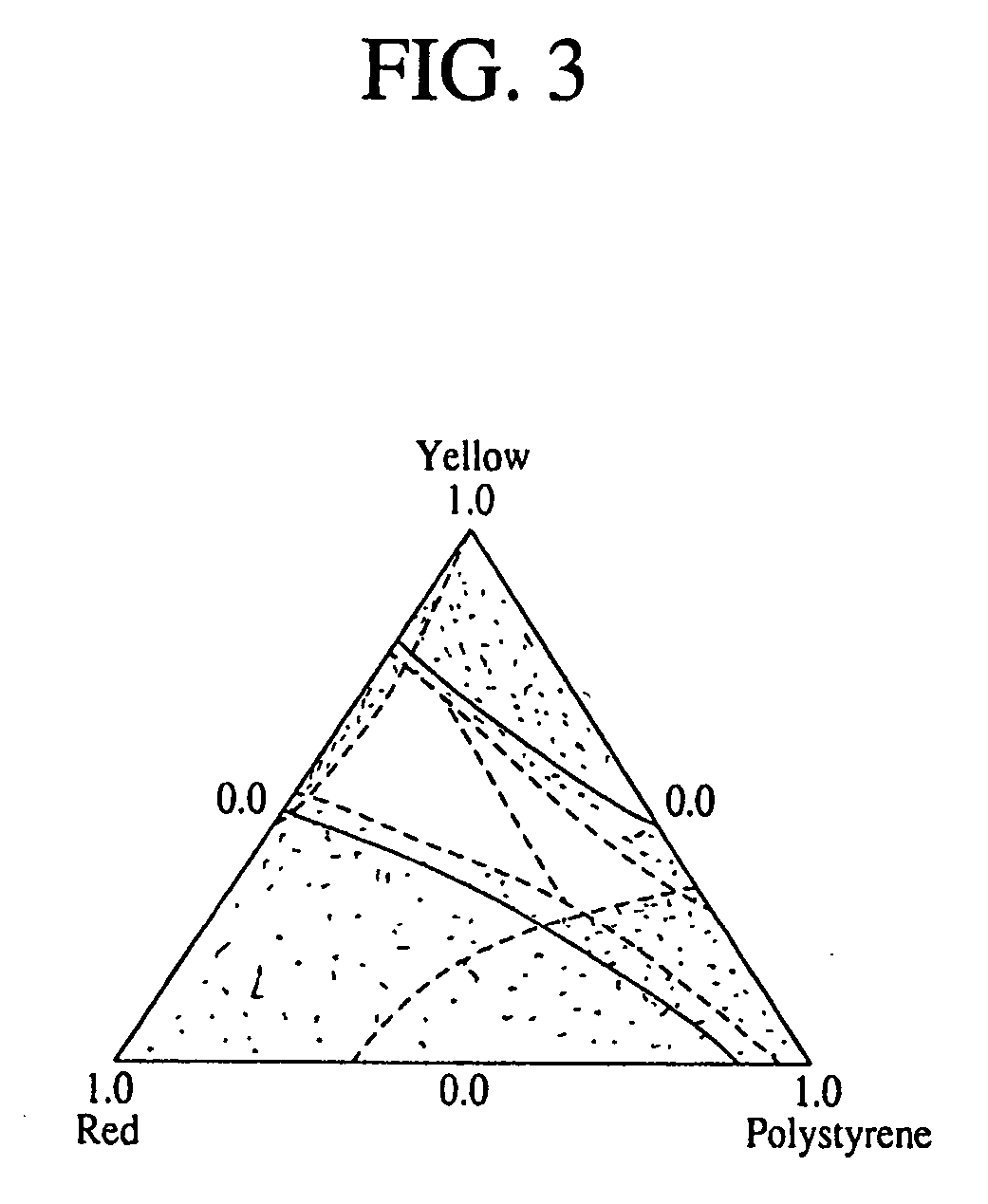
[0060] The two kinds of light-emitting polymers and the additive are mixed in an appropriate mass ratio and dissolved in a single solvent to prepare the light-emitting polymer composition. One light-emitting polymer is a PPV-based yellow electrolight-emitting polymer available under the trade name “SUPER YELLOW” from Covion Organic Semiconductors GmbH. The other light-emitting polymer is a PFO-based red electrolight-emitting polymer available under the trade name “RED-B” from Dow Chemical Company. The additive is a polystyrene having a molecular weight of 2,500 available from Sigma-Aldrich Corporation.
[0061] The light-emitting polymer composition is sufficiently stirred at a temperature of 60° C. for at least three hours. The light-emitting polymer composition is deposited on a transfer substrate to a thickness 80 nm to thereby form a transfer film. A substrate having an anode electrode pattern is cleaned and then UV / ozone-treated. A hole transporting layer made of a “PEDOT / PSS” fr...
example 2
[0070] The light-emitting polymer is a red electrolight-emitting polymer available under the trade name “AEF 2009 & 2045” from Covion Organic Semiconductors GmbH. The additive is a polystyrene available from Sigma-Aldrich Corporation. The molecular weight of the polystyrene is in a range between 2,000 and 2,500. The closer the molecular weight of the polystyrene is to 2,000, better the edge roughness of the light-emitting layer.
[0071] The light-emitting polymer and the additive are mixed in an appropriate mixing mass ratio and dissolved in a toluene to prepare the light-emitting polymer composition.
[0072] The light-emitting polymer composition is sufficiently stirred at a temperature of 60° C. for at least three hours. The light-emitting polymer composition is deposited on a transfer substrate to a thickness 80 nm to thereby form a transfer film. A substrate having an anode is cleaned and then UV / ozone-treated for fifteen minutes. A hole transporting layer made of “PEDOT / PSS” from...
PUM
| Property | Measurement | Unit |
|---|---|---|
| mass ratio | aaaaa | aaaaa |
| mass ratio | aaaaa | aaaaa |
| mass ratio | aaaaa | aaaaa |
Abstract
Description
Claims
Application Information
 Login to View More