Check patentability & draft patents in minutes with Patsnap Eureka AI!

Statistical language model for logical forms

a statistical language and model technology, applied in the field of automatic language systems, can solve the problems of not always employing logical forms or other parsed structures as intermediate representations in mt systems, does not test all possible combinations of input mappings, and does not necessarily use heuristic methods to resolve translation ambiguities

Inactive Publication Date: 2005-10-13
MICROSOFT TECH LICENSING LLC
View PDF19 Cites 108 Cited by
  • Summary
  • Abstract
  • Description
  • Claims
  • Application Information

AI Technical Summary

Problems solved by technology

This heuristic system, however, does not test all possible combinations of input mappings, but simply selects the first set of mappings that completely cover the source LF.
However, MT systems do not always employ logical forms or other parsed structures as intermediate representations.
Nor do they necessarily use heuristic methods to resolve translation ambiguities.
There are a number of problems associated with conventional, string-based statistical MT systems.
Without restricting this search space, a practical MT system cannot be built because it takes too long to consider all possible translation strings.
Since the simplifying assumptions made in string-based statistical MT models are based in large part on string locality, sometimes the conditioning elements are far enough from the element to be predicted that they cannot be taken into account by the models.
However, n-gram models have some limitations.
However, even in a syntax-based model, drawbacks remain: the distance between interdependent words can still be too large to be captured by a local model; also, similar concepts are expressed by different structures (e.g., active vs. passive voice) and are, therefore, not modeled together.
These result in poor training of the model and poor translation performance.

Method used

the structure of the environmentally friendly knitted fabric provided by the present invention; figure 2 Flow chart of the yarn wrapping machine for environmentally friendly knitted fabrics and storage devices; image 3 Is the parameter map of the yarn covering machine
View more

Image

Smart Image Click on the blue labels to locate them in the text.
Viewing Examples
Smart Image
  • Statistical language model for logical forms
  • Statistical language model for logical forms
  • Statistical language model for logical forms

Examples

Experimental program
Comparison scheme
Effect test

Embodiment Construction

[0029] It should be noted that to the extent that the present invention is described in the context of machine translation systems the present invention is also applicable to other systems that produce words or that require a language model. For example, systems can include speech recognition, optical character recognition (OCR), grammar checking and etc. Prior to describing the present invention in detail, embodiments of illustrative computing environments within which the present invention can be applied will be described.

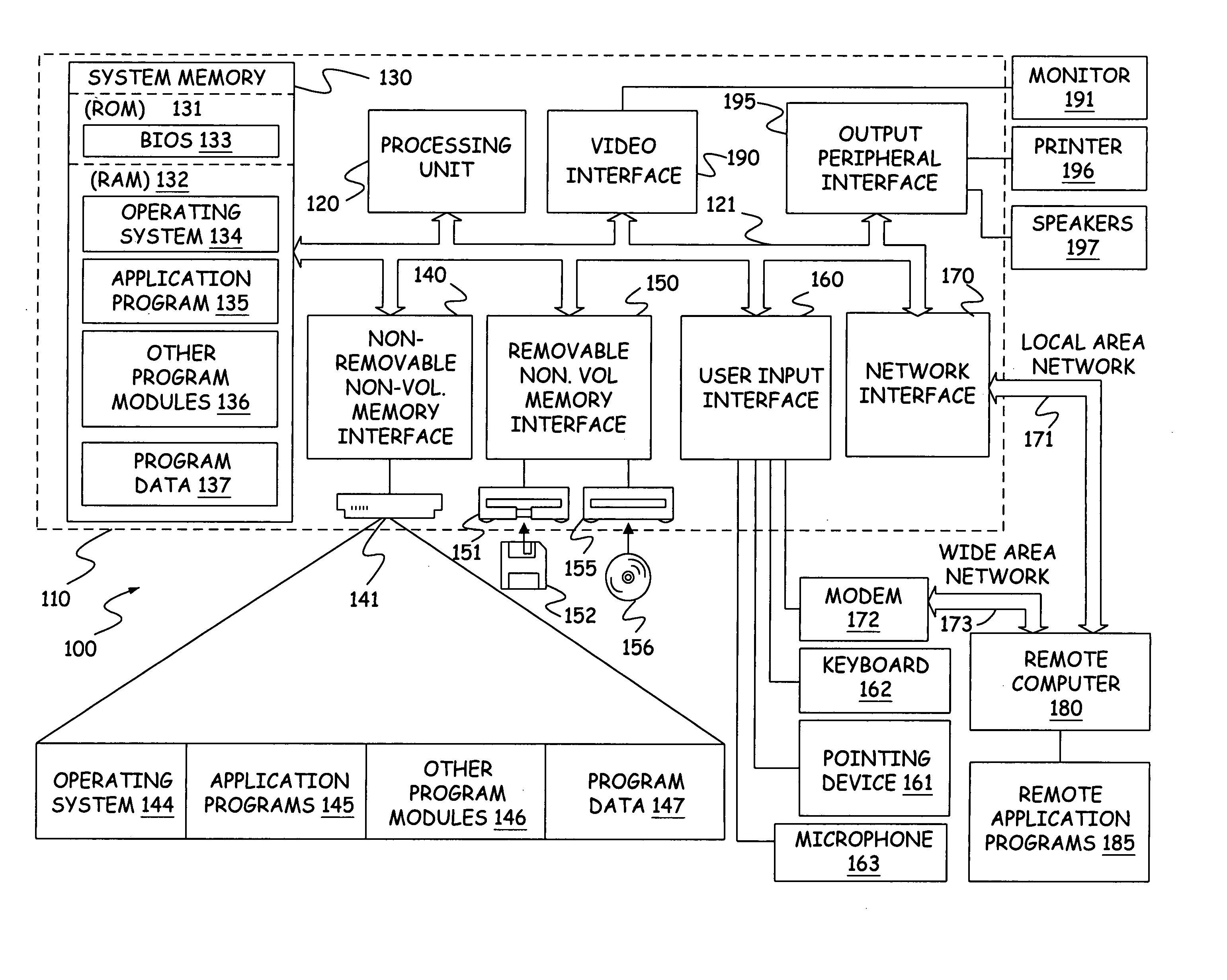
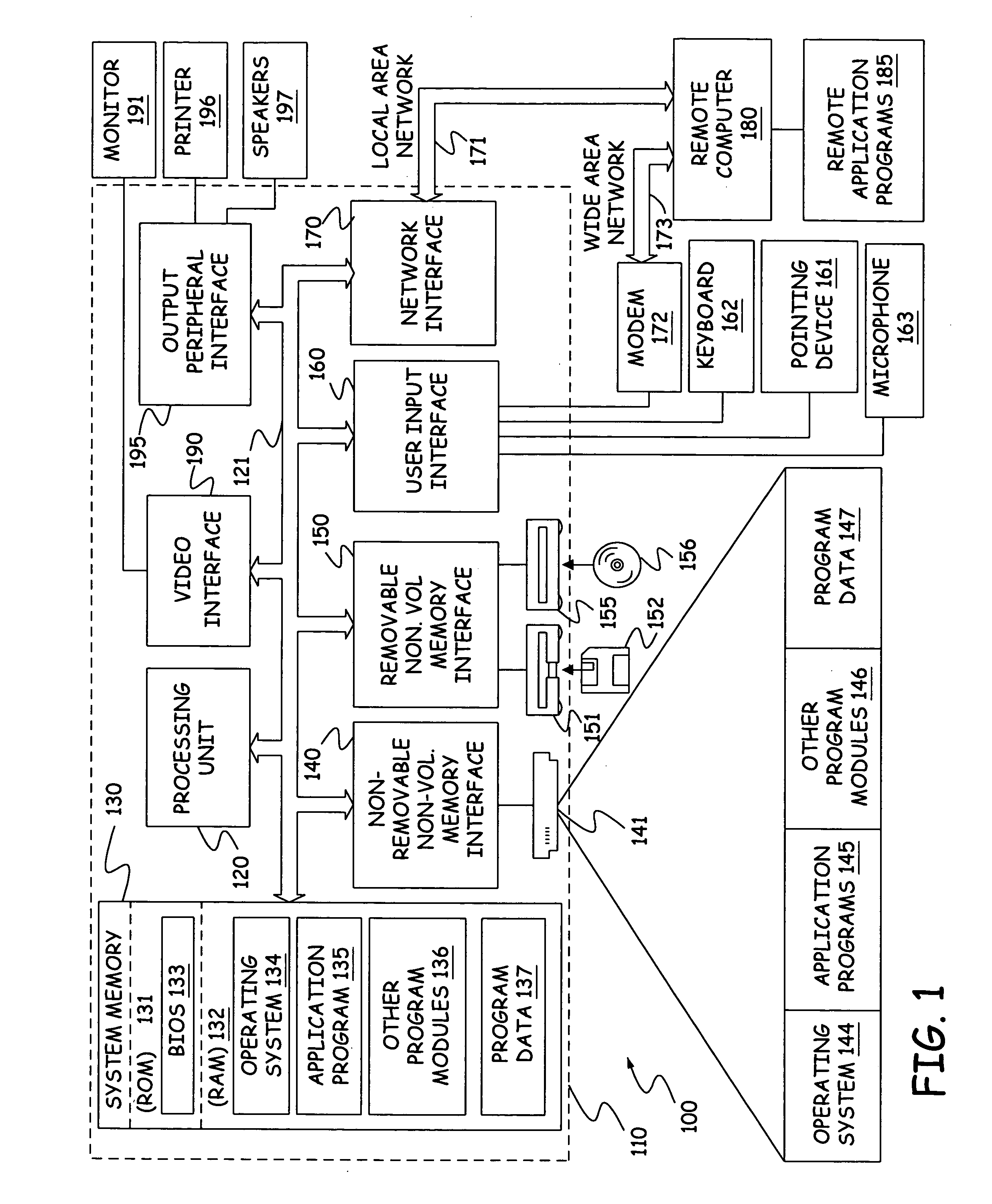
[0030]FIG. 1 illustrates an example of a suitable computing system environment 100 on which the invention may be implemented. The computing system environment 100 is only one example of a suitable computing environment and is not intended to suggest any limitation as to the scope of use or functionality of the invention. Neither should the computing environment 100 be interpreted as having any dependency or requirement relating to any one or combination of compo...

the structure of the environmentally friendly knitted fabric provided by the present invention; figure 2 Flow chart of the yarn wrapping machine for environmentally friendly knitted fabrics and storage devices; image 3 Is the parameter map of the yarn covering machine
Login to View More

PUM

No PUM Login to View More

Abstract

A method of decoding an input semantic structure to generate an output semantic structure. A set of transfer mappings are provided. A score is calculated for at least one transfer mapping in the set of transfer mappings using a statistical model. At least one transfer mapping is selected based on the score and used to construct the output semantic structure.

Description

BACKGROUND OF THE INVENTION [0001] The present invention relates to automated language systems. More specifically, the present invention relates to language models in statistical language systems. [0002] Automated language systems include speech recognition, handwriting recognition, speech production, grammar checking and machine translation. [0003] Machine translation (MT) systems are systems that receive an input in one language (a “source” language), translate the input to a second language (a “target” language), and provide an output in the second language. [0004] One example of a MT system uses logical forms (LFs), which are dependency graphs that describe labeled dependencies among content words in a string as an intermediate step in translation. Under this system, a string in the source language is first analyzed with a natural language parser to produce a source LF. The source LF must then be converted into a target language LF. A database of mappings from source language LF...

Claims

the structure of the environmentally friendly knitted fabric provided by the present invention; figure 2 Flow chart of the yarn wrapping machine for environmentally friendly knitted fabrics and storage devices; image 3 Is the parameter map of the yarn covering machine
Login to View More

Application Information

Patent Timeline
no application Login to View More
Patent Type & Authority Applications(United States)
IPC IPC(8): G06F17/27G06F17/28G06F40/00
CPCG06F17/2881G06F17/2818G06F40/44G06F40/56
Inventor AUE, ANTHONYRINGGER, ERIC K.QUIRK, CHRISTOPHER B.MENEZES, ARUL A.MOORE, ROBERT C.
Owner MICROSOFT TECH LICENSING LLC
Features
  • R&D
  • Intellectual Property
  • Life Sciences
  • Materials
  • Tech Scout
Why Patsnap Eureka
  • Unparalleled Data Quality
  • Higher Quality Content
  • 60% Fewer Hallucinations
Social media
Patsnap Eureka Blog
Learn More