
Dielectric ceramic composition and electronic device
a technology of dielectric ceramics and electronic devices, applied in the direction of fixed capacitors, basic electric elements, electrical appliances, etc., can solve the problems of increasing environmental conditions of electronic devices, reducing the specific permittivity of electronic devices, and reducing the use of precious metals. , to achieve the effect of reducing the atmosphere, reducing the cost of materials, and maintaining a lifetime of insulation resistan
- Summary
- Abstract
- Description
- Claims
- Application Information
AI Technical Summary
Benefits of technology
Problems solved by technology
Method used
Image

Examples
first embodiment
[0084] Below, a first embodiment of the present invention will be explained.
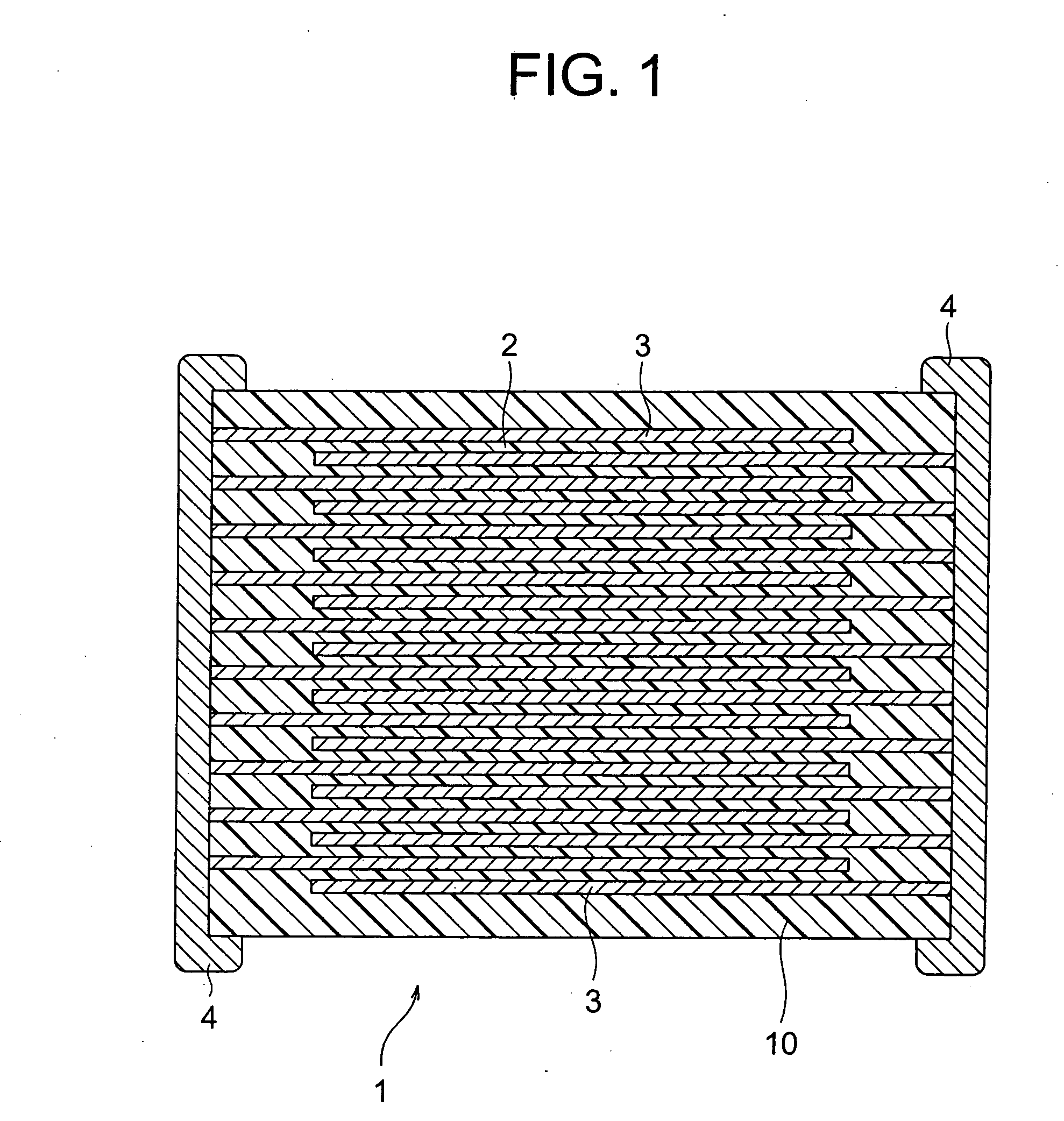
[0085] In the first embodiment, a multilayer ceramic capacitor 1 shown in FIG. 1 as an electronic device will be taken as an example and the configuration and production method will be explained.
[0086] Multilayer Ceramic Capacitor
[0087] As shown in FIG. 1, a multilayer ceramic capacitor 1 as an electronic device according to the first embodiment of the present invention comprises a capacitor element body 10, wherein dielectric layers 2 and internal electrode layers 3 are alternately stacked. Both end portions of the capacitor element body 10 are formed with a pair of external electrodes 4 respectively conducting to the internal electrode layers 3 arranged alternately in the element body 10. The internal electrode layers 3 are stacked, so that the respective end surfaces are exposed alternately to surfaces of two facing end portions of the capacitor element body 10. The pair of external electrodes 4 are fo...
second embodiment
[0169] Below, a second embodiment of the present invention will be explained.
[0170] In the same way as in the first embodiment, a multilayer ceramic capacitor 1 shown in FIG. 1 will be taken as an example of an electronic device and the configuration and production method will be explained in the second embodiment, as well.
[0171] In the second embodiment, the point that the dielectric layer 2 includes a dielectric ceramic composition according to the second embodiment is different from the first embodiment.
[0172] The most significant feature of the dielectric ceramic composition according to the second aspect is that it is essential to include MgO as the first subcomponent and Al2O3 as the eighth subcomponent, and a content of MgO as the first subcomponent and a content of MnO or Cr2O3 are in the above relationship explained above.
[0173] Note that an explanation will be omitted on overlapping parts with the first embodiment and only different parts will be explained.
[0174] Diel...
example 1
[0201] Below, examples 1 and 2 and a comparative example 1 are examples according to the first aspect of the present invention.
[0202] First, as starting materials to produce a dielectric material, a main component material (BaTiO3) having an average particle diameter of 0.1 to 1 μm and the first to eighth subcomponent materials were prepared.
[0203] Carbonates were used as a material of MgO and MnO (the first subcomponent: MgCO3 and the seventh subcomponent: MnCO3) and oxides were used for other materials (the second subcomponent: (Ba0.6 Ca0.4)SiO3, the third subcomponent: V2O5, the fourth subcomponent: Yb2O3, the fifth subcomponent: CaZrO3, the sixth subcomponent: Y2O3 and the eighth subcomponent: Al2O3). Note that (Ba0.6 Ca0.4)SiO3, as the second subcomponent was produced by wet mixing BaCO3, CaCO3 and SiO2 by a ball mill for 16 hours, drying, firing at 1150° C. in the air and furthermore wet mixing by a ball mill for 100 hours. Also, CaZrO3 as the fifth subcomponent was produced...
PUM
| Property | Measurement | Unit |
|---|---|---|
| Substance count | aaaaa | aaaaa |
| Substance count | aaaaa | aaaaa |
| Substance count | aaaaa | aaaaa |
Abstract
Description
Claims
Application Information
 Login to View More