
Promoter sequences from WSSV immediate early genes and their uses in recombinant DNA techniques
a technology of promoter sequences and early genes, which is applied in the field of isolated nucleotide sequences, can solve the problems of difficult recovery of proteins, inability to bind to peptides, and inability to bind to proteins,
- Summary
- Abstract
- Description
- Claims
- Application Information
AI Technical Summary
Benefits of technology
Problems solved by technology
Method used
Image

Examples
examples
I. Materials and Methods
Viral Gene Microarray—Chip Preparation
[0110] The Penaeus monodon WSSV 1994 Taiwan isolate (WSSV T-1), the genome of which was deposited in the NCBI database under accession no. AF440570, was used in all the experiments described below. This WSSV T-1 isolate was deposited in the China Center for Type Culture Collection (CCTCC, Wuhan University, Luo Jia Shan, Wuhan, Hubei, 430072, People's Republic of China) under the Budapest Treaty on Jan. 11, 1996, and was given accession number CCTCC-V96001 (see U.S. Pat. No. 5,824,535 and U.S. Pat. No. 6,190,862 issued to Guang-Hsiung Kou et al.).
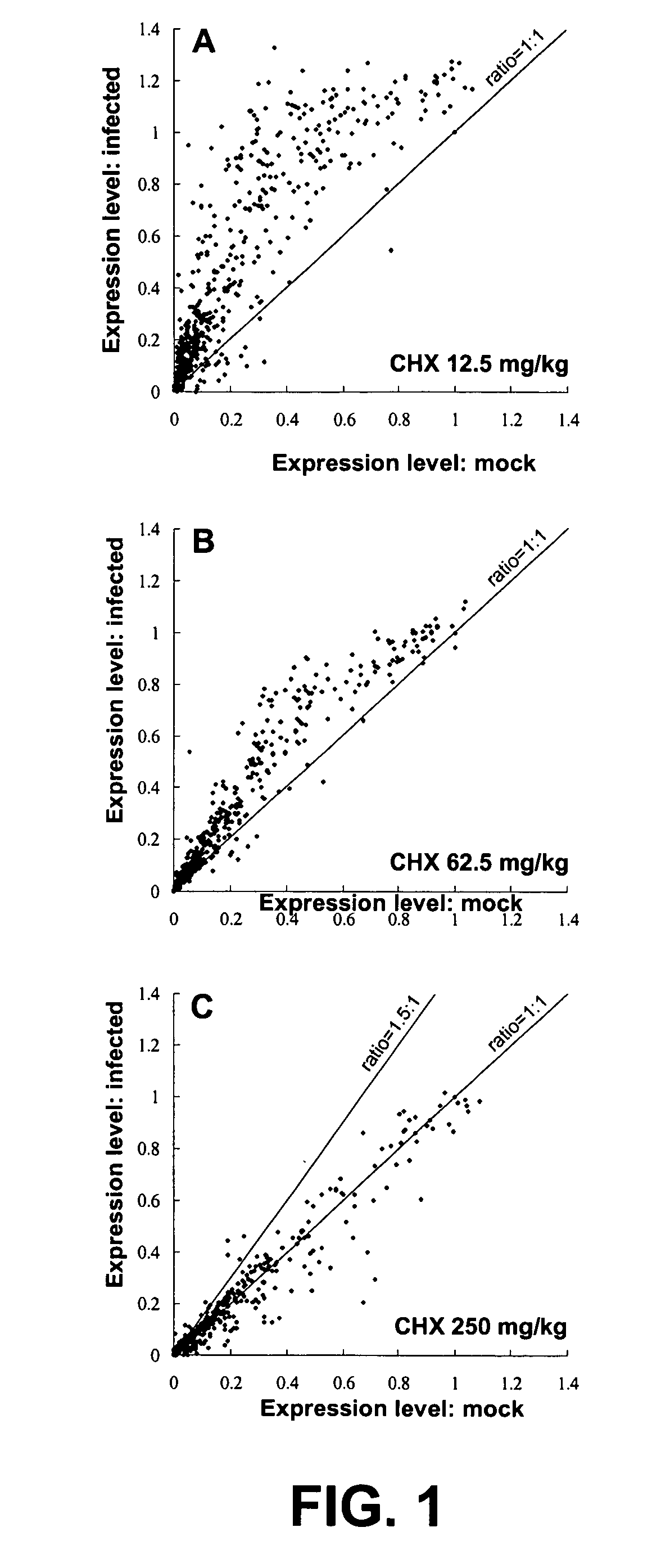
[0111] WSSV viral gene microarrays (chips) were designed based on the genome of the WSSV T-1 isolate. Briefly, each chip contains 532 predicted WSSV ORFs and a partial sequence of P. monodon β-actin gene. After conducting polymerase chain reaction (PCR) using specific primers derived from these 532 ORFs, PCR products with amplicon sizes of 200 to 600 bp were spotted on precoa...
PUM
| Property | Measurement | Unit |
|---|---|---|
| temperature | aaaaa | aaaaa |
| body weight | aaaaa | aaaaa |
| pH | aaaaa | aaaaa |
Abstract
Description
Claims
Application Information
 Login to View More