
Stable water-in-oil-in-water multiple emulsion system produced by hydrodynamic dual stabilization and a method for preparation thereof
a hydrodynamic dual stabilization and multiple emulsion technology, applied in the field of waterinoilinwater multiple emulsion system, can solve the problems of reducing or enhancing the stability of the multiple emulsion system, the limited application range of the phase-transition method using bifunctional solubility of the surfactant itself, etc., and achieves the effect of improving stability and much improving stability
- Summary
- Abstract
- Description
- Claims
- Application Information
AI Technical Summary
Benefits of technology
Problems solved by technology
Method used
Image

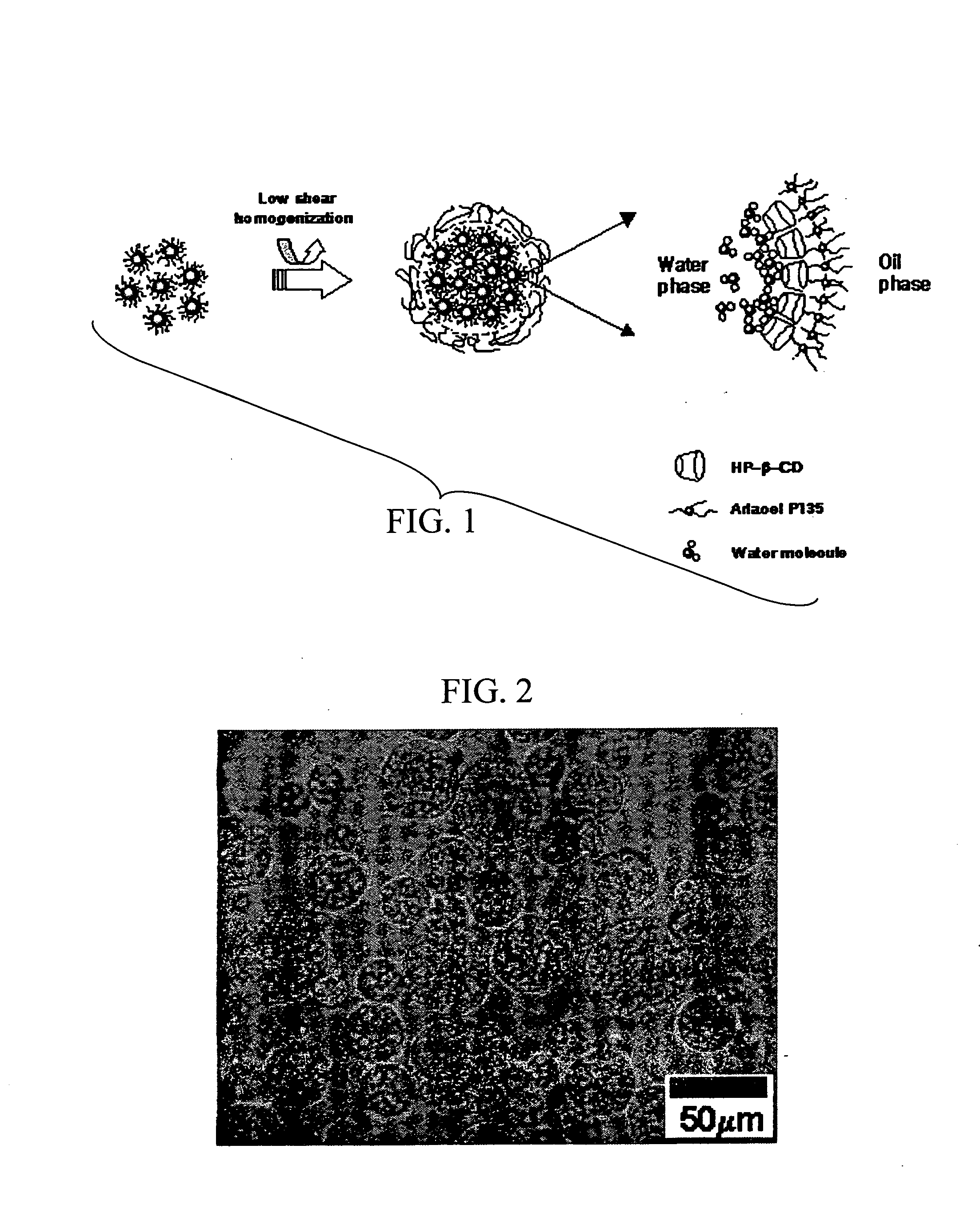
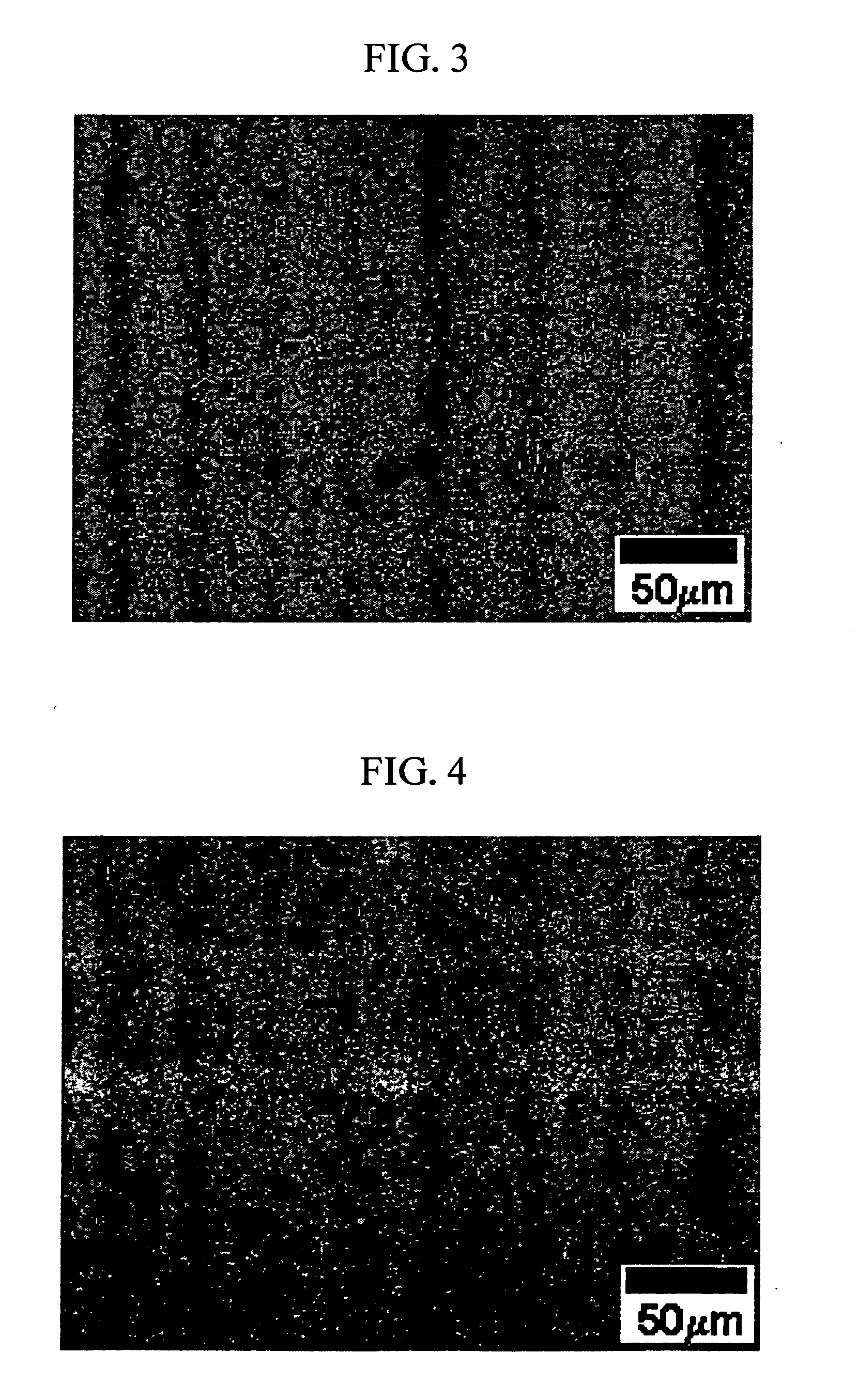

Examples
example 1
Preparation of Multiple Emulsion According to the Present Invention
[0039] A multiple emulsion stabilized using HDS was prepared by carrying out the following procedures. After hydrophobizing water by adding approximately 1% by weight of urea and approximately 2% by weight by of hydroxypropyl-beta-cyclodextrine (available from, for example, NIPPON Food Chemical Engineering Co., Ltd.), about 30% by weight of the hydrophobized water was melted, and was then gently stirred at a temperature of between approximately 70 and 75 degrees Celsius (Mixture A). The degree of hydrophobicity of water was determined by measuring the interface tension of the water. Then, approximately 15% by weight of mineral oil (LP70™, Witco Co., U.S.) dissolving approximately 1.5% by weight of hydrophobic surfactant and PEG-30 dipolyhydroxystearate (available from, for example, Arlacel P135™, ICI Company, Great Britain) were melted, stirring gently at a temperature of between approximately 70 and 75 degrees Cels...
example 2
Preparation of Multiple Emulsion Containing Kojic Acid in Internal Aqueous Phase
[0041] Kojic acid is used here as a water-soluble reference material and as a model of a water-soluble active material. A water-in-oil-in-water multiple emulsion was obtained using the same method as described in example 1 except that the water-in-oil emulsion was prepared after approximately 1% by weight kojic acid had been introduced into internal aqueous phase. At this time, heat treatment had to be carefully monitored in order that the active material was not modified by heat.
experimental example 1
Stability of Multiple Emulsion
[0043] The multiple emulsions obtained in Examples 1, 2 and Comparative Example 1 were used in the following experiments and were prepared after MgSO4 was introduced into each internal aqueous phase of each multiple emulsions. The resulting multiple emulsions were stored at approximately 4 degrees Celsius, approximately room temperature, approximately 30 degrees Celsius, approximately 37 degrees Celsius and approximately 45 degrees Celsius, respectively. The stability of the multiple emulsion obtained in Example 1 and the multiple emulsions obtained in Comparative Example 1 were evaluated by assaying changes in conductivity resulting from the outflow of electrolytes (MgSO4) from the internal to the external aqueous phase. A sample of each multiple emulsion was taken once per day and its conductivity was measured in units of 1 μS / cm. The measured conductivity was compared with standard curves obtained by measuring conductivities of various known concent...
PUM
| Property | Measurement | Unit |
|---|---|---|
| temperature | aaaaa | aaaaa |
| temperature | aaaaa | aaaaa |
| temperature | aaaaa | aaaaa |
Abstract
Description
Claims
Application Information
 Login to View More