
Efficient and flexible GPS receiver baseband architecture
a baseband and receiver technology, applied in the field of navigational signal receivers, can solve the problems of not providing all the different clock frequencies, high hardware complexity, and the inclusion of a baseband detector, and achieve the effect of minimizing the number of gate counts and power efficien
- Summary
- Abstract
- Description
- Claims
- Application Information
AI Technical Summary
Benefits of technology
Problems solved by technology
Method used
Image

Examples
Embodiment Construction
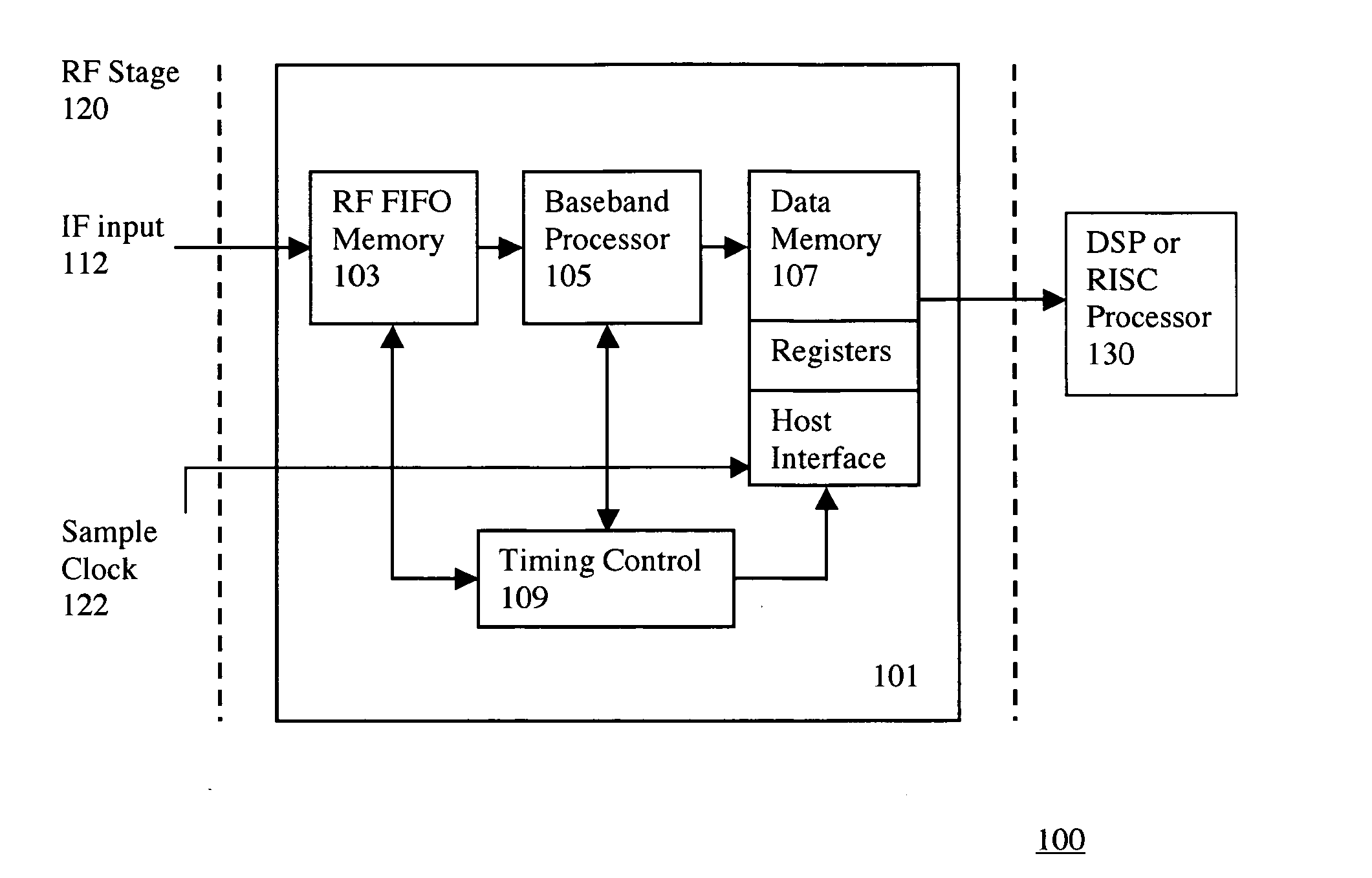
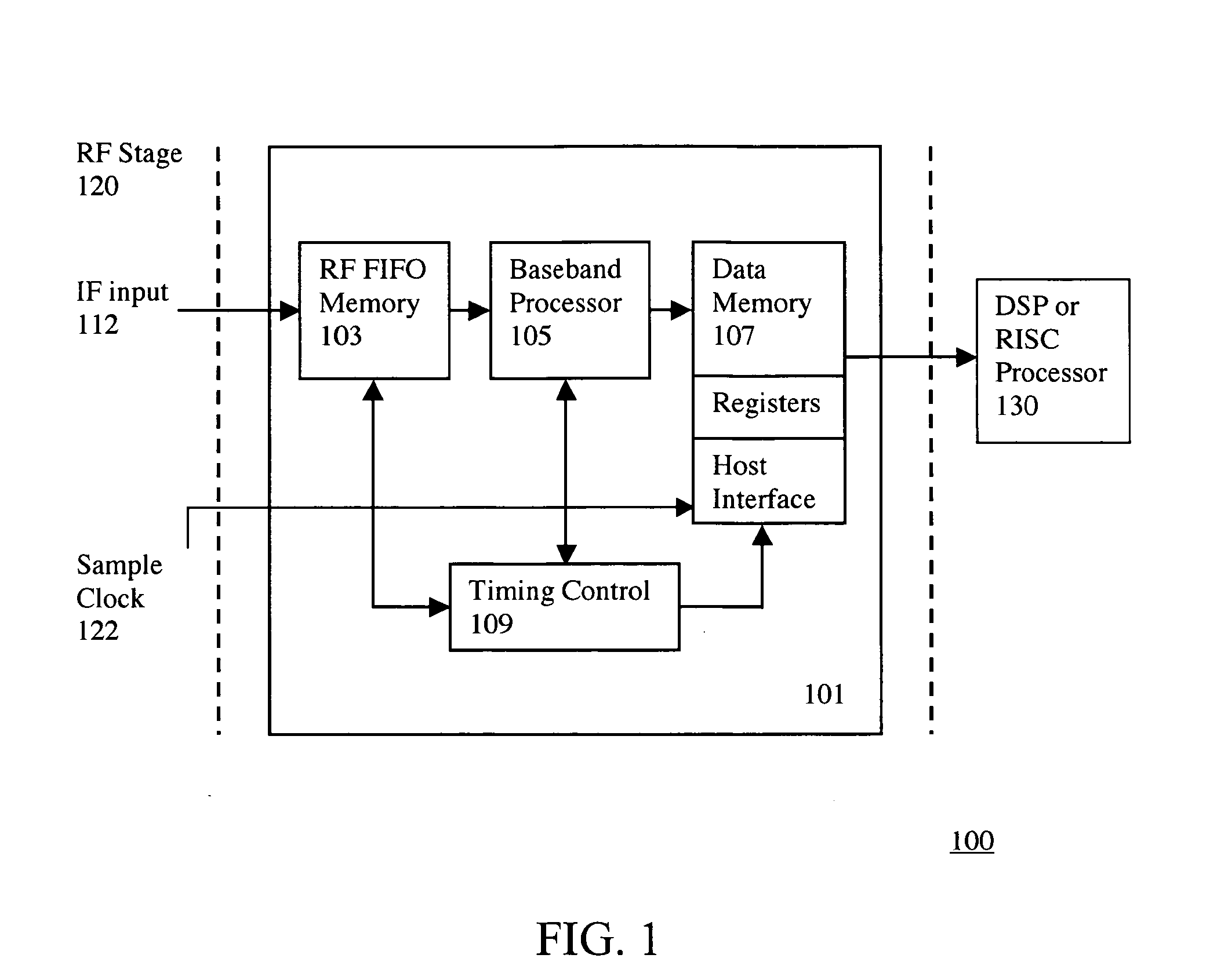
[0022]FIG. 1 is the functional block diagram of the baseband architecture 100 in a preferred embodiment. The baseband architecture 100 comprises a baseband chip 101 and associated off-chip functional blocks 120 and 130. The baseband chip 101 includes a host interface coupled to an off-chip sample clock 122 and an on-chip timing control 109. The IF input 112 from the RF section 120 is stored in memory 103 on the first-in-first-out (FIFO) basis. The baseband processor 105 performs correlation and processes the IF input 112 M samples at a time, where M is the number of samples in one PN-sequence.
[0023] After correlation, the resulting I and Q correlation values and other important parameters such as codephase covered, carrier frequency range examined, FIFO address, channel number are saved in a data memory means 107. Both memory 103 and data memory means 107 could be random access memories (RAMs). The parameters of the next channel are loaded and the correlation is carried out similar...
PUM
 Login to View More
 Abstract
Description
Claims
Application Information
 Login to View More